The Truth About Arsenic and Cadmium in Rice: A 2026
Reality Check
Managing Arsenic and Cadmium in rice is one of the trickiest safety hurdles for modern families. But I’m not here to scare you with jargon. I want to help you understand the soil beneath our feet.
As a PhD student, I look at the data. As a farmer, I look at the field. 🌾 And as a friend, I’m here to tell you that while the risk is real, the solutions are right in your kitchen.
Let’s skip the panic. Instead, I’ll show you exactly how to read the label (because Origin is the best brand) and the simple cooking trick that washes the heavy metals down the sink.
2026 Safety Snapshot: Reducing Arsenic & Cadmium
- 🍳 The PBA Cooking Hack: Don't just boil and absorb. Parboiling like pasta for 5 minutes and draining the water removes up to 73% of arsenic without losing all nutrients.
- 🌍 Geography Over Brand: Origin is your best safety filter. Rice from California, India (Basmati), and Thailand (Jasmine) consistently tests lower for heavy metals than the US South.
- 👶 Infant Safety Rule: Babies absorb toxins at a higher rate. The safest move in 2026 is to skip rice cereal entirely and choose oats, quinoa, or avocado instead.
- 🚫 The "Organic" Limit: Organic certification avoids pesticides but does not remove arsenic from the soil. You must check the origin even on organic labels.
The Big Picture: What Changed in 2025? 📊
 Figure 1: Rice acts like a sponge in flooded fields (left), absorbing heavy metals that end up in your bowl (right).
For us at Preforganic, food safety isn't just about reading labels. It is about understanding where our food comes from.
Here is the complex reality we face: Rice naturally acts like a sponge for arsenic—accumulating about 10 times more than other grains. Why? Because we grow it in flooded fields, and that water changes the chemistry of the soil.
Recent investigations have shown that a staggering number of rice samples contain detectable arsenic. Even more concerning, widely consumed rice products often exceed the strict limits we want for our babies.
We are also facing a "Trade-Off Paradox." The methods farmers use to stop arsenic often accidentally spike the levels of cadmium. While arsenic is a carcinogen, cadmium targets the kidneys and bones over a lifetime. It’s a delicate balance, but we are learning how to fix it.
🌍 The "Safest
Brand" is a Place: Risk Profile by Origin
Many of you ask me, "Which brand is safe?" The truth is, the "brand" matters less than the soil. A brand might source from Arkansas one month and California the next. You have to check the back of the bag for the Country/State of Origin.
Here is your 2026 Sourcing Guide:
The Science: Why Does Rice "Breathe" In Toxins?
🧪
To understand the risk, you have to picture the soil "breathing." Unlike wheat or corn, rice loves wet feet—it grows in flooded paddies.
How the Soil "Breathes" (Redox Potential)
When a field is flooded, the soil runs out of oxygen (it becomes anaerobic). In this state, soil bacteria get to work changing the soil chemistry.
- The Chain Reaction: As iron breaks down in the water, it releases the arsenic that was stuck to it.
- The Uptake: Rice plants are porous and thirsty. They drink up this arsenic-rich water through their roots.
The Farmer's Dilemma (The See-Saw Effect) ⚖️
This is where it gets tricky for us in the field. If we drain the water to let oxygen in, we stop the arsenic. Great, right?
But, when oxygen enters the soil, it wakes up Cadmium.
- Flooded Soil: High Arsenic risk, Low Cadmium risk.
- Drained Soil: Low Arsenic risk, High Cadmium risk.
This is why simply "buying organic" doesn't solve it—farmers need to use complex "Combined Strategies" to balance this out.
🥣 Consumption Scenarios:
How Often Can We Eat Rice?

You don't have to ban rice forever. You just need to match your intake to your risk level.
1. For Infants & Toddlers (The "Proactive Protector" Mode)
- Frequency: Rare to None.
- The Why: Babies eat more food per pound of body weight than adults, so a small dose of heavy metals is a massive hit to their developing system.
- The Swap: Skip rice cereal entirely. Use oatmeal, quinoa cereal, or mashed avocado/sweet potato. Avoid "teething biscuits" made of rice flour.
2. For the Average Adult (1-2 times a week)
- Strategy: Safe Sourcing.
- The Advice: If you eat rice occasionally, just stick to White Basmati or Jasmine. Your body can handle minor trace amounts, especially if you have a varied diet.
3. For The "Rice Lover" (Daily Consumers)
- Strategy: Aggressive Mitigation.
- The Advice: If rice is your daily staple, you must use the PBA cooking method (below).
- Rotation: Swap 50% of your meals with Quinoa or Millet. These grains do not grow in flooded paddies, so they don't have the same arsenic mechanism.
The Kitchen Hack: The PBA Method 🍳
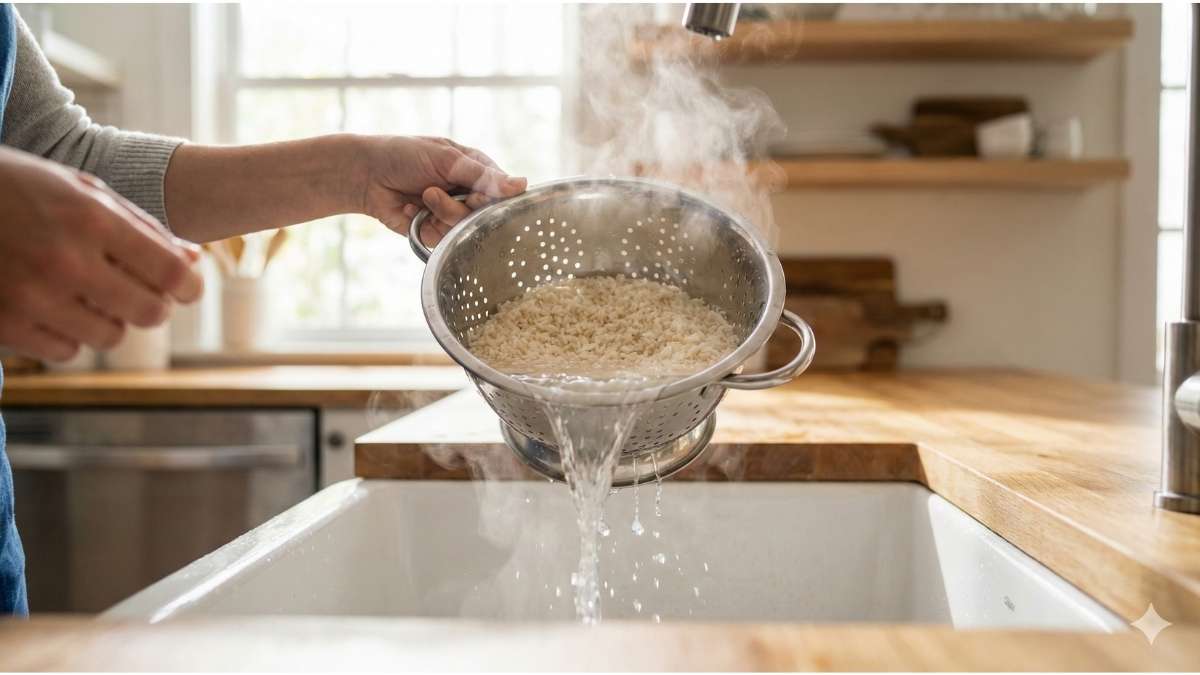 The Critical Step: Draining the excess water after 5 minutes is how you physically flush the toxins away.
You can strip out a massive amount of these toxins right in your kitchen. Forget the standard rice cooker method—that just traps the arsenic in the pot.
We recommend the Parboiling with Absorption (PBA) method. It’s what my grandmother used for flavor, and what science now confirms for safety.
1. The Boil: Boil your rice in lots of water (like pasta) for 5 minutes. This pulls the arsenic out.
2. The Dump: Drain that water immediately. You are pouring the toxins down the sink.
3. The Finish: Add fresh water (2 cups water to 1 cup semi-cooked rice) and finish cooking on low until absorbed.
The Result: This simple switch removes over 50% of arsenic in brown rice and up to 73% in white rice.
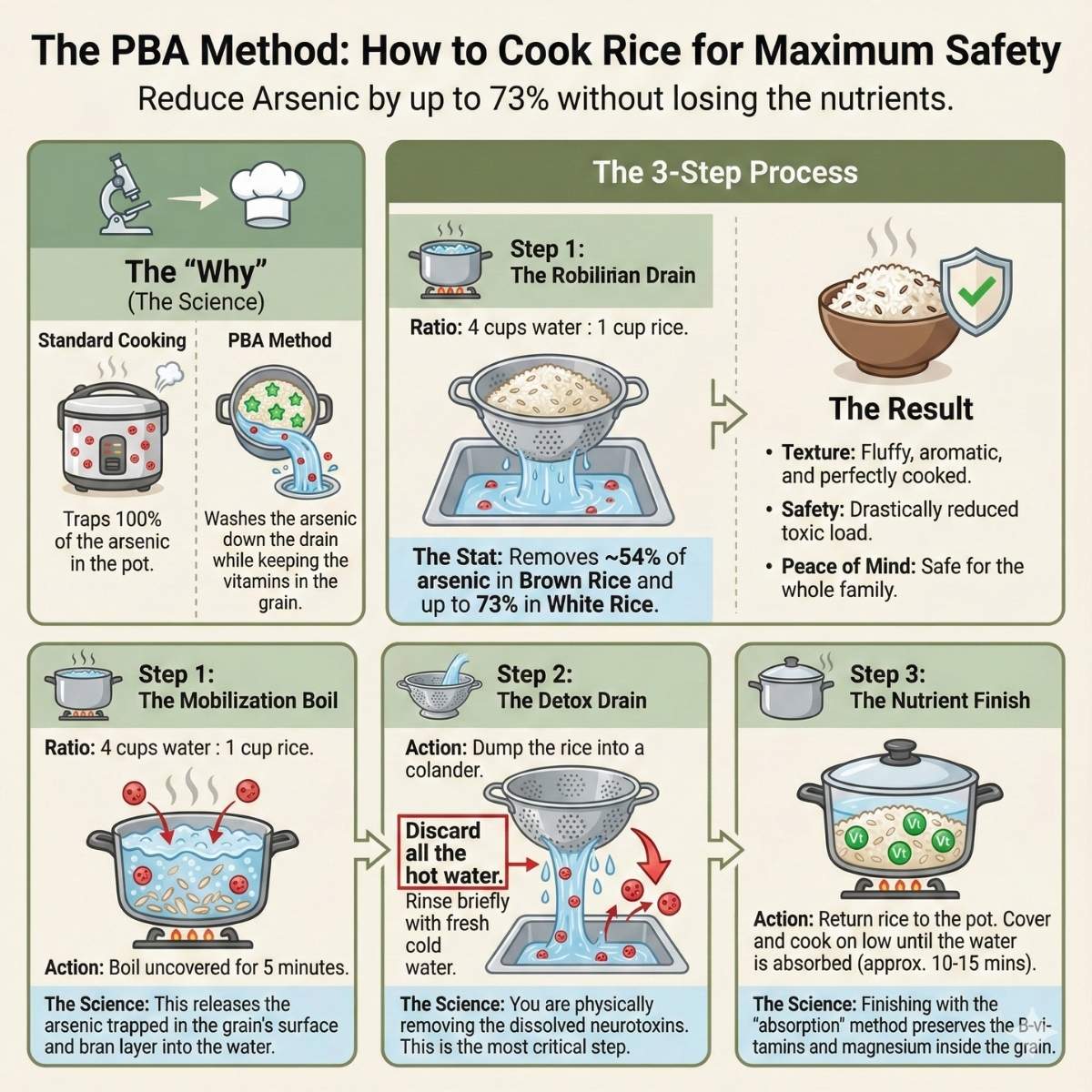 This is the only cooking method scientifically validated to remove >50% of heavy metals without stripping away all the nutrients.
A Final Thought from the Farm 🚜
- Myth: "Rinsing rice removes arsenic."
- Fact: A quick rinse only washes off dust (maybe 10%). To really clean it, you need the PBA Method (Boil, Drain, Finish).
You don't need a PhD to outsmart the soil. Just check the region, boil like pasta, and leave the heavy metals in the sink—not on your family's plate.
📚 External References for Further Reading
📚 Verified External References for Further Reading
-
1. U.S. Food & Drug Administration (FDA) – Arsenic in Food and Dietary Supplementshttps://www.fda.gov/food/environmental-contaminants-food/arsenic-food-and-dietary-supplements
-
2. European Food Safety Authority (EFSA) – Metals as Contaminants in Foodhttps://www.efsa.europa.eu/en/topics/topic/metals-contaminants-food
-
3. Dartmouth Toxic Metals Superfund Research Program – Arsenic and Youhttps://sites.dartmouth.edu/arsenicandyou/

Meet Saqib
Saqib Ali Ateel is a PhD Scholar by training and a "student of the soil" by nature. He combines deep research, hands-on farming wisdom, and agricultural systems supervision to reveal what’s really on your plate. His mission is simple: to help your family navigate the food industry's complexity so you can eat cleaner, safer, and smarter.