The Dirty Dozen & Clean Fifteen: A Smart Shopper’s
Guide to Avoiding Pesticides on a Budget
If you have ever stood frozen in the produce aisle, debating whether the dirty dozen list justifies doubling your grocery bill, you are not alone. As a parent, the anxiety is real: you want to shield your family from the "chemical cocktail" found on conventional produce, but inflation has made the organic premium feel like a luxury tax. You need a system that balances toxicological safety with financial reality, not just marketing fear-mongering.
I have been there—both as a PhD student analyzing Maximum Residue Limits (MRLs) in the lab and as a farmer watching pests decimate a crop of strawberries I refused to spray. The "all-or-nothing" approach to organic is not only expensive; it is unnecessary. The secret to smart protection lies in understanding plant biology. Nature has given some fruits armor, while others are sponges.
This guide is your 2025 strategic roadmap. We will move beyond the basic lists to understand the mechanism of contamination, giving you a timeless filter to make safe choices in any grocery store, forever.
🛡️ Summary in Bullets: Your 2025 Safety Strategy
- 🍓 The "Skin" Rule: Always buy organic for thin-skinned "sponges" like strawberries and spinach that absorb pesticides. Buy conventional for thick-skinned "shields" like avocados and onions.
- 🧪 The "Cocktail" Risk: Conventional Dirty Dozen items often carry 20+ different pesticide residues. Organic MRLs provide a zero-tolerance safety net against this mixture.
- 🚿 Washing Limits: While baking soda helps, it cannot remove systemic pesticides that have penetrated the fruit's flesh. Peeling or buying organic is the only true fix.
- 📉 Budget Hack: Use the "Clean Fifteen" to save money on safe conventional crops, and use delivery services like Misfits Market to get affordable organic versions of the high-risk items.
The "Sponge" vs. The "Shield": A Timeless Rule
Before we dissect the 2025 Dirty Dozen List, I want to teach you the biological principle that dictates pesticide absorption. If you understand this, you won't need to memorize a list every year.
In my research, we look at the interaction between the cuticle (skin) of the fruit and the chemical properties of the pesticide.
🍓 The Sponge (Thin Skin)🥑 The Shield (Thick Skin)
Crops with thin, porous, or edible skins offer zero resistance to chemical sprays.
- The Strawberry Vulnerability: Strawberries are historically the worst offender for a specific agronomic reason: they grow directly on the soil, making them highly susceptible to fungal rot and soil-dwelling pests. Farmers have to spray them heavily and frequently. Because the skin is covered in tiny pores and seeds, it acts like a sponge. You cannot peel a strawberry, so you eat every chemical that touched it.
- The Leafy Trap: Spinach and kale have massive surface areas designed to catch sunlight—which means they also catch every droplet of spray drift.
Crops with thick, inedible rinds provide a natural barrier.
- The Avocado Armor: An avocado’s thick, leathery skin is nearly impermeable to surface sprays. When you peel it, you are physically removing the contaminated layer.
- The Underground Bunker: Onions grow underground, protected by the soil and layers of papery skin that you discard.
The Golden Rule: If you eat the skin, pay the organic premium. If you peel the skin, save your money.
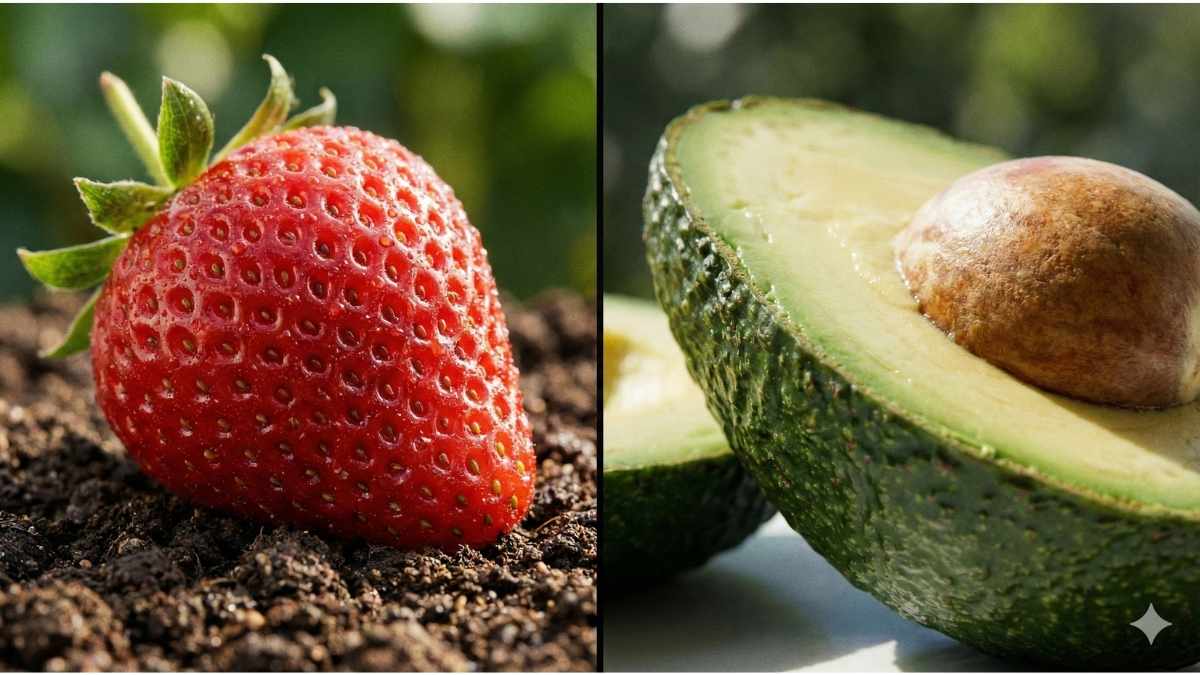 aster the "Skin Rule": The porous Strawberry is a chemical "Sponge" (buy organic), while the thick-skinned Avocado acts as an impermeable "Shield" (buy conventional). This is the key to safe, budget-friendly shopping.
The Data: The 2025 Dirty Dozen & Clean Fifteen
The Environmental Working Group (EWG) analyzes USDA data to track which crops carry the highest pesticide loads after they have been washed and peeled. This year, the data is particularly revealing.
🔴 The 2025 Dirty Dozen List (Always Buy Organic)
High Risk of "Chemical Cocktails"
These are the items where I strongly advise you to draw a hard line. The 2025 data shows that 95% of samples from this list tested positive for pesticides.
Important Note on 2025 Additions: Watch out for Blackberries and Potatoes. While they fluctuate in and out of the top 12, recent testing shows potatoes have high levels of chlorpropham (a sprout inhibitor), and blackberries share the same "sponge" risks as strawberries.
🟢 The Clean Fifteen (Safe to Buy Conventional)
The Pragmatic Compromise
Almost 60% of these samples had no detectable pesticide residues. Buying conventional here is the smartest way to balance your budget.
The "Why" vs. The "What": MRL Failure
Rates
As a PhD scholar, I look beyond the list to the toxicology. Why do we care if there are traces of pesticides?
The government sets Maximum Residue Limits (MRLs) based on what is achievable for a farmer following the label—not solely on what is safe for a child's developing endocrine system.
The "Cocktail Effect" Gap:
The most alarming finding in the 2025 data isn't just the presence of one chemical; it's the mixture.
- The Reality: A single sample of conventional kale can contain up to 21 different pesticides.
- The Risk: Regulatory agencies test chemicals in isolation. They rarely test what happens when you consume small amounts of 20 different neurotoxins and endocrine disruptors simultaneously. This "cocktail effect" is the unknown variable we are trying to avoid.
- The Organic Difference: Organic certification treats the MRL as a "Zero Tolerance" guardrail. If an organic apple tests at even 5% of the conventional tolerance, it triggers an investigation. That is the verifiable safety net you are paying for.
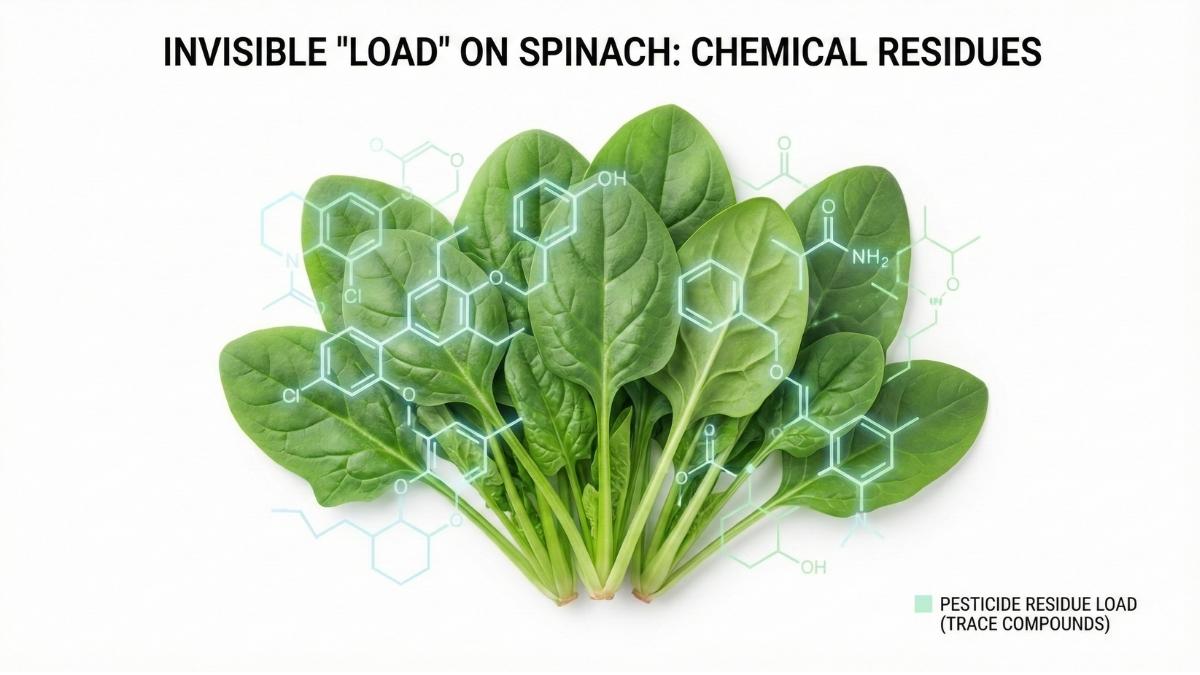 Spinach Risk: As a high-surface-area "Leafy Trap," spinach consistently carries the highest residue load by weight (including permethrin). It is a mandatory organic purchase to avoid the synergistic "Cocktail Effect."
The Solution: "Can't I Just Wash It Off?"
This is the question my friends ask me most often. "If I soak my conventional strawberries in vinegar, aren't they safe?"
The Hard Truth: No!
Research from the University of Massachusetts has shown that while washing helps, it has severe limitations.
- Baking Soda vs. Bleach: The study found that a solution of baking soda (sodium bicarbonate) was more effective than bleach or tap water at removing surface residues like phosmet. (Pro tip: Soak for 12-15 minutes in a mix of 1 tsp baking soda to 2 cups water).
- The Systemic Problem: However, the study also found that 20% of the pesticide thiabendazole had penetrated deep into the apple peel. No amount of scrubbing, vinegar, or expensive "veggie wash" can remove a chemical that is inside the fruit's cells.
My Advice: Wash everything to remove dirt and bacteria. But do not delude yourself into thinking you can "wash" a conventional strawberry into an organic one. The biology doesn't allow it.
The Budget Hack: "Best Organic Food Delivery"
Services
We have established that you need organic strawberries and spinach. But we also know organic prices are high. This is where we get resourceful.
The rise of "ugly produce" delivery services has been a game-changer for my own grocery budget.
1. Misfits Market (Top Pick for 2025)
Misfits Market is my top recommendation for the budget-conscious "Proactive Protector."
- The Hack: They source organic produce that is "imperfect"—too small, slightly scarred, or surplus inventory that grocery stores reject for cosmetic reasons.
- The Savings: You can find organic dirty dozen items for 20-30% less than supermarket prices.
- Why It Works: Does it matter if your organic bell pepper is oddly shaped? No. Does it matter if it has neurotoxins? Yes. Misfits allows you to afford the safety of organic without the "perfect produce" tax.
2. Thrive Market (For The Pantry)
For the dry goods that accompany your produce (like organic oats, which are often high in glyphosate), Thrive Market is essentially an online Costco for organic food.
- The Strategy: Use their annual membership to lock in savings on shelf-stable organic items, freeing up cash for your fresh produce budget.
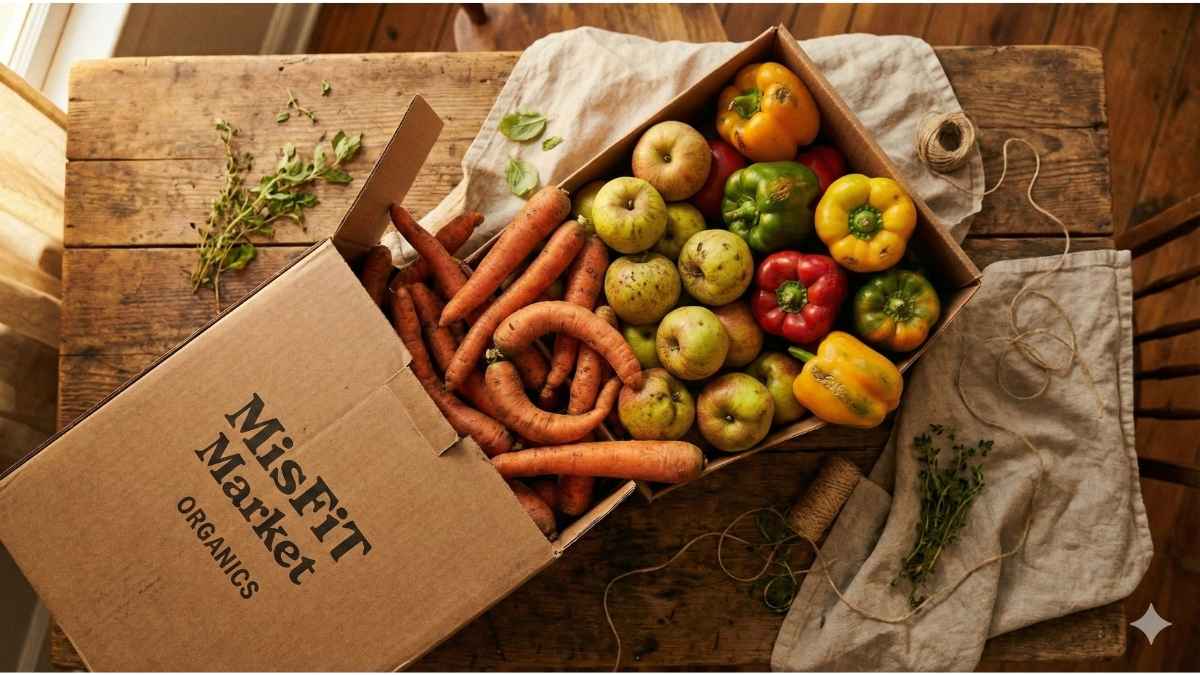 Misfits Market (The Budget Hack): Use "ugly produce" delivery services to source organic Dirty Dozen items 20-30% cheaper. This decouples aesthetic standards from toxicological safety, allowing you to afford your safety purchases.
Conclusion: Stop Guessing, Start Protecting
You do not need to be a toxicologist to shop safely. You just need to follow the logic of the skin.
- Thin Skin? The pesticides get in. Buy Organic. (Strawberries, Spinach, Grapes).
- Thick Skin? The pesticides stay out. Buy Conventional. (Avocados, Pineapples, Onions).
This system works today, it will work in 2026, and it works regardless of your budget. By using the dirty dozen list as your strict rule and the Clean Fifteen as your release valve, you are making a powerful, scientifically backed decision. You are reducing your family's chemical load significantly without breaking the bank.
That is what I call smart, proactive protection. 💪
📚 Further Reading (Top
Sources)
- The official source for the annual Dirty Dozen and Clean Fifteen lists, providing the most current data on pesticide residues.
- The raw government data source that tracks pesticide residues on food, offering transparency behind the rankings.
- An independent, comparative analysis of pesticide risks that often provides a stricter safety benchmark than federal limits.

Meet Saqib
Saqib Ali Ateel is a PhD Scholar by training and a "student of the soil" by nature. He combines deep research, hands-on farming wisdom, and agricultural systems supervision to reveal what’s really on your plate. His mission is simple: to help your family navigate the food industry's complexity so you can eat cleaner, safer, and smarter.
- Home
- Why Toxic Foods?
- Heavy Metals in Food
- Dirty Dozen List
2026 Environmental Working Group Clean Fifteen
100% Organic Food Label Verification
Organic vs Conventional Strawberries
How to Wash Organic Strawberries
%3B%20Avocados%20are%20%22shields%22%20(buy%20conventional%20%26%20SAVE).%20Stop%20guessing!%20PrefOrganic%E2%80%99s%20timeless%20filter%20protects%20your%20family%20and%20your%20budget.%20Read%20the%202025%20guide.%20%20%23SkinRule%20%23SpongeVsShield%20%23BuyOrganic%20%23SaveMoney%20%23Avocado%20%23Strawberry%20%23PesticideFree%20%23PrefOrganic)

%20without%20the%20%22perfect%20produce%22%20tax.%20Start%20saving%20today!%20%20%23BudgetHack%20%23MisfitsMarket%20%23OrganicDeals%20%23SaveMoney%20%23UglyProduce%20%23ProactiveProtector%20%23PrefOrganic)

