The Pure vs. The Fake: Why Monk Fruit Without Erythritol Is
the Only Medicinal Choice for Your Heart 🫀
You flip the package over expecting to see pure fruit, but instead, you find "erythritol" buried in the fine print. If you are searching for monk fruit without erythritol because you are worried about recent heart health studies, you are right to be cautious. As a PhD student and organic grower, I know that true "medicinal" quality is rare, but I am here to help you distinguish the fake fillers from the real, gut-healing gold.
The "Retail" Betrayal: When "Natural"
Isn't Safe
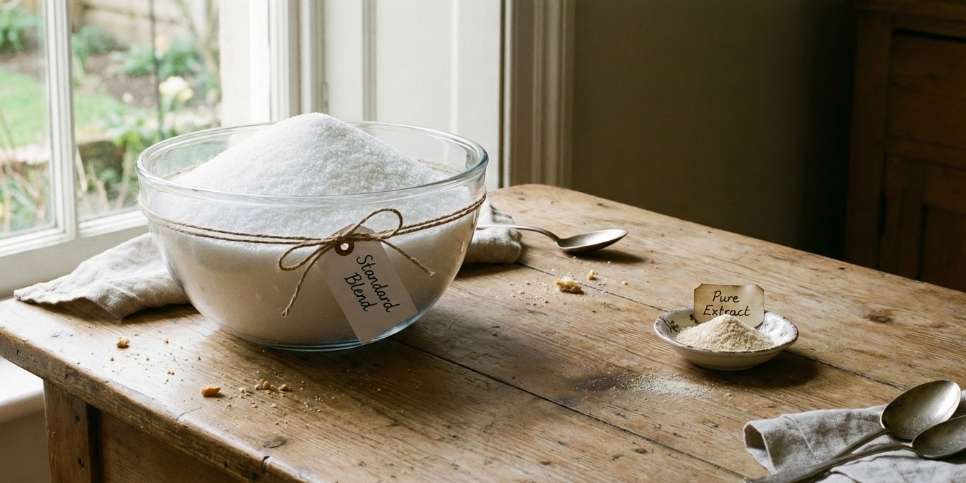 The Deception of Volume: The large bowl represents the "Standard Blend" diluted with erythritol to mimic sugar's bulk, while the small dish shows the highly concentrated "100:1" ratio of pure medicinal extract required for the same sweetness.
From what I've learned in my research as a PhD student in agriculture, the term "Natural" is often used as a shield to hide industrial processing. For years, the wellness community—myself included—embraced erythritol as the "safe" sugar alcohol. It didn't spike insulin, and it didn't cause the digestive distress of xylitol. We thought we had found the holy grail.
However, science is always evolving. A landmark study published in Nature Medicine (2023) and corroborated by further research in 2024 has fundamentally shifted our understanding. The data suggest that erythritol is not biologically inert. When we consume it in the high quantities found in "1:1 sugar replacements" (often 30 grams or more in a single dessert), it appears to "prime" our blood platelets.
Think of your platelets like tiny sentries patrolling your blood vessels. Under normal conditions, they only band together to stop bleeding if you are cut. But the research indicates that high levels of circulating erythritol might make these sentries hyper-reactive—more prone to clumping together when they shouldn't. This increases the risk of "thrombosis," or inappropriate clotting, which is a primary driver of heart attacks and strokes.
For the "Ingredient Detective" in you, this is the validation of your skepticism. The anxiety you feel isn't paranoia; it's a survival instinct. If you are buying a bag labeled "Monk Fruit" that is 99% erythritol, you aren't buying a fruit extract; you are buying a corn-derived chemical that might be working against your heart health.
The Botanical Reality: What is Pure Monk Fruit? 🍈
 A Botanical Specialist: Unlike stevia or corn, Monk Fruit vines (Siraitia grosvenorii) are photophobic and demand the unique, misty diffused light of Southern China's mountains to thrive
Let’s step away from the laboratory and onto the farm. As someone who has spent years with hands-in-dirt, I have a deep appreciation for Siraitia grosvenorii, the plant we call Monk Fruit or Luo Han Guo.
Growing this vine is not like growing corn or stevia. It is a botanical specialist. It demands the misty, subtropical mountains of Guilin in Southern China to thrive. It creates a natural monopoly; the vines are photophobic (they hate direct sunlight) and require the diffused light of the mountain mist.
The Magic of Mogroside V
The sweetness of this fruit does not come from fructose or glucose. It comes from a group of compounds called Mogrosides. The most precious of these is Mogroside V.
Imagine a tiny key that fits perfectly into the "sweetness lock" on your tongue. Mogroside V is that key, but it is 250 times more potent than sugar. Because your body doesn't recognize it as a carbohydrate, it doesn't unlock the door to your bloodstream (insulin spike). Instead, it passes through to your lower gut, where it performs a very different function.
While the science on this is still emerging, what we know so far is promising: pure monk fruit acts as an antioxidant. Unlike erythritol, which just takes up space, Mogroside V actively scavenges "free radicals"—the rogue molecules that cause inflammation and aging.
The "Medicinal" Thesis: Monk Fruit Benefits
Beyond Sweetness 💊
In Traditional Chinese Medicine (TCM), Luo Han Guo was never just a treat. It was, and is, a medicine. It is classified as a "Cooling" tonic, specifically targeting the Lungs.
The Lung & Gut Connection
My research as a scholar highlights a fascinating connection here. The monks used the fruit to treat "dry coughs" and sore throats—conditions of inflammation. Modern pharmacology validates this. Studies show that Mogroside V inhibits NF-κB, a protein complex that acts as the "master switch" for inflammation in the body.
Furthermore, monk fruit benefits extend to your gut microbiome. While artificial sweeteners can destroy healthy gut bacteria, pure monk fruit appears to act as a prebiotic. It helps feed Bacteroidetes, the "good" family of bacteria associated with a lean metabolism.
By choosing monk fruit without erythritol, you are not just avoiding a potential clotting risk; you are ingesting a potent, anti-inflammatory plant extract that supports your lung and gut health. You are upgrading from a "filler" to a "functional food." ✨
Culinary Science: Mastering the Micro-Dose 🥣
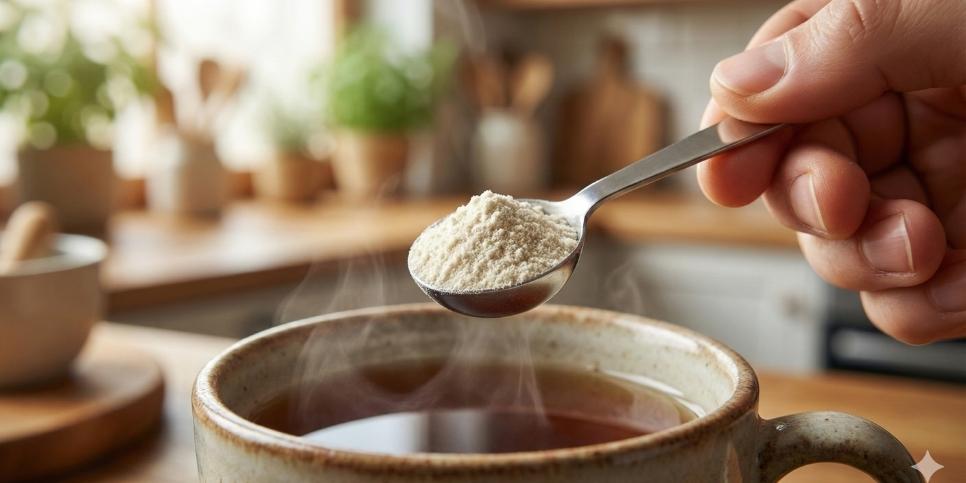 Mastering the Micro-Dose: Because pure extract is 250 times sweeter than sugar, you must shift from standard scoops to a "micro-dose" to avoid overpowering your drink
I know what you are thinking. "If it's so great, why is it so hard to use?"
This is where my "Trusted Friend" hat comes on. I’ve ruined my fair share of batches in the kitchen trying to figure this out. The reason retail brands blend monk fruit with erythritol is purely for volume. We are used to scooping a cup of sugar. But a cup of pure monk fruit would be inedible—it would be like eating 250 cups of sugar!
To use the pure stuff, you have to embrace Volumetrics and the art of the "Smidgen."
The "No-Filler" Conversion Chart
Here is a guide to help you transition from white sugar to pure extract (specifically the standard 50% Mogroside V concentration).
Pro-Tip from the Kitchen: 👩🍳
Because the powder is so fine and concentrated, it clumps easily. Never dump it straight into a cold liquid.
- For Baking: Dissolve the tiny pinch of powder in the liquid ingredients (oil, milk, egg) before mixing with flour.
- For Bulk: If your cookie recipe relies on sugar for "crunch" and bulk, pure monk fruit will leave your cookies flat. In these specific baking cases, consider blending it with Allulose (a rare sugar that doesn't have the clotting risks of erythritol) or adding fiber like inulin to make up the lost volume.
Label Forensics: How to Spot the Imposters 🕵️♀️
You are already a label detective, but here is exactly what to look for to ensure you are getting monk fruit without erythritol.
❌ The Red Flags (Do Not Buy):
- "1:1 Sugar Replacement": This claim is physically impossible with pure fruit. It must contain a filler.
- "Proprietary Blend": This is code for "mostly cheap corn dust, tiny bit of fruit."
- First Ingredient: Erythritol, Dextrose, or Xylitol.
✅ The Green Lights (Buy This):
- Ingredient List: Contains ONLY "Organic Monk Fruit Extract" or "Luo Han Guo Extract."
- Color: Look for an Off-White or Pale Yellow powder. If it is dark brown, it might have a smoky/burnt taste (great for TCM tea, bad for coffee). If it is stark white and crystalline like sugar, check the label again—it might be cut with something.
- Mogroside V Content: The best brands will proudly list "50% Mogroside V" (or MV50) on the spec sheet. This is the sweet spot between medicinal potency and clean taste.
Conclusion: The Choice is Yours
The transition to a "Clean Label" life isn't always easy. It requires reading the fine print and relearning how to cook. But when you weigh the inconvenience of measuring a micro-scoop against the potential cardiovascular risks of industrial polyols, the choice becomes clear.
You deserve food that heals, not food that harms. By choosing monk fruit without erythritol, you are reclaiming the ancient wisdom of the Luohan monks and applying it to your modern biology. You are choosing the "Medicinal Gold."
Trust your gut (and your heart). Make the switch. 💪
📚 Further Reading
(High-Authority Sources)
To ensure you have the most accurate and empowering information, I recommend exploring these sources:
- A groundbreaking clinical study that identified the link between erythritol and blood clotting.
- A digestible breakdown of the research by one of the world's leading heart health hospitals.
- A comprehensive review of the botanical and medicinal history of the fruit.

Meet Saqib
Saqib Ali Ateel is a PhD Scholar by training and a "student of the soil" by nature. He combines deep research, hands-on farming wisdom, and agricultural systems supervision to reveal what’s really on your plate. His mission is simple: to help your family navigate the food industry's complexity so you can eat cleaner, safer, and smarter.
Best Monk Fruit Without Erythritol
- Organic Monk Fruit Sweetener Showdown
- Lakanto Monk Fruit Sweetener
- Monk Fruit Brown Sugar
- Liquid Monk Fruit Sweetener
%20and%20the%20tiny%20amount%20of%20Pure%20Extract%20you%20actually%20need.%20Don't%20pay%20for%20cheap%20corn%20fillers%20that%20risk%20your%20heart.%20%F0%9F%9B%91%20%23MonkFruit%20%23CleanEating%20%23HeartHealth)


