The 'Natural' Label Trap: How the NuNaturals Monk Fruit Sweetener Recall Exposes the Risks of Unverified Supply Chains
You reached for your bottle of Monk Fruit to sweeten your morning coffee, expecting that clean, melon-like sweetness to support your gut health. But instead, you tasted something bitter, metallic, and lingering. Or perhaps, worse—you felt a strange tickle in your throat or a sudden wave of hay fever symptoms, despite staying indoors.
If you are reading this, you are likely holding a bottle with Lot #25104S, or you’ve seen the headlines about the NuNaturals monk fruit sweetener recall. You might feel confused, anxious, or frankly, betrayed. You paid a premium for a specific medicinal food, and you’re wondering: If the label says Monk Fruit, why is the FDA telling me it’s Stevia? And if they can mix up the plant, what else are they missing?
As a PhD student in agriculture who has spent years studying the journey of food from soil to spoon, and as a farmer who knows how hard it is to grow pure crops, I want to validate your frustration. This isn't just a "packaging error." It is a wake-up call. It exposes a systemic "White Powder Problem" in the natural food industry that most brands are too afraid to talk about.
In this deep dive, we are going to look past the press release. We will explore why this mix-up is dangerous for your biology, how the "Natural" label can be a trap, and exactly how you can become an "Ingredient Detective" to ensure this never happens to your family again.
🚨 Summary in Bullets: The Takeaway
- 🛑 The Mix-Up: A major labeling error swapped contents—Stevia was found in Monk Fruit bottles, and Monk Fruit in Stevia bottles (Lot #25104S).
- 🧬 The Allergy Risk: If you have a Ragweed allergy, the hidden Stevia could trigger cross-reactive symptoms like oral itching or respiratory distress.
- 🦠 The Metabolic Miss: Pure Monk Fruit feeds beneficial Akkermansia bacteria; if you consumed the mislabeled Stevia, you missed this critical gut-healing benefit.
- 🧪 The Solution: "Natural" is not enough. You must demand Certificate of Analysis (CoA) transparency and verify USDA Organic seals to ensure supply chain integrity.
The Event: Anatomy of a "White Powder" Mix-Up
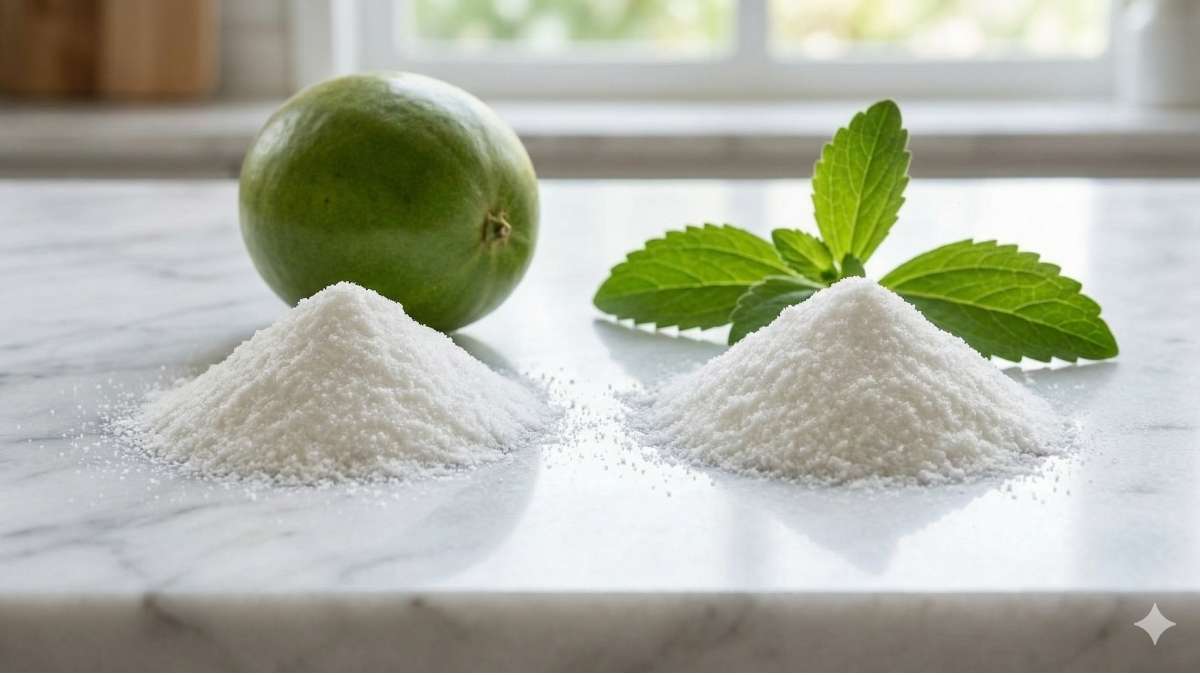 Without rigorous lab testing like HPTLC, processed Monk Fruit and Stevia powders look identical to the naked eye
Let’s start with the facts to clear the confusion immediately.
On July 14, 2025, NuNaturals Inc. voluntarily recalled specific lots of their two most popular products. On August 1, 2025, the FDA upgraded this to a Class II Recall. This classification means the use of the product may cause temporary or medically reversible adverse health consequences.
What actually happened? It was a direct swap.
Bottles labeled "Organic Pure Stevia" actually contained Monk Fruit. "Pure Monk Fruit Sweetener" actually contained Stevia. Lot Number: 25104S Best By Date: April 2028 Why Does This Happen? If a contract manufacturer (a factory that bottles products for many different brands) doesn't clean the line properly between runs, or if a worker grabs the wrong drum from the warehouse because they didn't scan a barcode, a mix-up is inevitable.
The Specifics to Check:
To the consumer, Stevia and Monk Fruit are worlds apart. But on a manufacturing line, they are both fine, white, fluffy powders.
From my experience studying processing facilities, I can tell you that without rigorous, expensive testing called High-Performance Thin-Layer Chromatography (HPTLC), these powders look identical to the naked eye.
This incident proves that "Trusting the Brand" is no longer enough. We need to trust the testing.
Stevia vs. Monk Fruit: It’s Not Just Taste, It’s Biology
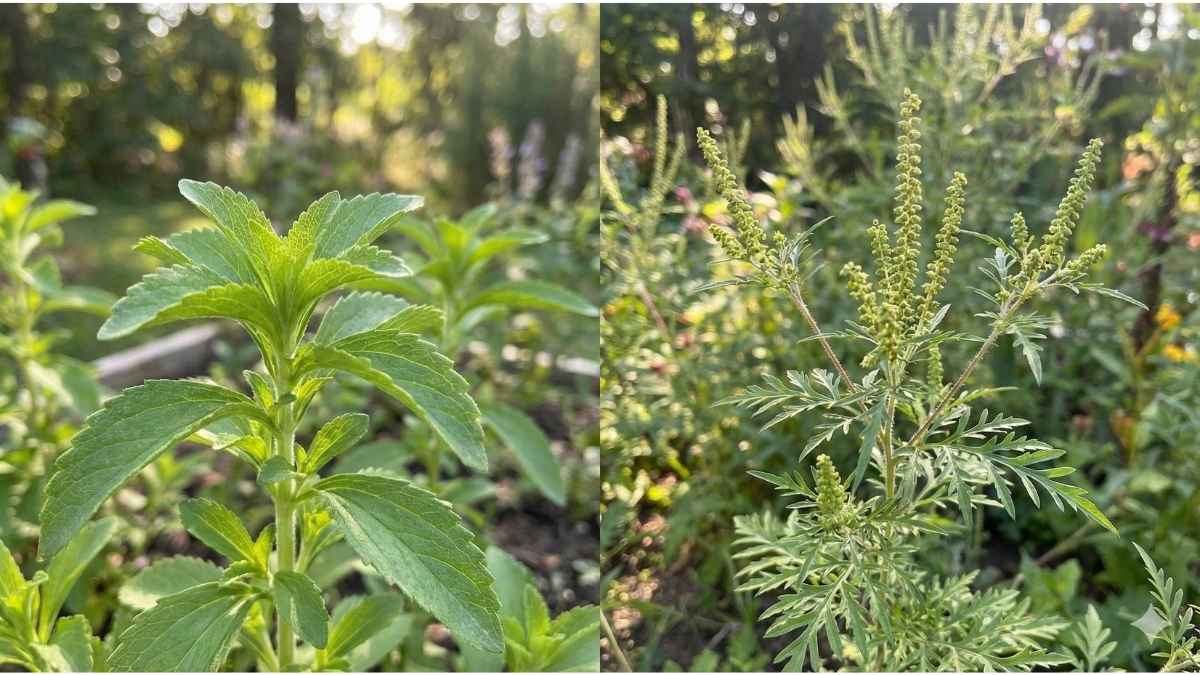 Stevia belongs to the Asteraceae family—the same plant family as Ragweed—which can trigger Oral Allergy Syndrome
The FDA classified this as a Class II recall because it poses a risk of "temporary or medically reversible adverse health consequences". That sounds technical, so let’s break down what this swap actually does to your body. It is not just about a bad cup of coffee; it’s about a missed biological signal.
The Allergy Risk: The Ragweed Connection
If you are someone who specifically avoids Stevia, you probably have a good reason. Stevia rebaudiana is a plant in the Asteraceae family.
For my gardening friends, you know this family well. It includes marigolds, daisies, chrysanthemums, and the arch-nemesis of sinus sufferers everywhere: Ragweed.
The Science of Cross-Reactivity:
If you suffer from seasonal hay fever (allergic rhinitis), your body has antibodies trained to attack ragweed pollen proteins (specifically Amb a 1). Unfortunately, the proteins in Stevia leaves can look structurally similar to these pollen proteins. When you consume Stevia, your immune system may get confused—a phenomenon called cross-reactivity.
This can trigger Oral Allergy Syndrome (OAS). You might experience:
- Itching or tingling of the lips and tongue.
- Mild swelling of the throat.
- An unexplained flare-up of your seasonal allergy symptoms.
For the "Allergen-Aware Parent" who bought Monk Fruit to keep their child safe, this NuNaturals monk fruit sweetener recall is terrifying. You weren't being paranoid; you were being protective. The mix-up bypassed your safety protocols.
The Metabolic Miss: Starving the "Good Guys"
On the flip side, let’s talk to the "Betrayed Bio-Hacker." You likely bought Monk Fruit not just for sweetness, but for the mogrosides.
As I’ve discussed in previous research, pure Monk Fruit acts as a prebiotic fertilizer for a very specific gut bacteria called Akkermansia muciniphila. This bacteria strengthens your gut lining and protects against inflammation.
The Swap Consequence:
- Stevia: While generally safe, Stevia is bacteriostatic. It doesn't feed your gut microbiome; it just passes through.
- The Result: If you were using the mislabeled product, you missed every single dose of gut-healing "fertilizer" you thought you were taking. You were expecting to feed your Akkermansia, but instead, you gave them nothing.
"Phantom" Side Effects: Decoding Your Symptoms
Since this news broke, search interest for "monk fruit side effects" and "monk fruit allergy" has spiked. Many of you likely felt sick and blamed the Monk Fruit.
It is vital to understand that your symptoms might not be from Monk Fruit at all—they might be from the hidden Stevia.
1. The "Metallic" Headache
Stevia is famous for triggering the hTAS2R4 bitter receptors on the human tongue. For genetically sensitive "supertasters," this bitterness can be so intense it triggers headaches or nausea. If you drank "Monk Fruit" coffee and felt nauseous, you weren't reacting to the fruit; you were reacting to the Stevia leaf.
2. The "Gut Rumble"
Here is where it gets tricky.
- Real Monk Fruit: Can cause "Good Gas" (mild bloating) because your bacteria are fermenting it. This is a sign of healing.
- Stevia: Should be silent in the gut.
- Erythritol (The Common Filler): If you are buying blends, this sugar alcohol pulls water into the colon, causing "Bad Gas" (sharp pain and diarrhea).
If you experienced an itchy throat or metallic taste, that was the Stevia. If you experienced "Good Gas" while using the bottle labeled "Stevia," you were actually getting the benefits of Monk Fruit!
The Preforganic Thesis: Why "Natural" is a
Marketing Myth
This recall validates what I preach every day on the farm and in my research: "Natural" is a marketing term; "Certified" is a safety standard.
The FDA has no strict definition for "Natural". A product can be labeled "Natural" even if it was processed in a facility that doesn't do DNA testing on its ingredients.
The "White Powder" Vulnerability
The supplement industry relies on contract manufacturers (co-packers). Your favorite brand might just be a marketing office, while the actual powder is blended in a massive warehouse alongside hundreds of other white powders.
Without Identity Testing—where a chemist runs a sample through a machine to verify its molecular fingerprint—errors like the NuNaturals recall happen. They relied on the label on the drum, not the chemistry inside it.
Why Organic is Your Safety Net
This is why I am so adamant about USDA Certified Organic and rigorous third-party verification.
- The Audit Trail: To carry the Organic seal, a manufacturer must prove a "Chain of Custody." They must document exactly when the machine was cleaned, what was run before it, and where the ingredient came from.
- Segregation: Organic regulations require strict physical separation of organic and non-organic ingredients. This reduces (though doesn't eliminate) the risk of a tired worker grabbing the wrong drum.
Empowerment: How to Be an Ingredient Detective
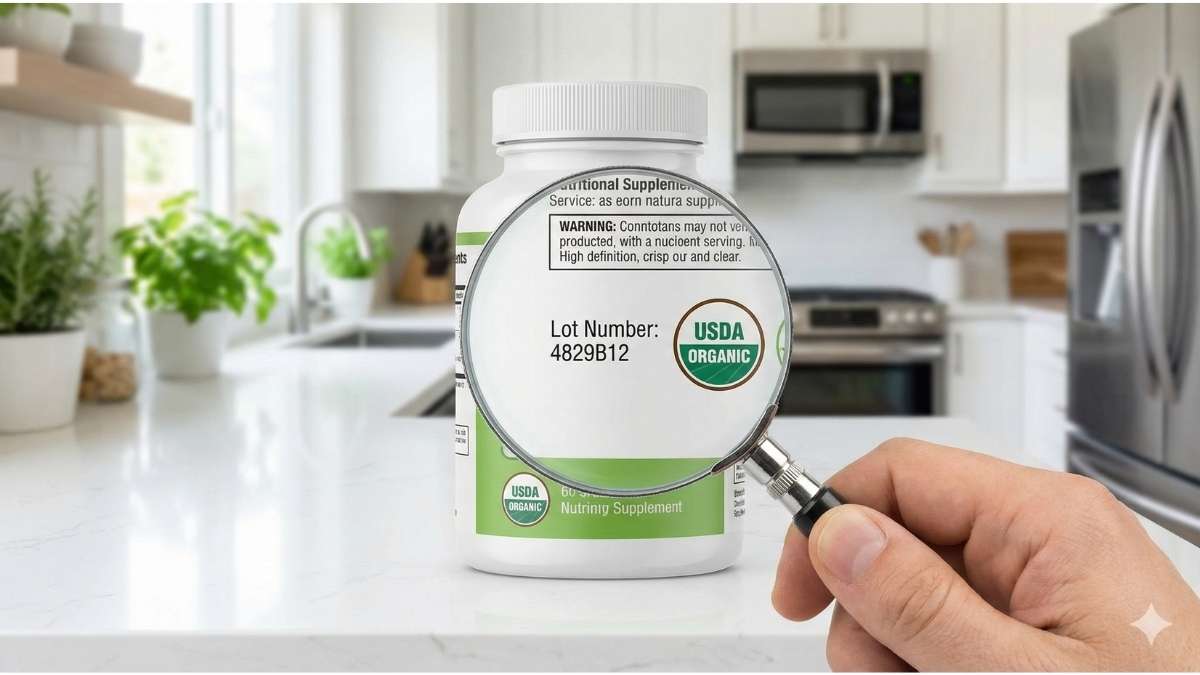 "Natural" is a marketing term; demand a Certificate of Analysis (CoA) and look for the Organic seal to ensure safety
You don't have to be a victim of the supply chain. You can take control. Here is my "Trusted Friend" guide to protecting your pantry right now.
Step 1: The Pantry Audit
Go to your kitchen immediately. Look for Lot #25104S on any NuNaturals bottles.
- If you have it, do not consume it.
- Even if you aren't allergic to Stevia, the product is compromised. Contact the retailer for a refund.
Step 2: The Taste Test (Sensory Verification)
In the future, train your palate to be your first line of defense.
- Stevia Taste: hits quickly, spikes high, and leaves a metallic/licorice coating on the back of the tongue.
- Monk Fruit Taste: builds slowly, feels rounder, and tastes like melon rind or fruity caramel. It should never taste metallic.
Step 3: Demand the "CoA"
This is the advanced move for the "Proactive Protector."
When you find a brand you love, email them. Ask this simple question:
"Do you perform Identity Testing on every finished batch, and can I see a Certificate of Analysis (CoA) for the lot I just bought?"
A transparent brand will reply with a PDF showing the lab results. A brand with something to hide will give you a generic "we follow strict quality standards" response. Buy from the transparent ones.
Conclusion: Trust, but Verify
The NuNaturals monk fruit sweetener recall is unfortunate, but it is also an opportunity. It has peeled back the curtain on the "Natural" food industry, showing us that a pretty label is not a guarantee of what's inside.
But let's be clear: Monk Fruit itself is not the villain here.
Pure, verified Monk Fruit remains the "Metabolic Shield"—a powerful tool for reversing insulin resistance and feeding your gut guardian bacteria. The failure here was in the process, not the plant.
Don't let this scare you back to sugar. Let it upgrade you to a smarter consumer.
- Be skeptical of "Natural."
- Look for "Certified Organic."
- Listen to your body (it knows the difference between fruit and ragweed).
You are doing the hard work of healing your family. You deserve a supply chain that works just as hard as you do.
Stay vigilant, stay pure, and keep asking the hard questions.
🔗 Further Reading &
Authority Sources
To deepen your understanding of the science and safety protocols discussed, I recommend these high-value resources:
- A crucial read for understanding why we advocate for pure fruit extracts over blends associated with clotting risks.
- The official source for verifying Lot #25104S and understanding the Class II classification.
- Detailed scientific explanation of Oral Allergy Syndrome and the ragweed cross-reactivity mechanism.

Meet Saqib
Saqib Ali Ateel is a PhD Scholar by training and a "student of the soil" by nature. He combines deep research, hands-on farming wisdom, and agricultural systems supervision to reveal what’s really on your plate. His mission is simple: to help your family navigate the food industry's complexity so you can eat cleaner, safer, and smarter.