Affordable Organic Coffee: Cost-Per-Cup Math + USDA Label
Checks
There is a specific sound a coffee bean makes when it's truly dense and grown at altitude—a sharp, glass-like crack in the grinder, not a dull thud. If you've ever stood in a humid warehouse smelling the burlap sacks of green coffee, you know the difference between a bean treated with respect and one treated with synthetic fungicides.
Most people assume that finding affordable organic coffee means sacrificing quality or risking invisible grit—mold spores, pesticide residue, or flavor defects. They are secretly wondering if the cheaper stuff is "dirty." When I track the lot numbers back to the source, I don’t find hidden pesticides—I find the exact same certified beans, just stripped of the fancy branding tax. You do not need to choose between your budget and your biology.
By understanding unit economics (math, not magic) and the strict legal definitions of the USDA National Organic Program (NOP), you can drink high-quality, chemical-free coffee for less than $0.50 a cup. Here is the exact playbook for finding certified clean beans without the specialty markup—so you can wake up without wondering what else is floating in your mug.
Detailed Breakdown: The "Value Wins" Analyzed
We don't just recommend these because they are cheap. We recommend them because the supply chain data confirms they are clean.
1. The Bulk Club Hero: Kirkland Signature / Member's Mark
Why it's a value win:
Volume is leverage. Warehouse clubs like Costco and Sam's Club move so much product that they can demand lower prices from top-tier roasters. The beans inside these generic bags are often roasted by major specialty companies (white-labeled) under strict NOP handling protocols.
- The Spec: usually a blend of Arabica beans from Central/South America.
- The Taste: engineered for mass appeal—chocolatey, nutty, low acidity.
- The Catch: Often roasted darker to ensure consistency. If you like "light and fruity," this isn't it.
- Smart Buy: Look for the "Certified by [Agent Name]" text on the back panel. It reveals the true quality control behind the generic label.
2. The Everyday Origin: Aldi / Trader Joe’s Single Origin
Why it's a value win:
Most budget coffee is a blend of whatever was cheap that month. Aldi and Trader Joe’s rotate seasonal "Single Origin" lots (e.g., Peru, Honduras, Ethiopia). This means you get distinct flavor profiles—floral, citrus, berry—at grocery store prices.
- The Spec: 100% Arabica, often Fair Trade certified alongside Organic.
- The Taste: Varies by season, but generally cleaner and brighter than the Bulk Club options.
- The Catch: Stock is inconsistent. When a good lot lands, it sells out fast.
- Smart Buy: Check the "Best By" date. In high-turnover stores like Aldi, these beans can be surprisingly fresh.
3. The Ethical Bulk: Equal Exchange (5lb Bags)
Why it's a value win:
If you want to support small farmer co-ops without paying $25 for a 12oz bag, you have to change your buying format. Buying direct in 5lb bulk bags drops the price-per-pound drastically while maintaining the highest ethical standards.
- The Spec: Strictly High Grown (SHG) Arabica, fully traceable co-ops.
- The Taste: High quality, clean, and specific to the roast you choose (Love Buzz, French Roast, etc.).
- The Catch: You need to pay ~$50+ upfront.
- Smart Buy: Use airtight storage (see below) to make the last pound taste as good as the first.
4. The Clean Decaf: Water Process (Generic/Bulk)
Why it's a value win:
Cheap decaf is often processed using solvents (like methylene chloride). Organic decaf must use non-synthetic methods to maintain the seal, but "Water Process" (like Swiss Water) is the gold standard for flavor retention.
- The Spec: 99.9% Caffeine-free, chemical-free processing.
- The Catch: It is physically more expensive to produce, so the "floor price" is higher ($0.60/oz).
- Smart Buy: Never buy budget decaf unless it explicitly says "Water Process" or displays the USDA Organic seal.
The "Real Cost" Calculator: How to Math Your
Morning Cup
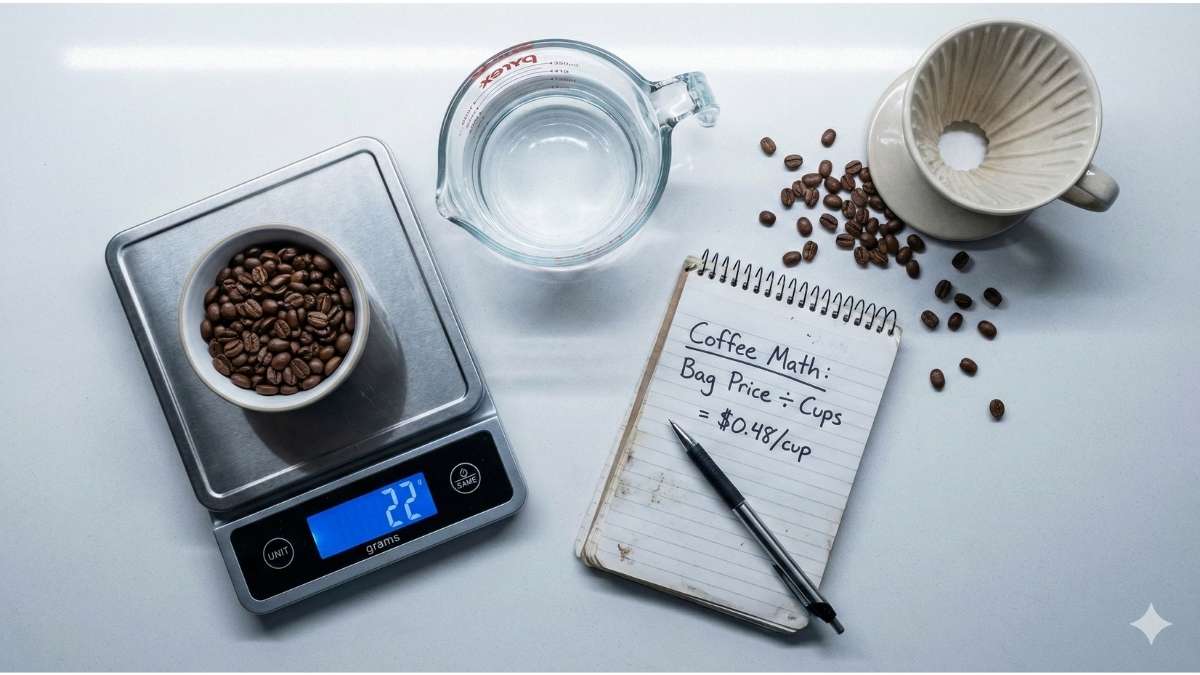
The biggest marketing trick in the grocery aisle is the sticker price. A $12 bag looks cheaper than a $30 bag, but your metabolism doesn't care about the bag—it cares about the dose. To find budget organic beans that are actually worth brewing, we have to look past the sticker price and calculate the real cost per cup.
According to the National Coffee Association (NCA), a standard starting dose is about 1–2 tablespoons per 6 ounces of water. In the lab, we standardize this to weight. Let's use a standard 1:16 ratio—approx. 20 grams of coffee for a large mug (320ml).
The Formula:
Cost_per_cup ≈ (Bag_Price) ÷ (Bag_Weight_Grams ÷ 20g)
Scenario A (The Trap): A fancy 10oz (283g) bag for $14.
- 283g ÷ 20g = ~14 cups.
- $14 ÷ 14 = **$1.00 per cup.**
Scenario B (The Hack): A 2lb (907g) organic coffee bulk bag for $22.
- 907g ÷ 20g = ~45 cups.
- $22 ÷ 45 = **$0.48 per cup.**
The Science of "Convenience Tax":
If you buy K-Cups or pods, you are paying for plastic, not coffee. A typical organic pod costs $0.75–$1.00 and contains only 10–12g of coffee. You are paying nearly double the price per gram for a product that stales faster due to increased surface-area interaction with residual oxygen inside the cup.
Definition Check: Are You Paying for
"Marketing" or "Certified"?
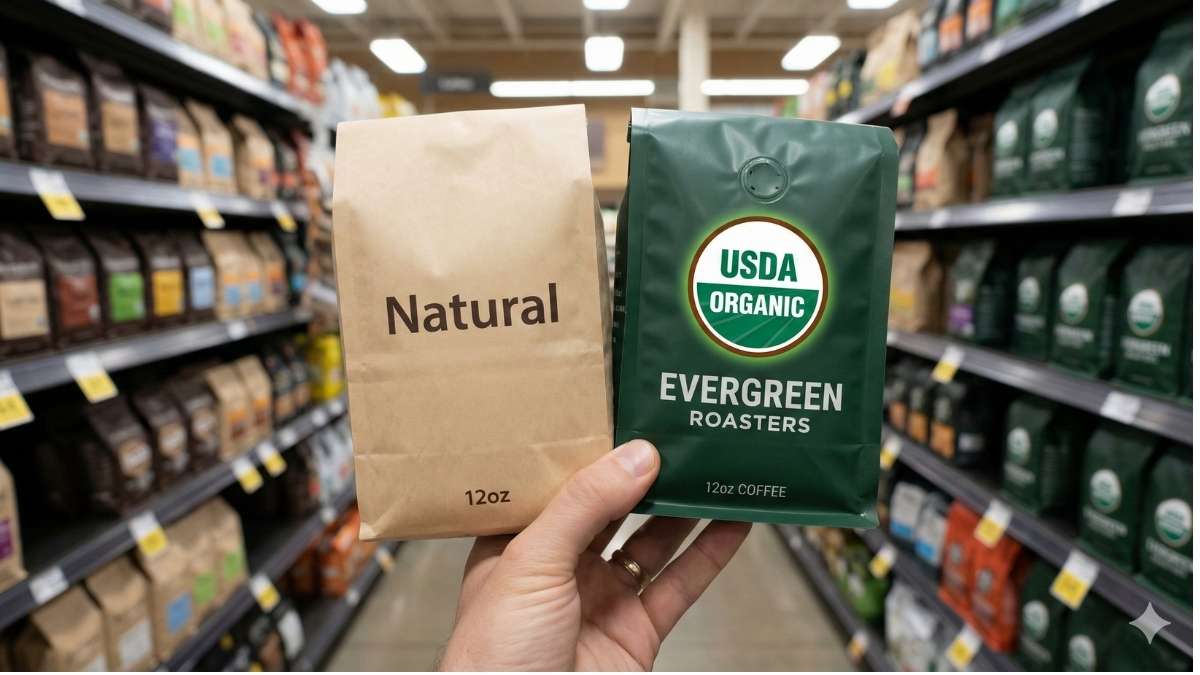
Marketing teams love adjectives. Regulatory bodies love evidence. In the U.S., the term "Organic" is not a vibe; it is a legal structure codified in 7 CFR Part 205.
5 Strategies to Take Affordable Organic Coffee
Strategy 1: Buy Whole Bean & Grind at Home
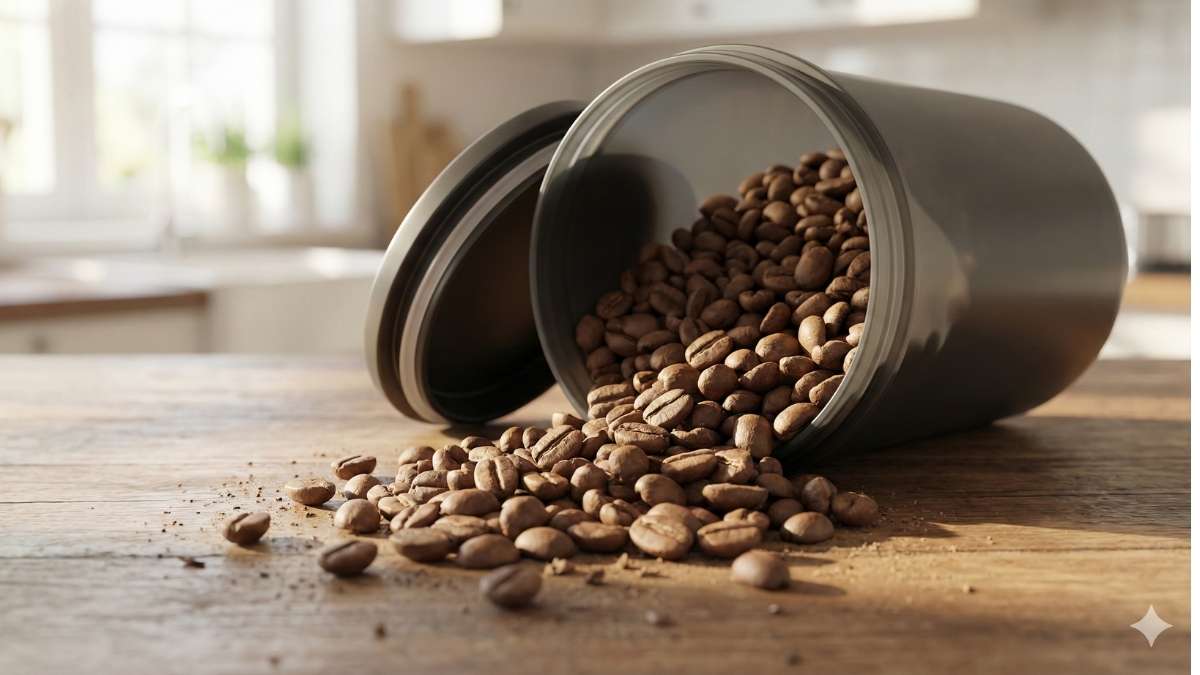
Oxygen is the enemy of value. Whole-bean coffee retains volatile aroma compounds longer because the bean structure protects the oils. Once you grind, surface area increases exponentially, and those oils—what you paid for—evaporate.
- The Math: A 2lb bag of whole beans stays "fresh enough" for 4 weeks. A 2lb bag of ground coffee is stale in 1 week. If you throw away the last third of a stale bag, you just raised your cost per cup by 33%.
Strategy 2: Embrace Blends Over Single Origins
Single-origin coffees are traceable to a specific farm and command a premium. Blends mix multiple lots to create a consistent flavor profile (e.g., "Breakfast Blend").
- The Insight: Roasters use blends to use up good organic beans that didn't have enough volume to be sold as a single origin. You get the same clean chemistry for a lower price.
Strategy 3: The "Store Brand" Hack
Private-label organic coffees (like Kirkland or 365) are often roasted by the same big-name roasters who generally sell bags for $18/lb.
- The Trick: Legally, the USDA labeling rules require them to list the certifying agent. This audit trail ensures the supply chain is just as clean as the name brand, just without the marketing markup.
Strategy 4: The "5lb Bag" Commitment
Buying standard 12oz bags is the most expensive way to drink coffee. Roasters save massive amounts on packaging and shipping when they sell in bulk, and they pass those savings to you.
- The Math: A typical 12oz organic bag costs ~$18 ($1.50/oz). That same roaster often sells a 5lb (80oz) bag for $80 ($1.00/oz). You save 33% instantly just by committing to the volume.
- The Tip: Combine this with Strategy 1 (Airscape storage) so the last pound tastes as fresh as the first.
Strategy 5: Stop Overdosing (Use a Scale)
Most home brewers "eyeball" their scoops, often using 25g–30g of coffee when they only need 20g. That extra 5g–10g doesn't make the coffee better; it just wastes inventory.
- The Science: Coffee bean density changes with roast level (dark roasts are less dense). A "scoop" of light roast weighs more than a scoop of dark roast. Volume is a lie; mass is the truth.
- The Savings: By weighing your dose to exactly 20g, you stop the "invisible waste" and can stretch a bag for an extra 3–4 days. The $15 scale pays for itself in one month.
Making Affordable Coffee Taste Expensive (Brewing
Science)
You can buy the most affordable beans and make them taste like gold if you control the extraction variables.
Dialing in the Ratio and Temp
Budget organic beans often have a darker roast profile to mask variability.
- Temperature: Do not use boiling water. The NCA recommends 195°F–205°F (90.6°C–96.1°C). For cheaper, darker roasts, stick to the lower end (195°F) to avoid extracting bitter compounds (pyrolysis products).
- Ratio: Use a scale. A 1:16 ratio (coffee to water) is the sweet spot. Eye-balling it leads to under-extraction (sour) or over-extraction (bitter).
Storing Your Bulk Buy
If you buy 5lbs to save money, storage is your bank vault.
- Do: Use opaque, airtight containers (e.g., Airscape) at room temperature.
- Don't: Put coffee in the fridge. The condensation from opening and closing the door introduces moisture, which accelerates degradation and can introduce odors from other foods.
What Real Buyers Say (Community Consensus)
I analyzed the chatter across coffee forums and social groups to see where the real "value heroes" are hiding.
- The Costco Consensus: The "House Blend" (green bag) is widely regarded as the volume winner. Users report it is consistent, though oily (dark roast), making it perfect for French Press but tricky for super-automatic espresso machines.
- The Aldi Surprise: Users frequently mention Aldi’s seasonal Single Origin Organic beans (Peru/Honduras) as the best "under $6" bag on the market, though stock varies wildly by region.
- The Subscription Hack: Smart buyers are signing up for "Roaster's Choice" subscriptions in 5lb intervals. By prepaying, they lock in fresh-roasted organic beans at prices competing with grocery store staleness.
Frequently Asked Questions
Is organic coffee actually pesticide-free?
Generally, yes. Ingredients and processing aids must meet the NOP National List, which restricts synthetic pesticides. However, there is always a tolerance for unintended environmental drift, but it is vastly cleaner than conventional.
Why is organic coffee more expensive?
It comes down to certification costs and lower yields per acre (since farmers can't use synthetic fertilizers to pump up growth). However, note that very small farms (grossing <$5,000) are exempt from certification. They might be organic but can't use the seal—this is where local farmers markets can offer deals.
Does affordable organic coffee taste worse?
Not necessarily. "Organic" is an agricultural standard, not a taste standard. A cheap organic coffee might be roasted dark to hide defects, but it isn't the organic growing method that makes it taste bad—it's the roasting and grading.
Next Steps
Stop staring at the sticker price. Just run the math, verify the USDA seal over "natural" hype, and switch to bulk whole beans—that is how you drink clean for under fifty cents a cup.

Meet Saqib
Saqib Ali Ateel is a PhD Scholar by training and a "student of the soil" by nature. He combines deep research, hands-on farming wisdom, and agricultural systems supervision to reveal what’s really on your plate. His mission is simple: to help your family navigate the food industry's complexity so you can eat cleaner, safer, and smarter.