Can Dogs Have Stevia? The Definitive Safety Guide to
Avoiding Xylitol and Choosing Organic
Can dogs have stevia without risking their health, or is this natural sweetener just another hidden danger in your pantry?
You are likely standing in your kitchen right now, holding a container of yogurt or a "sugar-free" treat, while your dog gives you that irresistible, pleading look. Your heart wants to say yes, but your mind is racing with headlines about toxic foods. As a pet parent, that hesitation you feel isn't paranoia—it's protection. You know that in the world of food processing, "natural" doesn't always mean safe, and the difference between a healthy treat and a medical emergency can be found in the fine print of an ingredient's label.
As a PhD student in agriculture who has spent years studying food systems, combined with my own muddy-boots experience raising animals on our family farm, I have learned that we must look beyond the marketing on the front of the package. We need to understand the biology of what happens inside our dogs when they eat what we eat. The short answer to your question is generally yes, dogs can have pure stevia in moderation. However, the long answer is far more critical because stevia products are rarely just stevia. They often hide ingredients that are harmless to us but devastating to our dogs.
My goal in this guide is to walk you through the complex chemistry of sweeteners with the warmth of a trusted friend and the rigor of a researcher. We will dismantle the confusion around toxicity, expose the lethal imposter known as Xylitol (or "Birch Sugar"), and explain why organic stevia isn't just a fancy label—it is the only way to ensure you aren't feeding your dog industrial solvents. Let’s turn your anxiety into expertise.
Essential Safety Guide: Navigating Sweeteners and Protecting Your Pet's Health
- 🛡️ The Organic Shield: Discover why choosing certified organic stevia is the only way to ensure your dog avoids toxic industrial solvents like hexane and petroleum residues left behind by conventional processing.
- ⚠️ The Lethal Imposter: Learn to identify "Birch Sugar" and other clever marketing aliases for Xylitol, a common sweetener that can trigger fatal liver failure and seizures in dogs within minutes.
- 🔍 Label Detective Secrets: Master the art of reading the fine print to uncover hidden glycemic-spiking fillers like maltodextrin and dextrose that turn a "sugar-free" treat into a health hazard.
- 🌱 Nature's Sweet Alternatives: Explore nutrient-dense, whole-food options from the garden that satisfy your dog's cravings while providing antioxidants and fiber without the chemical risks.
🧪 Is Stevia Safe for
Dogs? The Science of Sweetness
To understand the answer to "can dogs have stevia," we have to look at the plant itself. Stevia rebaudiana is a shrub native to South America, used for centuries by the Guaraní people. The sweetness comes from compounds called steviol glycosides, which are extracted from the leaves.
From an academic perspective, the safety profile of these glycosides is well-documented. Unlike humans, who evolved to crave sugar as a survival mechanism, dogs are facultative carnivores. They have taste receptors for sweets, but their metabolism handles them differently. When a dog ingests stevia, the glycosides pass through the upper digestive tract largely unabsorbed. They do not enter the bloodstream as glucose, and most importantly, they do not stimulate the canine pancreas to release insulin.
The "Non-Toxic" vs. "Healthy" Distinction
It is crucial to lead with empathy here: knowing something isn't "poison" is a relief, but it doesn't make it a "superfood." Stevia is reassuring & informative because it is non-toxic. If your dog snags a stevia-sweetened cookie, you generally do not need to rush to the emergency vet.
However, in my research and hands-on experience with farm dogs, I’ve seen that "safe" amounts vary. Steviol glycosides can act as a gastrointestinal irritant if consumed in large quantities. Because the dog's body doesn't break them down like food, they sit in the gut and ferment. This can lead to osmotic diarrhea—essentially, the sweetener pulls water into the bowel, leading to loose stools and gas. So, while can dogs have stevia is a "yes," it should be treated as a tiny garnish, not a main course.
☠️ The "Birch Sugar"
Deception: Why Xylitol is the Real Danger
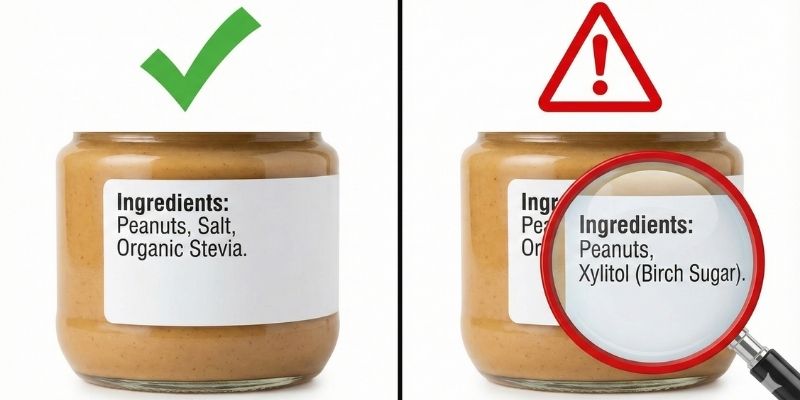 The difference between chemical solvent extraction (Hexane/Methanol) and safe, organic water-based processing for stevia
This is the most important section of this entire article. Please, read this carefully. The reason you are anxious about stevia is likely because you have heard horror stories about artificial sweeteners killing dogs. Those stories are almost always about Xylitol.
Manufacturers are getting clever. As consumers catch on to the word "Xylitol," companies are rebranding it as "Birch Sugar", "Wood Sugar," or even just "Sugar Alcohol." If you see any of these words on a peanut butter jar or yogurt cup, that product is a loaded gun for your dog.
The Mechanism of the Crash
Here is the physiology: In humans, xylitol absorbs slowly and doesn't affect insulin. In dogs, xylitol is absorbed rapidly into the bloodstream—often within 30 minutes. The dog's pancreas mistakes the xylitol for a massive influx of real sugar and releases a catastrophic surge of insulin to combat it.
Because there was no actual sugar to burn, this insulin spike depletes the dog’s existing blood sugar, causing hypoglycemia. This can happen in as little as 10 to 60 minutes.
Symptoms of Xylitol Poisoning:
- Vomiting (usually the first sign)
- Loss of coordination (ataxia) or stumbling
- Collapse
- Seizures
- Liver Necrosis (acute liver failure)
Why this matters for Stevia users: Many products labeled "Stevia Blend" or "Natural Sweetener" are actually cut with xylitol to make them cheaper and bulkier. If you assume "Stevia" on the front means "Safe," you might miss the "Xylitol" on the back. This is why being an "Anxious Label-Reader" is a badge of honor—it saves lives.
🌿 The Organic Imperative:
Why Process Matters
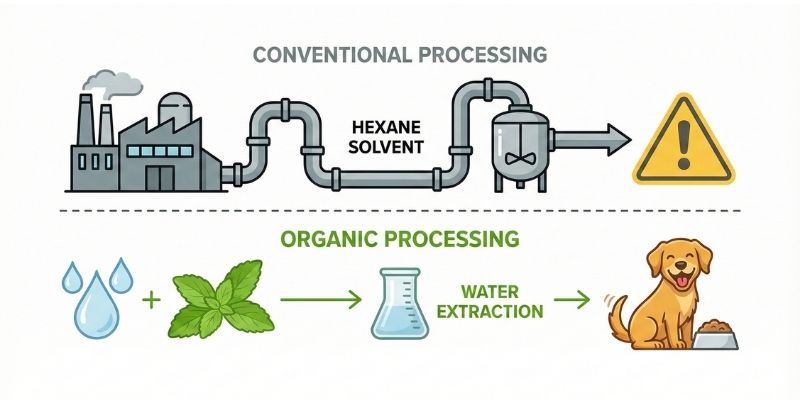 Visual comparison: Identifying safe Organic Stevia versus the lethal imposter, Xylitol (often labeled as Birch Sugar).
Once you have confirmed there is no Xylitol, the next question is quality. Why should you care about organic stevia for a dog? Isn't stevia a plant?
As a student of agriculture, I can tell you that the journey from leaf to white powder is chemically intensive. In conventional (non-organic) processing, manufacturers need to strip the sweet glycosides from the leaf matter efficiently. To do this, they often use chemical solvents.
The Hidden Chemicals: Hexane and Methanol
Conventional processing often utilizes Hexane, a solvent derived from petroleum refining, or methanol. While the FDA sets limits on how much residue can remain in human food, these standards are based on a 150-pound human adult.
Consider your dog. Their bodies are smaller, their metabolisms are faster, and their livers are often more sensitive to chemical insults. Why introduce even a micro-dose of a petroleum solvent into their system if you don't have to?
The Organic Solution
Certified organic stevia is produced under strict regulations that prohibit the use of these harsh synthetic solvents. Organic certification usually mandates extraction using water or food-grade alcohol (ethanol), which evaporates cleanly.
By choosing organic stevia, you are ensuring:
1. No Pesticides: The leaves were grown without synthetic pesticides that can bioaccumulate in your dog’s tissues.
2. Clean Extraction: No hexane or methanol residues.
3. Non-GMO: Organic standards prohibit Genetically Modified Organisms.
It is the purist & uncompromising choice. If you wouldn't let your dog drink from a puddle near a gas station, don't feed them a sweetener processed with petroleum byproducts.
🕵️♀️ Label Detective:
Fillers and "Natural" Flavors

Pure stevia extract is 200 to 400 times sweeter than sugar. A teaspoon of pure extract would be overwhelmingly sweet. To make it spoonable (like sugar), companies mix it with "fillers" or bulking agents. This is where the "Anxious Label-Reader" needs to look closely.
Maltodextrin & Dextrose
These are starches, usually derived from corn or wheat.
- The Trap: If you are avoiding sugar because your dog is diabetic or overweight, these fillers defeat the purpose. Dextrose is glucose. Maltodextrin has a higher glycemic index than table sugar! They will spike your dog's blood sugar.
- The GMO Factor: Unless the product is organic, that corn-based filler is likely genetically modified and treated with herbicides like glyphosate.
Erythritol
You will often see Erythritol paired with stevia (like in Truvia).
- Is it safe? Generally, yes. Erythritol does not cause the deadly insulin spike that Xylitol does.
- The Side Effect: It is a sugar alcohol that is notorious for causing "gurgly gut," gas, and diarrhea in dogs. It isn't toxic, but it isn't comfortable for them.
Brand Watch:
- Truvia: Mostly Erythritol. Safe from toxicity, but watch for tummy aches.
- Stevia in the Raw: Often contains Dextrose (Sugar). Not suitable for diabetic dogs.
- SweetLeaf: Often uses Inulin (fiber) or silica. Usually a safer, cleaner bet if you must use a sweetener.
🍗 The Root Cause: Why Are
We Sweetening?
Let’s take a step back and talk friend-to-friend. Why are we reaching for the sweetener for our dogs?
Usually, it's because we are trying to get them to eat their food, or we are sharing our own "diet" foods (like yogurt or peanut butter) with them. I get it—I’ve spent cold mornings on the farm trying to coax a picky animal to eat. But dogs do not crave "sweet" the way humans do; they are driven by the smell of fat and protein.
If you need to add sweeteners to get your dog to eat, it’s a red flag that their foundational diet might be lacking in palatability or nutrition. High-quality, organic dog food is formulated to be naturally delicious to canines without the need for sugary disguises.
Nature’s Sweeteners
Instead of a processed white powder, why not look to the garden?
- Blueberries: High in antioxidants and naturally sweet.
- Sweet Potatoes: Great fiber and beta-carotene (found in many premium organic dog foods).
- Carrots: Crunchy, sweet, and great for teeth.
These whole foods align with the preforganic.com philosophy: whole, unadulterated, and straight from the earth.
🏁 Conclusion: The Safe
Path Forward
So, can dogs have stevia? Yes. If it is pure, organic stevia, it is safe and non-toxic.
But the most important takeaway from my research is this: Vigilance is love. The real danger isn't the stevia leaf; it is the industrial ecosystem surrounding it—the deadly Xylitol/Birch Sugar hiding in the ingredients list, and the chemical solvents used in non-organic processing.
As a proactive protector of your pet, your best strategy is to read every label, every time. Avoid blends, avoid anything with "xyl" in the name, and prioritize organic stevia to ensure purity. Ultimately, though, the best treat you can give your dog isn't a sweetened chemical simulation—it's a life lived closer to nature, with whole, organic ingredients and a diet that nourishes them from the inside out.
🔗 Top 3 Sources for
Further Reading
- The ASPCA Poison Control Center is the gold standard for toxicity data. This page provides the definitive veterinary consensus that Stevia rebaudiana is non-toxic to dogs, cats, and horses.
- An essential government resource detailing the specific dangers of Xylitol (Paws Off Xylitol), distinguishing it clearly from safe sweeteners like Stevia.
- A comprehensive breakdown by the American Kennel Club regarding which artificial sweeteners are safe versus toxic, helping owners navigate the confusing "sugar-free" landscape.

Meet Saqib
Saqib Ali Ateel is a PhD Scholar by training and a "student of the soil" by nature. He combines deep research, hands-on farming wisdom, and agricultural systems supervision to reveal what’s really on your plate. His mission is simple: to help your family navigate the food industry's complexity so you can eat cleaner, safer, and smarter.