The 2026 Truth About Glyphosate in Organic Food: A
Farmer’s PhD Review
Let’s be real: Organic certification doesn't build a glass dome over my fields to stop the wind—which means it cant promise a zero-residue bubble for your dinner plate, either.
You pay the organic premium to keep chemicals out of your kids' breakfast bowls, so the idea that weedkiller might be sneaking in anyway is enough to make your stomach churn.
Here is the reality for 2026: We live on a shared planet. Wind and water do not respect property lines. However, as a PhD scholar reviewing the pivotal data released over the last twelve months, and a farmer watching the seasons change, I can assure you of one thing: Organic remains the single most effective tool for detoxification.
While agencies like the EPA maintain their safety stance, the landmark 2025 Global Glyphosate Study has fundamentally shifted our understanding of risk. We’ll put a real number on that risk, show you exactly where the safety net has holes, and give you a cheat sheet to spot the safest oats and grains on the shelf. 🛡️
2026 Action Plan: Key Safety Takeaways
-
🚫 The "Safe Dose" Myth is Broken:
New 2025 research confirms that even trace levels of glyphosate—previously considered safe—are linked to early-onset leukemia and microbiome damage. The old safety buffers are gone. -
📉 Rapid Detox Works:
The Nutrire Study (2025) proves that switching to an organic diet reduces urinary pesticide levels by 98.6% in just two weeks. Your body can heal if you cut the source. -
🌾 Prioritize the "Dirty Three":
If you are on a budget, you must buy organic for Oats, Wheat, and Legumes. These crops are often desiccated (dried) with weedkiller just days before harvest. -
✅ Look for the "Outcome" Seal:
Standard Organic certification only monitors the process. To avoid wind drift contamination, look for the "Glyphosate Residue Free" seal to verify the actual outcome.
The Core Question: Does Organic Food Contain Glyphosate?
The short answer: Sometimes, but usually at trace levels.
The long answer: We must look at the soil and the sky. ☁️
Why "Organic" Doesn't Mean "Zero"?
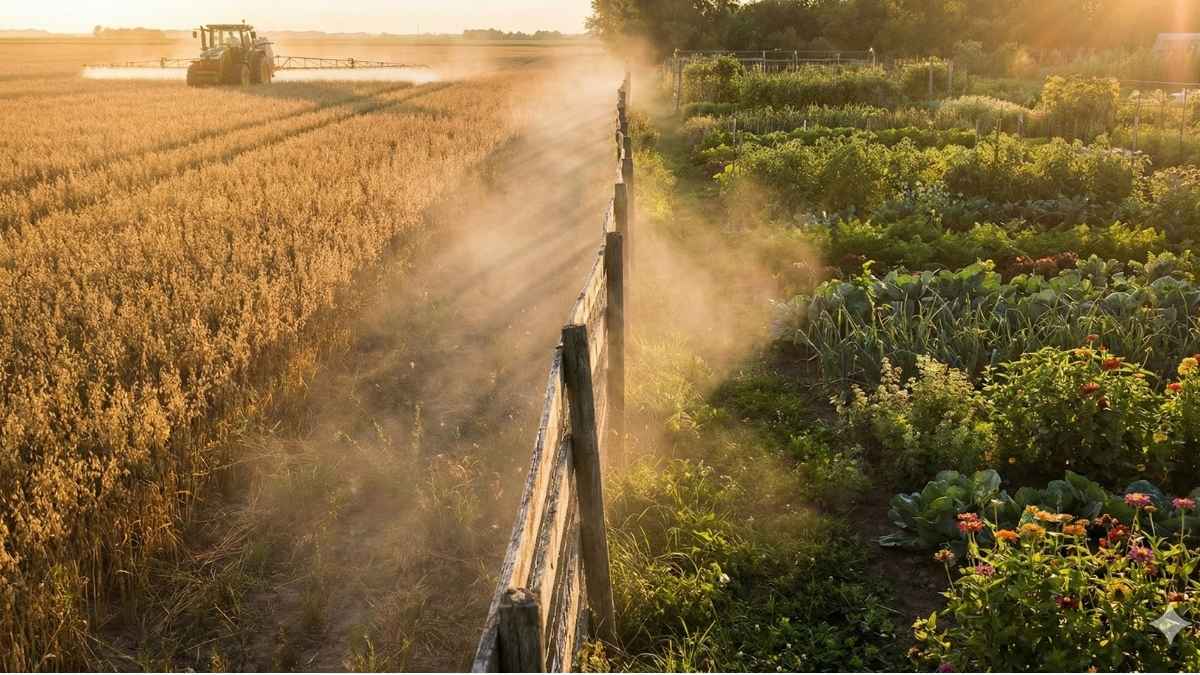 The "Glass Dome" Myth: Pesticides bind to dust and water droplets, traveling miles to contaminate "pristine" organic environments.
As a farmer, I know that if my neighbor sprays on a windy day, my fields are at risk. This is called Atmospheric Deposition. Pesticides bind to dust and water droplets. They move through the atmosphere to contaminate "pristine" environments.
- The Science: A major study published last year in Water Research found over 80 pesticide substances in streams located within protected nature reserves.
- The Reality: Even if an organic farmer follows every rule, the environment can encroach on their crop.
The "Legacy" Problem: Soil Persistence
There is a myth that glyphosate biodegrades instantly. The data suggests otherwise. The herbicide can persist in soil for months or years depending on soil chemistry. A farmer converting to organic today might still be fighting the "legacy" residues of conventional farming practiced years ago.
The Data: How Much is Actually in There?
Contamination happens. But the magnitude is what matters for your health. The difference between "accidental drift" and "deliberate spraying" is massive. 📉
Comparison of Residues: Drift vs. Desiccation (2024–2025 Data)
Our Perspective:
Conventional crops are often sprayed days before harvest. This "Desiccation" process kills the crop for easier processing. The chemical is systemic—it goes inside the grain. Organic residues are typically surface-level drift and are orders of magnitude lower.
⚠️ The "Cocktail" Warning: Glyphosate rarely travels alone. Investigations by the EWG found Chlormequat chloride—a reproductive toxin—in over 90% of oat-based foods tested.
Why "Trace" Levels
Matter When Testing Glyphosate in Organic Food?
For years, regulators said, "the dose makes the poison." They argued trace levels were harmless. Research concluded in late 2025 has dismantled this assumption. 🚫
1. The Leukemia Link at "Safe" Doses
The most concerning development comes from the Ramazzini Institute.
🛑 Key Finding (2025):
- The Risk: Early-onset leukemia observed in rats.
- The Dose: 0.5 mg/kg/day.
- The Context: This dose is currently deemed "safe" (Acceptable Daily Intake) by EU authorities.
- The Implication: If "safe" doses trigger early-life cancer, the regulatory safety buffer does not exist.
2. The Gut-Brain Axis & Anxiety
We often focus on cancer. But the immediate effect of glyphosate is on the microbiome. 🧠
- Mechanism: Glyphosate acts as an antibiotic. It selectively kills beneficial bacteria like Bifidobacterium pseudolongum.
- Mental Health Impact: A 2025 study in Frontiers in Toxicology showed this bacterial depletion reduces serotonin production.
- The Result: In animal models, this led to a significant increase in anxiety-like behaviors.
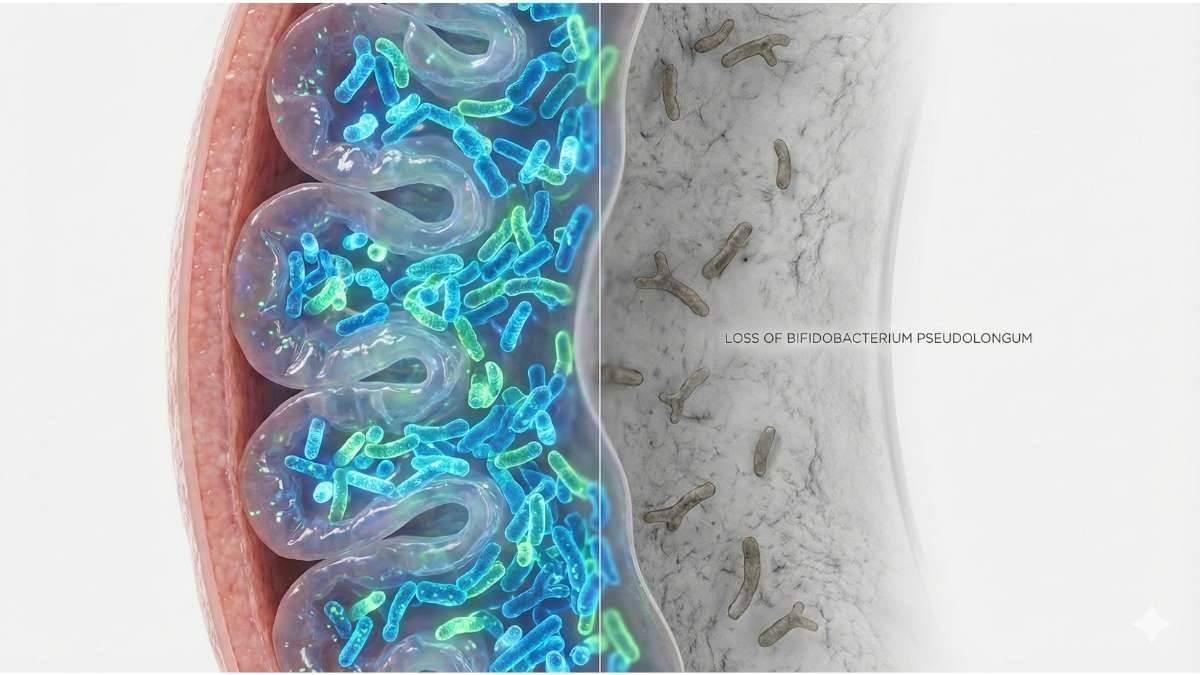 The Antibiotic Effect: Glyphosate selectively kills beneficial bacteria like Bifidobacterium, which can reduce serotonin production and trigger anxiety.
Regulatory Loopholes: Why the USDA Seal Isn't Enough
If organic food can have residues, why does it get the seal? This comes down to "Process" vs. "Outcome."
The USDA's "5% Rule" Explained
The USDA National Organic Program (NOP) certifies the process. No spraying is allowed. However, they acknowledge drift and allow for "Inadvertent Residues".
- The Math: Products can be organic if residues are less than 5% of the EPA tolerance.
- The Loophole: The EPA tolerance for oats is huge (30,000 ppb). 5% of that is 1,500 ppb.
- The Reality: Technically, "organic" oats could contain 1,500 ppb of glyphosate and remain legal.
The Rise of "Glyphosate Residue Free"
To close this gap, private certifications like The Detox Project have stepped in. Their seal requires testing below the Limit of Detection (<10 ppb). This certifies the outcome, not just the process. ✅
Does Eating Organic Actually Work?
With all this news about drift, is it worth the money in 2026?
Yes. And we have the data to prove it.
📉 The Detox Effect (Nutrire Study, 2025)
A landmark clinical trial followed participants switching to fully organic diets.
✅ The Result: Urinary pesticide levels dropped by an average of 98.6%.
✅ Timeframe: Within just two weeks.
✅ Takeaway: Your body is efficient. If you stop the intake, your system clears the burden rapidly.
The "Location Effect" Warning
Crucial research in Environmental Health Perspectives added a nuance:
- Far from farms (>0.5km): Organic diet works dramatically.
- Near farms (<0.5km): Ambient exposure blunts the benefit. Air and water filtration become essential here. 🏡
Source: Urinary Glyphosate Concentrations among Pregnant Participants in a Randomized, Crossover Trial of Organic and Conventional Diets (Hyland et al.)
Action Plan: Protect Your Family in 2026
You cannot control the wind. But you can control your pantry. Here is a tiered framework.
Tier 1: High-Priority Swaps 🌾
If you are on a budget, only buy organic for these three categories. These are the crops most often legally desiccated with glyphosate.
 The "Dirty" Three: Oats, Wheat, and Legumes are legal to spray just days before harvest. Always buy these organic.
1. Oats (The Highest Risk)
Oats have historically shown the highest levels of contamination due to pre-harvest spraying. While the industry is shifting, risks remain.
- The Strategy: Avoid generic organic brands. Look for "Glyphosate Residue Free".
- Deep Dive: 👉 Best Brands of Oat Milk here.
2. Wheat (Bread, Pasta, Crackers)
Like oats, wheat is often sprayed to dry it out for harvest. This is common in the northern US and Canada.
- The Strategy: Switch to organic sourdough. The fermentation process can help degrade some pesticide residues and improves gut digestibility.
3. Legumes (Chickpeas, Lentils, Hummus)
Legumes are indeterminate growers (they don't ripen all at once), so farmers use glyphosate to force them to dry.
- The Strategy: Dried organic beans are safer and cheaper than canned conventional ones.
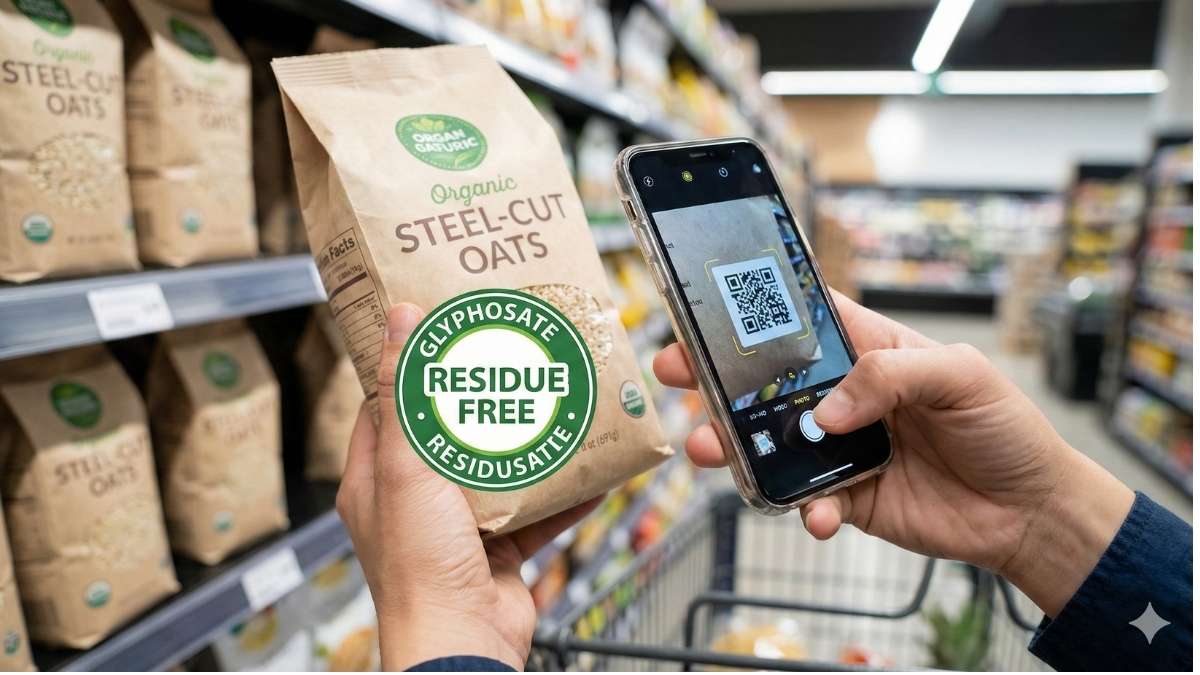 Process vs. Outcome: Standard organic seals certify the farming process. The "Residue Free" seal tests the actual outcome in the bag.
Tier 2: Verification Beyond the Label 🔍
Don't just trust; verify.
- Look for the "Glyphosate Residue Free" seal.
- Buy from brands that use QR codes to show exact test results for your batch.
Tier 3: Biological Support 🦠
You will be exposed to trace levels. It is unavoidable.
The Strategy: Fortify your microbiome. Consume fermented foods like sauerkraut and kefir. This directly counteracts the bacteria depletion caused by glyphosate.
FAQ: Answering Your Burning Questions
Q: Can you wash glyphosate off organic produce?
A: No. Glyphosate is systemic and water-soluble. It is absorbed into the plant tissue. Washing removes dust, but not what is inside the grain.
Q: Does cooking destroy glyphosate?
A: No. Glyphosate is heat-stable. Studies on cookies show oven temperatures (approx 100°C internal) are too low to break the chemical bond.
Q: Why is glyphosate in my water?
A: It comes from agricultural runoff and urban sources. Surprisingly, recent research links it to the degradation of certain laundry detergents in wastewater.
Conclusion: You Have Agency
The science is clear. Risks exist at low doses. The regulatory safety net has holes. But the solution is also clear.
Switching to organic reduces your body's pesticide burden by nearly 99%. That is a victory you can claim today. You don’t need to find a magical, zero-residue unicorn to keep your family safe—just blocking the worst offenders at the checkout counter gets you 99% of the way there. Make the high-priority swaps, and take a deep breath—the science proves your body can flush out the burden in days, not years. 💪

Meet Saqib
Saqib Ali Ateel is a PhD Scholar by training and a "student of the soil" by nature. He combines deep research, hands-on farming wisdom, and agricultural systems supervision to reveal what’s really on your plate. His mission is simple: to help your family navigate the food industry's complexity so you can eat cleaner, safer, and smarter.
- Home
- Clean Coffee Guide
- Best Organic Coffee Brands
- Organic Mold Free Coffee
- Glyphosate in Organic Food