The Invisible Load: Why Organic is Your Mathematical
Defense Against Heavy Metals in Food vs. Organic Safety Standards
You’re standing in the store, holding two identical bags of carrots, conventional and organic. You see the headlines about toxic elements, and a single, heavy thought lands: is this expensive organic label truly worth the investment, or am I being played? When facing the threat of heavy metals in food, the simple truth is that confusion paralyzes action.
As a PhD Student in agriculture who grew up gardening, I understand this deep-seated skepticism. It feels like your family’s health is a vessel—a "bucket"—that is slowly and invisibly filling with environmental toxins, what we call the "Chemical Load." You are the Proactive Protector, and your goal isn't magical purity; it is scientifically verifiable load reduction.
My goal here is simple: to share what my research and hands-on experience show is the mathematical difference the organic choice makes. This guide gives you the precise facts and actionable solutions you need to turn off the largest toxic faucets once and for all.
Stop Worrying: Your Action Plan for Reducing Toxic Load Today
- 🧠 Know the Enemy: Understand exactly how Lead sabotages brain signaling and how Arsenic starves cells of energy.
- 🛡️ Find the Mathematical Defense: Learn why the strict organic prohibition of sewage sludge is the single most important rule protecting your family from rising heavy metal accumulation in soil.
- ⚖️ Shop Smart: Use the Clean Fifteen strategy to save money and redirect your budget toward the highest-impact interventions.
- 🌿 Power Your Detox: Discover three purity-tested supplements—Zeolite, Chlorella, and Modified Citrus Pectin—that help your body safely bind and eliminate unavoidable toxins.
- 💪 Gain Control: Move from paralyzing fear to empowering, evidence-based kitchen tactics that create a resilient, low-toxin lifestyle.
I. The Deep Stakes: Toxicology of the Invisible Load
We cannot defend against what we do not understand. The metals we are concerned with are toxic because they perform molecular sabotage, confusing our body's essential systems. This section isn't meant to cause alarm; it's here to provide the precise knowledge that justifies your proactive choices.
Lead (Pb): The Molecular Mimic and Neurotoxicant
Lead is a xenobiotic metal. That’s a scholar’s way of saying it has absolutely zero necessary function in the human body. The toxicity of Lead is insidious, however, because it's a master of atomic mimicry.
The Lead cation (Pb²⁺) has a structure almost identical to the Calcium ion (Ca²⁺). This structural similarity allows Lead to act as a molecular Trojan Horse, hijacking the body’s essential calcium transport channels. Once ingested, Lead easily penetrates the Blood-Brain Barrier (BBB), particularly vulnerable in the young. Inside the central nervous system, Lead actively disrupts synaptic transmission. It binds to calcium-dependent regulatory proteins like calmodulin with a much higher affinity than calcium itself. This effectively "dims" the signaling capacity of the brain, leading to measurable cognitive deficits and behavioral disorders.
In my research, I found the multigenerational risk particularly compelling. The body attempts to hide Lead by storing it in the skeletal system, where it substitutes for calcium in the bone matrix. This accumulated Lead can then be mobilized back into the bloodstream during times of high bone turnover, such as pregnancy and lactation. This mechanism underscores why reducing your current Chemical Load is a profound, long-term act of protection.
Arsenic (As): The Metabolic Thief
Arsenic, a metalloid often found in inorganic forms in rice and water, employs a different, but equally devastating, strategy: it steals the cell’s energy.
Inorganic Arsenic mimics Phosphate (PO₄³⁻). During cellular respiration in the mitochondria, where our energy is made, Arsenic competes directly with phosphate during the synthesis of Adenosine Triphosphate (ATP). Instead of forming stable, usable ATP, the cell mistakenly forms unstable molecules that instantly break down. This process "uncouples" oxidative phosphorylation, starving the cell of the energy needed for processes like DNA repair and detoxification. This energy depletion, combined with Arsenic's ability to inactivate critical antioxidant enzymes, leads to genomic instability and explains why it’s classified as a Group 1 Carcinogen.
II. The Organic Shield: The Sewage Sludge Prohibition
You ask: "Is Organic Really Organic?" This is where the core of the defense lies. Organic certification provides a verifiable, mathematical defense because it closes the door on the largest preventable source of heavy metals.
MRLs: From Speed Limit to Forensic Tripwire
For decades, conventional agriculture relied on the Maximum Residue Limit (MRL) for food safety. The MRL functions as a regulatory speed limit. If a conventional food tests below the MRL, it’s legally compliant and deemed "safe." This is a boundary of legality, not an assurance of biological safety.
As a PhD Student studying food safety policy, I see the genius in the National Organic Program (NOP) because it repurposes the MRL as a forensic tripwire.
The NOP mandates testing. If a prohibited synthetic pesticide is detected above a tiny threshold, it triggers a mandatory investigation and is treated as evidence of a compliance failure—a "crime scene," not an acceptable tolerance. This distinction is crucial for the Proactive Protector who demands assurance.
The Core Defense: Sewage Sludge Prohibition
The single most significant protection organic certification offers against rising heavy metal concentrations—specifically Lead, Cadmium, and Mercury—is the explicit prohibition of Biosolids (Sewage Sludge).
Growing up on a farm taught me that you must choose your inputs carefully. Conventional farming often uses treated municipal sewage sludge as a fertilizer. But sewage sludge is a concentrated sink for non-degrading industrial contaminants that flow into our municipal systems: heavy metals, pharmaceutical residues, and persistent chemicals.
Because these heavy metals are elements, they don't break down; they accumulate permanently in the topsoil when sludge is applied. The Organic Shield—mandated by USDA regulation (7 CFR § 205.105)—explicitly prohibits this practice.
By preventing the continuous introduction of new metal loads via sludge, organic farming is statistically less likely to see rising heavy metal levels compared to conventional farms. Acknowledge the complexity: organic fields cannot remove metals from historical sources like leaded gasoline or natural geology. But they stop the toxic inflow. Preventing the problem from getting worse is the best defense. These are the benefits of eating organic food, clearly proven by regulation.
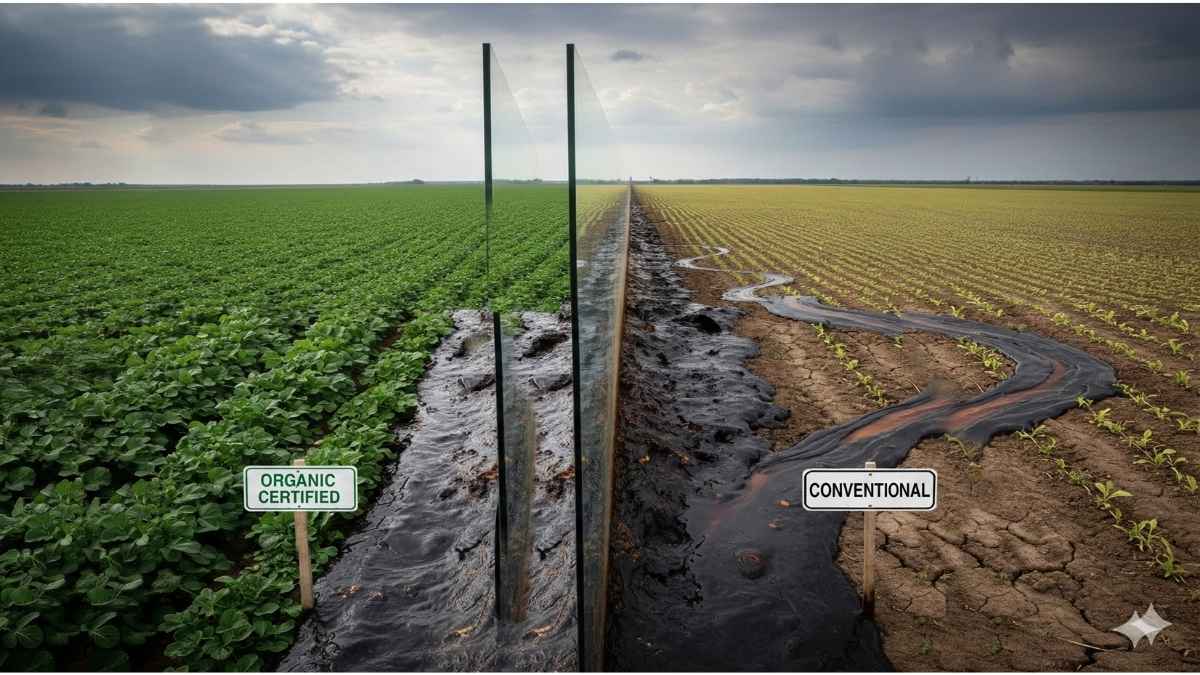 The "Organic Shield": USDA regulation (7 CFR § 205.105) prohibits the use of sewage sludge, preventing the accumulation of industrial heavy metals in topsoil.
III. Agronomic Strategy: The Clean Fifteen Overlay
The Proactive Protector must shop strategically. Since we excluded the high-pesticide risk Dirty Dozen (which should always be organic), let’s focus on the Clean Fifteen—the foods where buying conventional is a smart way to save money.
These crops—like Avocados, Sweet Corn (Non-GMO), Onions, and Pineapples—possess thick skins or husks that act as a natural barrier, protecting the edible portion from sprays. By purchasing these conventionally, you redirect your grocery budget to the truly high-impact organic items and quality proteins. This empowers you to manage the total Chemical Load while staying within budget.
IV. The Heavy Metal "Watch List" and Mitigation
 Actionable Defense: Deeply peeling root vegetables and using a 6:1 water ratio for rice can significantly reduce exposure to legacy soil contaminants.
Heavy metals follow soil chemistry, not just farming labels. To manage the risk of foods high in heavy metals, you must implement specific mitigation tactics that go beyond the organic label.
1. Rice and Arsenic: As the PhD Scholar, I can tell you the rice plant is a hyper-accumulator because it absorbs it efficiently through its silicon transporters in flooded soil. Organic certification does not remove geological Arsenic. Action is required. Rinse rice thoroughly until the water runs completely clear. Cook it using a high water-to-rice ratio (e.g., 6:1, like pasta), and immediately drain the excess water. This simple step can reduce Arsenic content by 40–60%. Furthermore, rotate your grains, favoring Quinoa, Millet, or Amaranth, which accumulate significantly less Arsenic.
2. Root Vegetables and Lead/Cadmium: Carrots, Sweet Potatoes, and Turnips grow in direct contact with the soil. Any legacy Lead (from old old paint or past pollution) or Cadmium will concentrate in the peel. Action: Always peel all root vegetables deeply. As a Trusted Friend, I would caution you: do not use the peels for broth or stock if you suspect the soil source.
V. Internal Resilience: Supporting Your Detox Pathways
Since zero exposure is impossible, the body's internal detoxification system is your second line of defense. We can support this system nutritionally and strategically.
Detoxification occurs primarily in the liver through three highly specialized phases:
- Phase I (Transformation): Enzymes modify fat-soluble toxins, making them more reactive (free radicals) to prepare them for Phase II. Support: You need potent antioxidants, like Vitamin C, Vitamin E, and B-Vitamins, to protect the liver from the resulting oxidative stress.
- Phase II (Conjugation): The liver attaches a harmless, water-soluble molecule—like Glutathione or Sulfur—to the reactive intermediate, safely "packaging" it for excretion. Support: Glutathione is essential for binding metals like Mercury and Lead. Sulfur-rich foods like broccoli, cauliflower, onions, garlic, and eggs provide the essential raw materials for these pathways.
- Phase III (Elimination): The packaged, water-soluble toxins are transported out of the liver for elimination via bile (stool) or urine. Support: Fiber and hydration are absolutely non-negotiable. If elimination is sluggish, packaged toxins can be re-absorbed from the gut, forcing the liver to redo the work.
VI. Targeted Support: The Molecular Binding Strategy
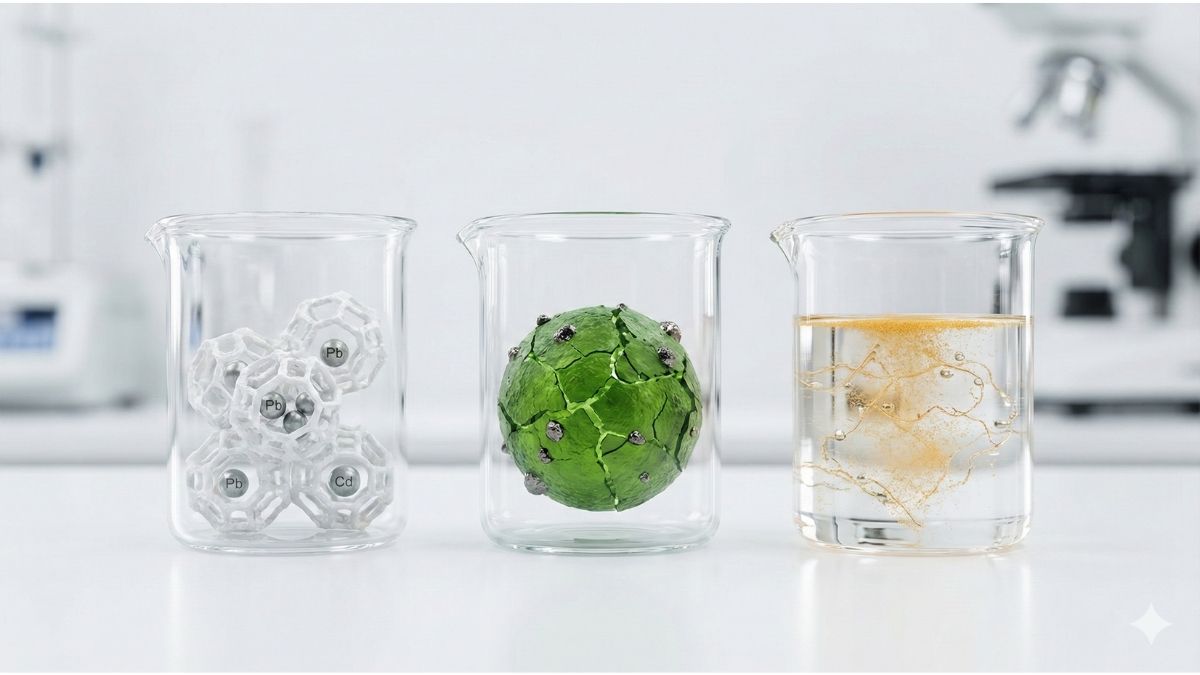 Targeted Support: Strategic use of purity-tested binders like Zeolite and Chlorella helps trap and remove heavy metals from the body via ion exchange.
To enhance the elimination of heavy metals that have already crossed into the body, strategic supplementation acts as a molecular binding and clean-up crew. These products must be sourced with extreme scrutiny for purity.
1. Zeolite (Clinoptilolite): The Molecular Cage
Zeolite is a naturally occurring volcanic mineral with a unique, negatively charged, cage-like structure. It is designed by nature to trap heavy metals.
- Mechanism: Its negative charge acts like a molecular magnet, attracting and trapping positively charged heavy metal ions (Lead²⁺, Mercury, Cadmium) via Adsorption and Ion Exchange. It locks the metal inside its structure and carries it safely out via stool.
- Quality Marker: Look for Micronized or Nano Zeolite. My research suggests smaller particle size translates directly to a greater binding surface area and systemic reach.
2. Chlorella: The Green Binder
Chlorella is a single-celled freshwater algae. It is essential to treat Chlorella as a purification tool, not just a food.
- Mechanism: Its tough cell wall contains polysaccharides that possess a high affinity for binding heavy metals in the digestive tract, actively preventing their re-absorption.
- Quality Marker: USDA Organic certification is mandatory. Chlorella aggressively absorbs substances from its environment; if grown in dirty water, it concentrates toxins. Furthermore, insist on "Broken Cell Wall" or "Cracked Cell Wall" Chlorella to ensure the binding sites are digestible and available.
3. Modified Citrus Pectin (MCP): The Systemic Chelator
Modified Citrus Pectin (MCP) is chemically altered from regular citrus pectin to reduce its molecular size, allowing it to move from the gut into the bloodstream for systemic action.
- Mechanism: MCP specifically binds to heavy metals (Arsenic, Lead, Cadmium) circulating in the body. Clinical evidence shows it promotes the urinary excretion of these toxic elements without depleting essential minerals like Calcium or Zinc.
- Quality Marker: Seek brands that confirm a low molecular weight (ideally under 15 kilodaltons) to guarantee the systemic effect.
Conclusion: Protection Rooted in Science, Not Fear
The Proactive Protector’s journey is one of continuous, intelligent action. We began with the core question: is the organic choice a true defense against heavy metals in food? The answer is a resounding yes, rooted in mathematical probability and legal mandate.
You cannot scrub the earth’s crust of geology, but you can choose a system that prevents the continuous, man-made addition of non-degrading toxins. By demanding organic certification, you enforce the prohibition of sewage sludge, shutting off the single largest preventable faucet of heavy metal contamination.
This final assurance is your empowerment: combine the regulatory certainty of organic with the actionable steps of kitchen mitigation (rice washing, root peeling) and biological support (detox supplements). You are not protected by luck; you are protected by science and verifiable action.
Further Reading
1. Understanding USDA Organic Requirements and Prohibited Materials: This page from the USDA's National Organic Program details the substances and methods that are prohibited under organic certification, specifically listing the ban on sewage sludge (biosolids), irradiation, and genetic engineering (GMOs).
2. Heavy Metal Toxicology and Contamination in Common Foods: This academic review discusses the global health concern of heavy metal contamination (including lead, arsenic, and cadmium) in food, outlining sources, health impacts, and nature-based solutions like bioremediation to mitigate risk and exposure.
3. The Scientific Argument for Organic Food and Lower Toxic Load: This study specifically investigates the accumulation characteristics of heavy metals, including cadmium (Cd), in organic farm soil compared to conventional agriculture, concluding that organic agricultural soils generally have lower heavy metal concentrations and lower ecological risks.

Meet Saqib
Saqib Ali Ateel is a PhD Scholar by training and a "student of the soil" by nature. He combines deep research, hands-on farming wisdom, and agricultural systems supervision to reveal what’s really on your plate. His mission is simple: to help your family navigate the food industry's complexity so you can eat cleaner, safer, and smarter.
- Home
- Why Toxic Foods?
- Heavy Metals in Food
Cocktail Effect of Pesticides in Food