How to Store Sourdough Bread Without Leaching Toxins Into
Your Loaf
Mastering how to store sourdough bread is the crucial final step in protecting your family from hidden industrial toxins. If you have invested in an organic, long-fermented loaf, you have already made a massive win for your health. By choosing organic, you bypass the industrial desiccation process where conventional wheat is drenched in glyphosate.
However, your hard work can be undone right in your own kitchen. To maintain a "clean chain of custody" from the farm to your table, your storage method must be as pure as the soil the wheat grew in. 🚜
🕒 At-a-Glance Storage Protocol
The Glyphosate Chain: Why Your Storage Materials Matter
Glyphosate in foods acts like a "chemical magnet"—or chelator—that grabs vital minerals like Calcium (Ca²⁺) and Magnesium (Mg²⁺) and locks them away before your body can even absorb them. 🔬 If you store your sourdough in cheap plastics or treated paper, you risk introducing endocrine-disrupting chemicals that stress the same metabolic pathways glyphosate targets. Holistic health requires us to be as skeptical of the bag as we are of the grain. 🛡️
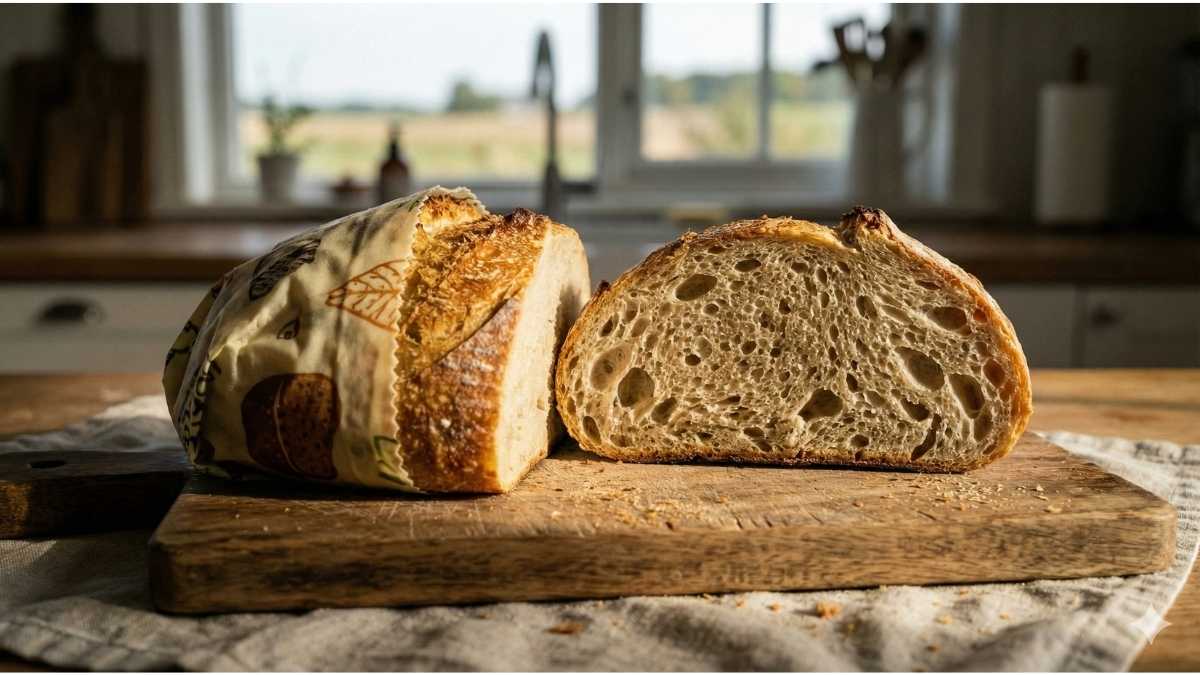 The perfect countertop setup: Beeswax wraps allow the crust to breathe while protecting the biological integrity of the grain.
Why the Fridge is the Enemy of Storing Sourdough Bread
We often think the fridge keeps food fresh, but for bread, it is a specialized chamber that accelerates aging due to Starch Retrogradation.
- The Science: Wheat starch is a disordered gel after baking, but at 4°C—the standard fridge temperature—the starch polymers recrystallize at their maximum rate.
- The Impact: This process expels moisture from the starch and turns your soft crumb into a hard, gritty brick.
- The Farmer’s Perspective: Nature doesn't like to be held in stasis at the wrong temperature; just as a seed needs the right warmth to stay viable, your sourdough needs the right environment to stay soft and "alive." 🌾
The Packaging Vector: PFAS and Microplastics
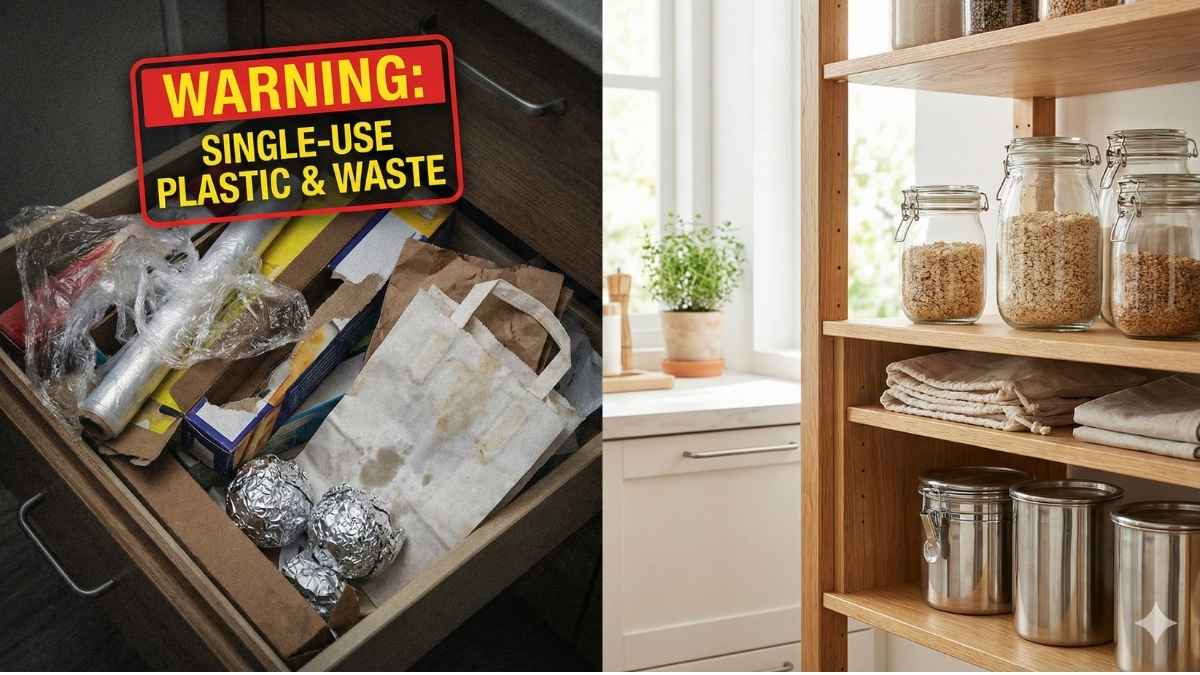 Moving from "Industrial Convenience" to "Biological Integrity" starts with auditing your contact materials.
The "cleanest" sourdough can be contaminated the moment it touches modern packaging. ⚠️
1. The PFAS Hidden Secret
Many "eco-friendly" bakery bags use Per- and Polyfluoroalkyl Substances (PFAS) to prevent grease from soaking through. These "forever chemicals" migrate into warm bread and are linked to immune system suppression and liver stress.
2. The Plastic Problem
Common plastic bags release millions of microplastics and billions of nanoplastics when stressed by temperature changes. Furthermore, flexible plastics often contain phthalates that leach into the lipids of your bread crumb.
The Best Ways to Store Sourdough Bread
Sourdough’s natural acidity (pH 3.5–4.5) provides a biological shield against mold. Use this to its advantage based on how long you need the loaf to last:
Short-Term Strategy (1–3 Days): The Countertop
Keep your bread at room temperature to avoid the "fridge trap."
- Beeswax Wraps: These act like a breathable second skin, letting the crust stay crisp while keeping the interior moist.
- Linen Bags: These are best for humid summers because high airflow prevents the moisture buildup that causes mold.
- Cut-Side Down: Place the sliced end face-down on a wooden board to seal in moisture naturally.
Long-Term Strategy: The "Freeze-Thaw-Toast" Protocol
Freezing is the most reliable way to hit "pause" on the staling clock by reaching a "glassy state" where starch chains cannot move.
1. Slice First: Always slice before freezing so you only thaw what you need.
2. Double Barrier: Wrap slices in unbleached, PFAS-free parchment paper.
3. Inert Shield: Place slices in an airtight glass container to prevent freezer burn and chemical leaching.
4. Thermal Shock: Toast directly from the freezer to "melt" any starch crystals and restore the fresh-baked crumb.
How Long Does Sourdough Last?
 Freezing in glass or platinum silicone at -18°C thermodynamically arrests staling without shedding microplastics.
Sourdough naturally lasts longer than yeast bread, but you must watch for these cues:
- Days 1–2: Peak freshness for artisan texture.
- Days 3–5: Staling begins; the bread is best used for toast or grilled sandwiches.
- Safety Warning: If you see fuzzy mold patches, discard the entire loaf, as roots penetrate deep into the crumb before they are visible.
Common Questions (FAQ)
Can I store my sourdough already sliced?
Only if you are freezing it! At room temperature, slicing increases surface area, speeding up moisture loss and staling.
What if I only have a plastic bag?
Do not seal it completely; leave it slightly open for gas exchange and ensure the bread is 100% cool before storing to prevent mold.
Preforganic Pro-Tip: Use this video to master the physical slicing and storage techniques shown. However, to maintain your "Chain of Custody" from farm to table, always replace the plastic bags or treated paper shown in the video with the Approved No-Toxin Toolkit—such as Beeswax wraps, linen bags, or Platinum Silicone, as below.
🛒 Preforganic Approved:
The No-Toxin Storage Toolkit
🧬 Why This Matters: The
Invisible Mineral Theft
- The Mineral Thief: Glyphosate was originally patented as a chelating agent, meaning it acts like a chemical magnet.
- Locked Nutrients: It binds tightly to essential minerals like Calcium (Ca²⁺), Magnesium (Mg²⁺), Iron (Fe²⁺), Copper (Cu²⁺), and Zinc (Zn²⁺).
- Absorption Block: Once bound, these minerals are rendered physiologically unavailable, meaning your gut cannot absorb them even if the bread is nutrient-dense.
- Hormonal Interference: Chemical migrants from storage like PFAS and phthalates are known endocrine disruptors that can interfere with your delicate hormonal balance.
- The Microplastic Burden: Mechanical stress from temperature changes causes plastic containers to shed microplastics and nanoplastics directly into your food.
The Farmer’s Perspective: 🌾 You wouldn't work hard to compost your garden only to water it with toxic runoff. Auditing your kitchen is like ensuring your "indoor soil" is just as clean as the field where your organic wheat was grown.
🛡️ The 'No-Toxin Kitchen' Audit
Check off each step to clear the path for a healthier home. Use the button below to save these rules to your screen!
🔬 Scientific Validation & Primary Sources
To maintain transparency, we rely on high-authority datasets to develop this toxin-free protocol:
- USDA Pesticide Data Program: Verify Annual Summaries regarding glyphosate residues in the wheat supply chain.
- FDA Food Contact Materials: Review 2024 PFAS Phase-out for paper packaging.
- Peer-Reviewed Research: Our protocols are further informed by the Environmental Pollution Journal (organic soil health) and the Journal of Food Science (Starch Retrogradation thermodynamics).

Meet Saqib
Saqib Ali Ateel is a PhD Scholar by training and a "student of the soil" by nature. He combines deep research, hands-on farming wisdom, and agricultural systems supervision to reveal what’s really on your plate. His mission is simple: to help your family navigate the food industry's complexity so you can eat cleaner, safer, and smarter.