How to Wash Organic Strawberries to Prevent Mold and Remove Field Residue?
When figuring out exactly how to wash organic strawberries straight from the farm, the first thing I do is check the clamshell lot numbers. Tracing those residue logs back to the soil data tells me exactly what biological amendments they used—because that sharp, sweet "fresh-from-the-farm" smell doesn’t mean the fruit is sterile.
Don't start with expensive produce sprays; start with what actually changes safety and shelf life. Washing at the wrong time, or leaving moisture hiding in the seeds, is exactly what makes mold explode in your fridge. Here is the FDA-safe baseline for eating right now, plus the precise vinegar-and-dry protocol to keep them firm for days.
| 🎯 Category | 🏆 The Winner | 📊 Key Metric | 👨🌾 The PhD Farmer Verdict |
|---|---|---|---|
| 🍽️ Immediate Eating | 💧 Cold Running Water | ⏱️ 20 Seconds | The FDA-recommended baseline. Mechanical friction removes field dirt and bacterial load. |
| 📅 3–5 Day Storage | 🍶 Vinegar Bath (1:3 Ratio) | 🧪 Acidity (pH Drop) | Best for dropping surface spore counts to prevent premature molding in the fridge. |
| 🛡️ Pesticide Paranoia | 🧂 Baking Soda Soak | ⚖️ Alkalinity | A 12-minute soak helps degrade certain organic-approved acidic field compounds. |
| 🐛 Bug Removal | 🌊 Salt Water Soak | 💥 Osmotic Shock | Forces small field larvae out of the fruit without harsh chemicals. |
🛑 The Blunt Answer: How to Wash Organic Strawberries?
The safest way to wash organic strawberries is to rinse them gently under cold running water in a clean colander right before eating, then pat them completely dry. Never use soap or commercial produce washes. For longer storage, soak them in a 1-part vinegar to 3-parts water solution.
- ✅ If you want the lowest price and highest safety: Plain cold water and gentle friction is your best tool.
- ✅ If you want extended flavor and firmness: Use the vinegar soak, dry them meticulously, and store in a ventilated glass container.
- ✅ If you are worried about soapy residues: Stick to water. Berry skin is highly porous; detergents will seep into the flesh and cause gastrointestinal distress.
Do Organic Strawberries Actually Need Washing? (The Deep
Science Bridge)
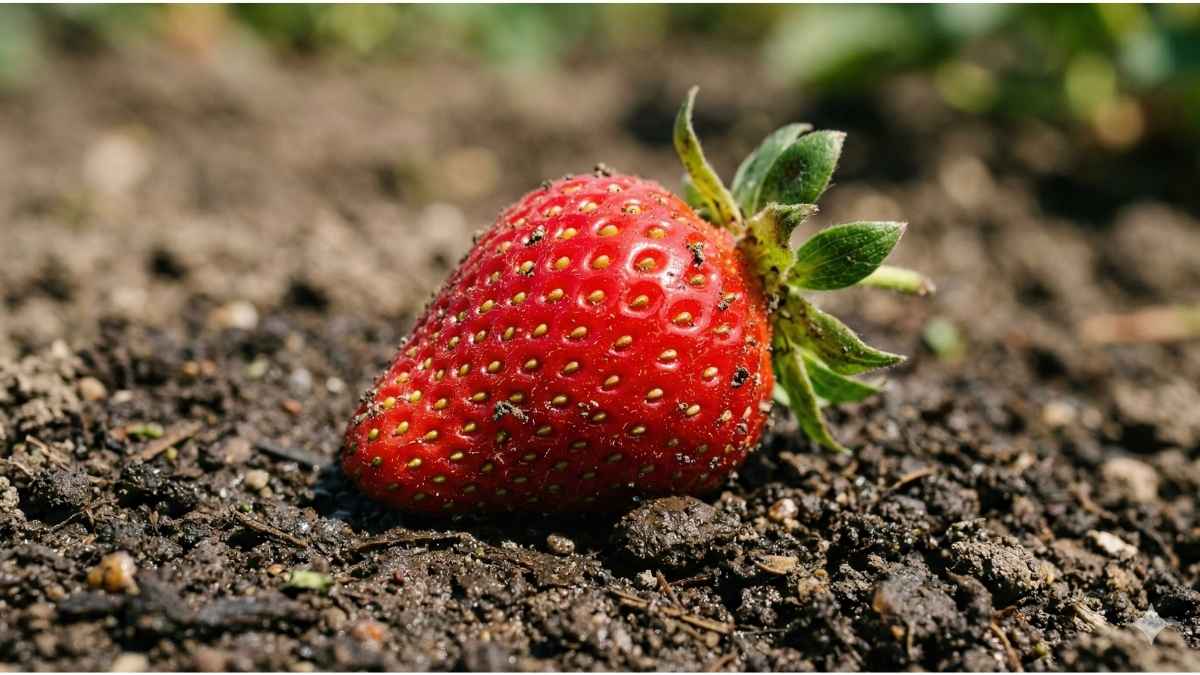 Organic farming uses biological soil amendments. Washing removes field residue and soil-borne microbes.
There is a persistent marketing myth that organic produce skips the washing phase because it is "chemical-free." Biologically, this is entirely false. Under the USDA National Organic Program (7 CFR Part 205), farms are legally permitted to use a specific National List of approved biological and botanical pest-control substances. "Organic" dictates how a crop is managed; it does not mean "never treated" or "dirt-free."
More importantly, you are washing for microbes, not just agricultural sprays. The biological reality is that soil-borne pathogens do not care about farm certifications. Listeria monocytogenes and highly contagious Norovirus—where it only takes a few microscopic particles to make you sick—can travel from field workers' hands to packing facility conveyor belts, and eventually to your kitchen counter. This is why the FDA produce safety rules apply equally to organic and conventional crops.
⚖️ The Truth Table: Regulations vs. Marketing Myths
| 🔍 Feature / Claim | 🔬 Scientific Reality (The Regs) | 🤥 Marketing Myth | 👨🌾 The PhD Farmer Verdict |
|---|---|---|---|
| 🧼 Produce Washes | The FDA explicitly states: "Do not use commercial produce wash products." | "You need special sprays for organic berries." | ✅ Save your money. Running water provides the necessary mechanical friction to dislodge gunk. |
| 🚿 Pre-Washing | Moisture accelerates mold growth. Wash only before eating or prepping. | "Wash everything as soon as you get home." | ✅ Only pre-wash if you are committed to the 100% thorough drying protocol. Otherwise, leave them unwashed. |
| 🌱 Organic Status | USDA organic regulations allow specific biological pesticides. | "Organic means zero pesticides and zero dirt." | ✅ Wash organic strawberries with the exact same rigor as conventional ones. |
Choose Your Wash Method: The Decision Tree (Mini-Reviews)
Before you touch your produce, wash your hands with soap and water for at least 20 seconds. This is the single most effective handling control to prevent cross-contamination from raw meats or everyday surfaces.
Method 1: The Plain Water Rinse (Best if Eating
Immediately)
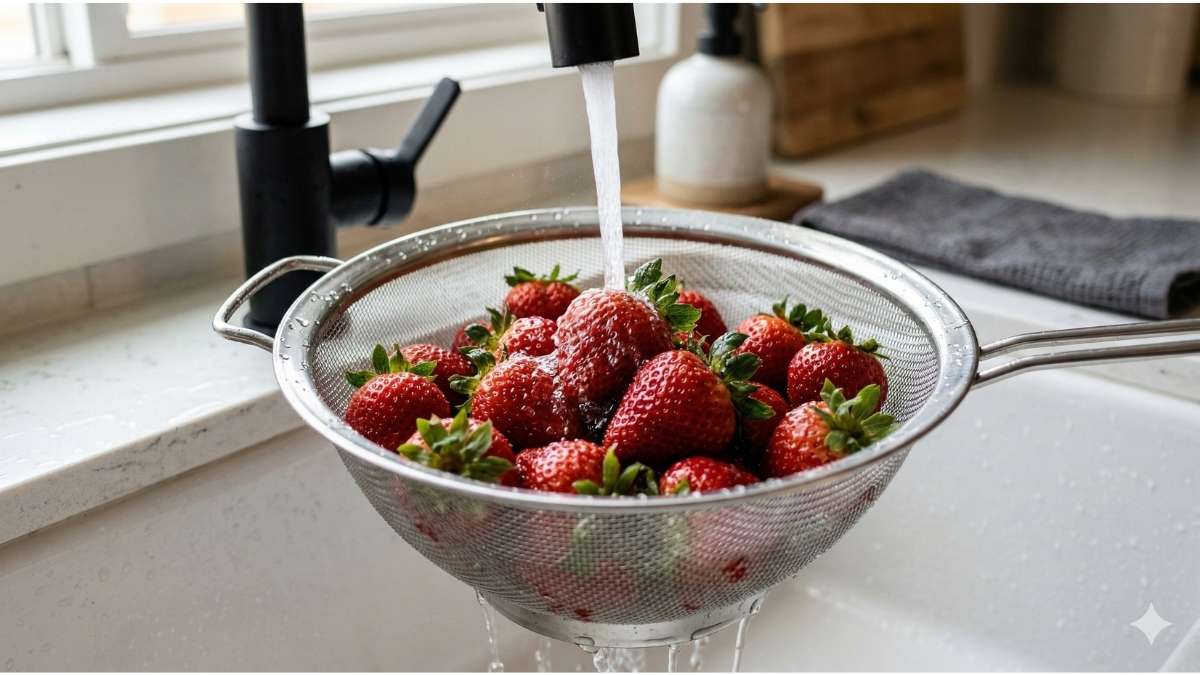 The physical friction of running water is the most effective way to remove soil and microbes without leaving chemical residues.
If you’d rather skip the chemistry lesson and just eat your harvest, here is the cheat sheet. A clean colander and a cold faucet are the only tools you need.
- The Science: This relies entirely on mechanical removal. The physical friction of water molecules striking the berry surface dislodges dirt, microbes, and loose field residues.
- The Catch: You must rub the berries. The FDA produce handling guidelines advise rubbing fruits briskly, but strawberries have incredibly delicate cellular walls. Rub them gently by hand. Do not use a vegetable brush, which will cause bruising and rapid spoilage.
- Smart Buy: A high-quality stainless steel mesh colander allows for 360-degree water flow without pooling dirty water at the base.
Method 2: The Vinegar Soak (Best for Storing 3-5 Days)
If you bought a bulk flat of berries at the farmer's market and need them to last, use a weak acetic acid solution (white vinegar).
- The Science: A 1-part white vinegar to 3-parts water solution creates an acidic environment that rapidly drops the pH on the fruit's surface. This inhibits the growth of mold spores, acting like a microscopic inhospitable desert for fungi.
- The Catch: You must rinse them with plain water afterward to remove the residual vinegar taste.
- Smart Buy / Pro Tip: Do not remove the green stem (the calyx) before soaking. Plucking the stem creates an open, porous wound at the top of the fruit. The berry will act like a sponge, pulling the dirty wash water directly into its flesh through osmotic pressure. Always hull after washing.
What NOT to Do: Strawberry Washing Myths Busted
The internet in 2026 is still full of viral kitchen advice that directly compromises food safety. Let's filter those out using federal data.
- Never Use Dish Soap: The CDC explicitly warns against washing fruits with soap or detergent. Berry skin is highly porous. Detergents contain synthetic surfactants that the fruit absorbs. You cannot rinse this out, leading to gastrointestinal distress and chemical residue ingestion.
- Do Not Ignore Bruises: If a berry is smashed or growing gray fuzz, remove it from the batch immediately. Mold spores travel rapidly through physical contact. Cut away any damaged areas on otherwise healthy berries before washing.
The Science of Drying: The Real Secret to Preventing Mold
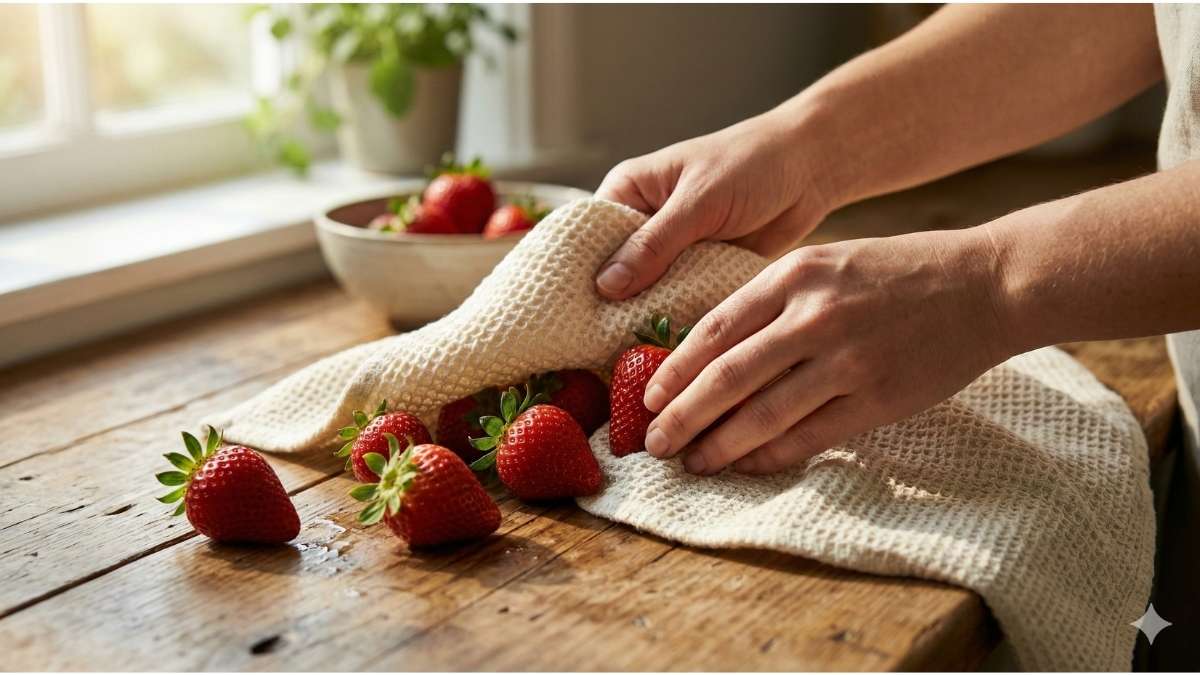 Always pat berries completely dry using a clean paper towel or cotton cloth. Excess moisture is the primary catalyst for rapid mold growth.
Drying your organic strawberries is just as critical as washing them. Leaving strawberries wet in the fridge is a guaranteed way to culture mold. Moisture is the catalyst for rapid cellular degradation.
Once rinsed, lay the strawberries in a single layer on a clean paper towel or a highly absorbent organic cotton kitchen towel. Gently pat the tops. You are relying on capillary action to pull the excess moisture out of the tiny crevices around the seeds.
Do not use a salad spinner. The centrifugal force required to strip water will crush fragile, ripe organic berries against the plastic walls, bruising the flesh and destroying the texture.
Proper Storage: Keeping Berries Fresh in the Fridge
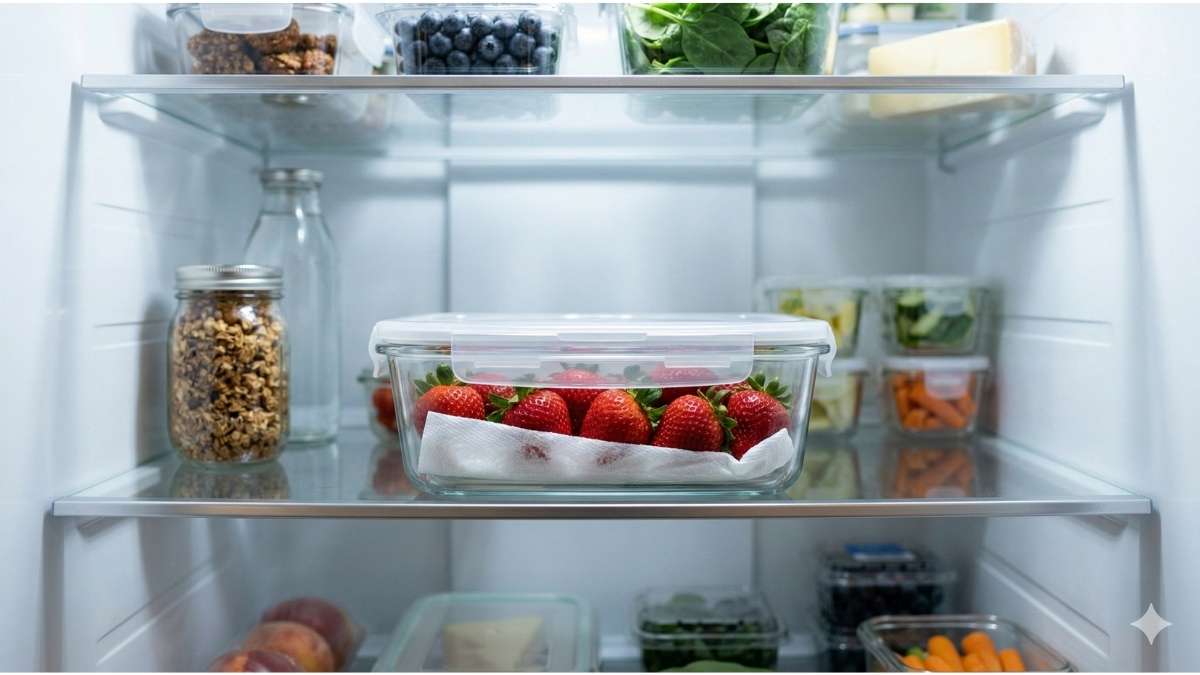 Lining a ventilated glass container with a dry paper towel controls ambient humidity and significantly extends shelf life.
The temperature math for food preservation is non-negotiable. U.S. food-safety guidance dictates that your refrigerator must be maintained at 40°F (4°C) or below. This thermal threshold is necessary to halt the replication of Listeria.
If you have cut or sliced your strawberries, a strict timer starts. Perishable cut fruit cannot sit at room temperature for more than 2 hours (or just 1 hour if your kitchen is above 90°F).
The Ideal Setup: Store your fully dried berries in a shallow, ventilated glass container. Line the bottom with a dry paper towel to wick away ambient condensation. Leave the lid slightly cracked—or use a container with adjustable airflow vents—to prevent the buildup of ethylene gas, which triggers over-ripening.
Frequently Asked Questions (FAQ)
Should I wash organic strawberries as soon as I get home?
No. Unless you plan to meticulously dry them using the paper towel protocol mentioned above, introducing water to the berries and immediately putting them in the fridge will dramatically accelerate mold growth. The FDA recommends waiting to wash produce until right before you are ready to prep or eat it.
Are commercial produce washes better for organic berries?
Absolutely not. Both the CDC and the FDA expressly state that you should avoid commercial produce washes. Regulatory agencies have found no scientific evidence that these expensive, bottled sprays perform better than plain tap water and gentle friction.
What happens if I use soap to clean my organic strawberries?
Because strawberry skins are highly porous, they absorb the chemical compounds found in household soaps and detergents. Ingesting these synthetic surfactants can cause nausea, vomiting, and diarrhea. Stick to clean, cold water.

Meet Saqib
Saqib Ali Ateel is a PhD Scholar by training and a "student of the soil" by nature. He combines deep research, hands-on farming wisdom, and agricultural systems supervision to reveal what’s really on your plate. His mission is simple: to help your family navigate the food industry's complexity so you can eat cleaner, safer, and smarter.