Organic Shade-Grown Coffee: The Science of Taste, Health
& Carbon Stocks
When you step into a forest cultivating organic shade-grown coffee, the first thing you notice is the drop in temperature. It isn’t the scorching heat of a monoculture field; it’s a cool, humid sanctuary smelling of damp leaf litter and jasmine. That temperature drop isn’t just pleasant for the farmer—it is the single most important variable in the chemistry of your morning cup.
If you are reading this, you are likely navigating the confusing marketplace of "low-acid," "mold-free," and "sustainable" labels. You want to know if the extra cost actually translates to a better bean or a healthier body.
As a researcher and a grower, I look at what the harvest logs actually tell us—mostly about density and natural sugar. What I keep seeing is that shade-grown coffee isn't just a donation to the planet. It’s a physically better bean that ripens slowly, giving you a cup that is naturally sweeter without that harsh, bitter bite.
🛑 The Blunt Answer: Is It Worth The Premium?
Forget the label art—here is the raw logic on whether you should upgrade:
-
☕ For Flavor Geeks: YES.
Shade prolongs maturation, increasing bean density (>0.70 g/mL) and sugar content. -
🩺 For Sensitive Stomachs: YES, BUT...
Shade alone isn't enough. You need the right roast (Medium-Dark) to block acidity. -
🍄 For Mold Anxiety: MAYBE.
Shade doesn't prevent mold; Wet-Processing does. Processing matters more than the shade tree. -
🌍 For The Planet: ABSOLUTELY.
It protects existing carbon stocks (482 million tons globally) that new trees can't replace.
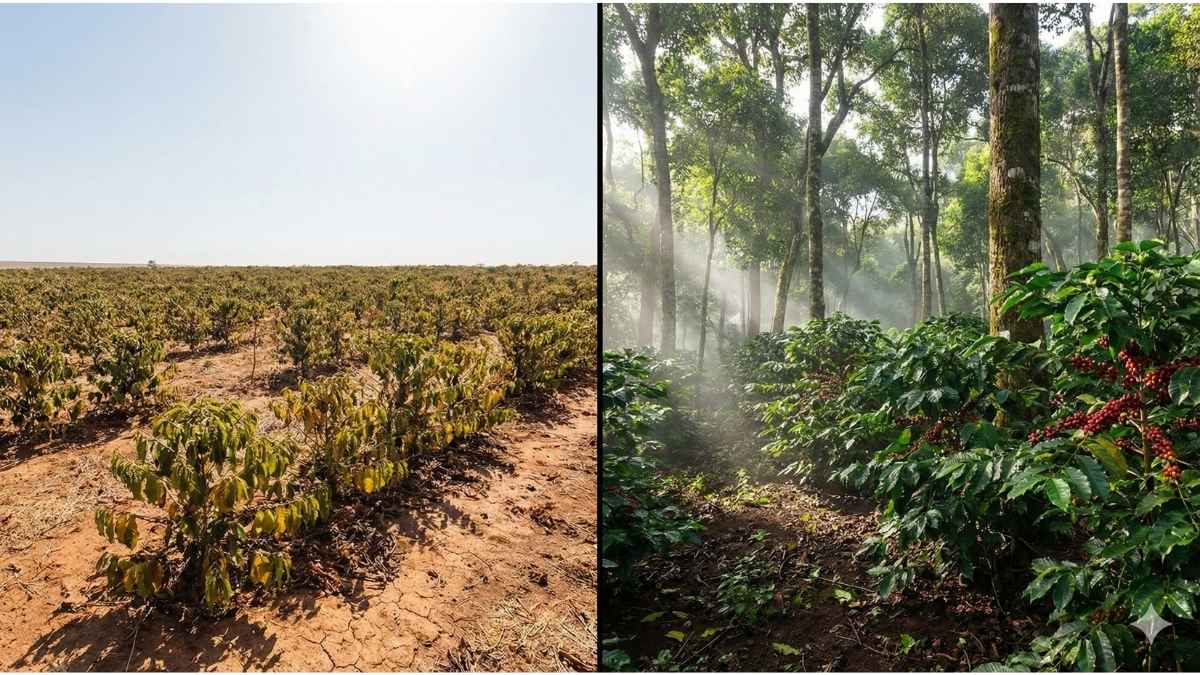 The visual difference is stark: The "green desert" of monoculture (left) vs. the biodiversity of a shade forest (right).
The PhD Farmer’s 30-Second Buyer’s Playbook
Don't have time for the biochemistry? Take this cheat sheet to the grocery aisle.
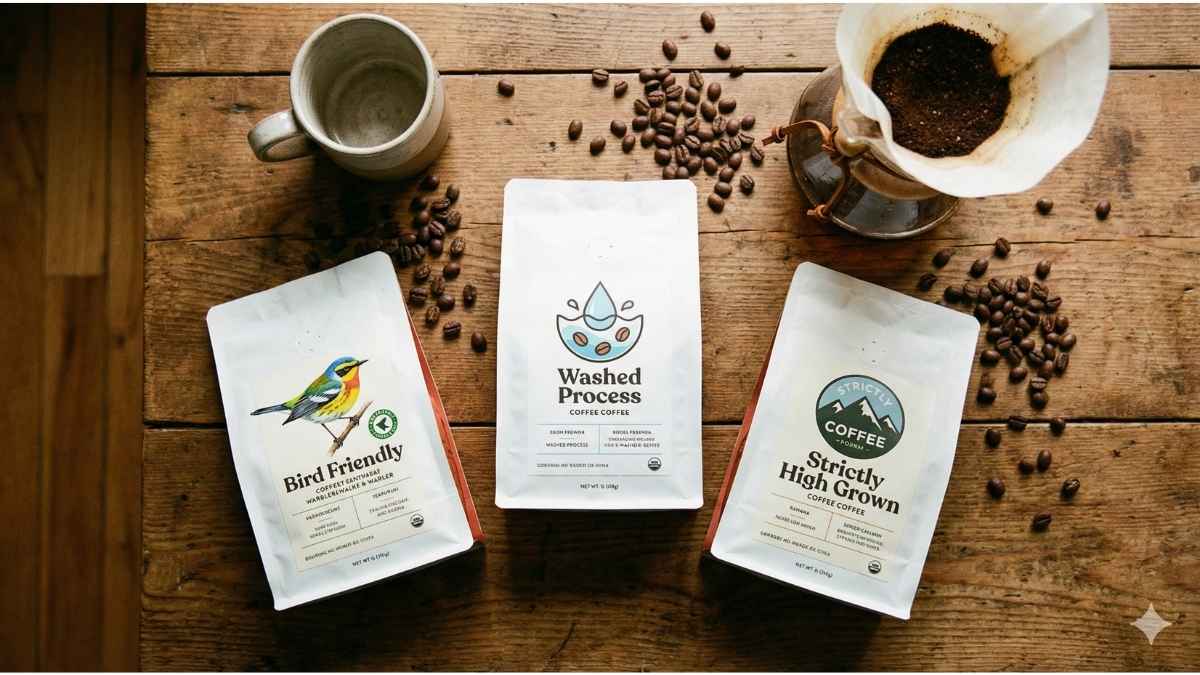
🧬 The Physiology of
Flavor: Why "Slow" Tastes Better
The difference in taste isn't magic; it's metabolic.
The Maturation Extension
Think of the coffee cherry like a slow-cooked meal versus a microwave dinner. In full-sun systems, the coffee plant is under high metabolic stress. It photosynthesizes rapidly, forcing the fruit to ripen before the seed (the bean) is fully developed. This is "forced ripening."
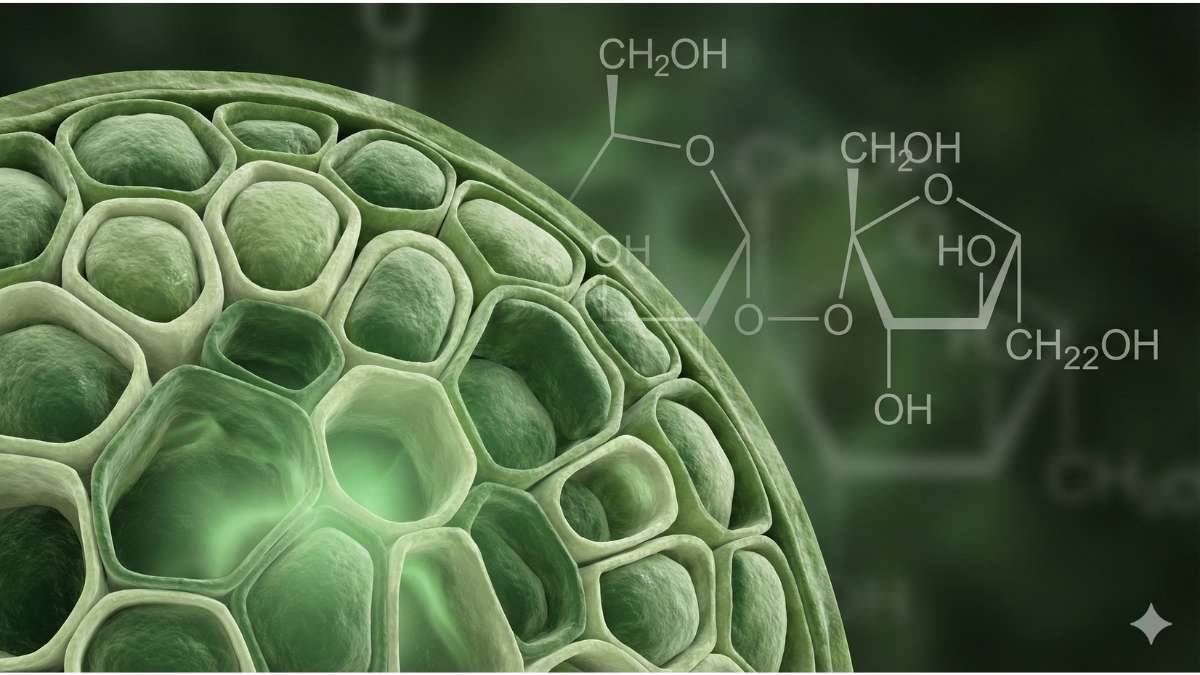
In a shade system, the canopy lowers the ambient temperature by 4–6°C. This signals the plant to pace itself. Recent plant physiology studies confirm that this delay upregulates sucrose synthase, the enzyme responsible for pumping sugar into the bean. The result is a seed that is physically harder and chemically packed with precursors that turn into flavor when roasted.
Density is King
In the lab, we measure density in grams per milliliter.
- Sun beans are soft. If you roast them dark, they scorch and taste like ash.
- Shade beans are dense. They can withstand high heat, allowing the roaster to develop deep chocolate and caramel notes without burning the cellulose.
📊 At-A-Glance: The Side-by-Side Breakdown
We cut through the slogans to compare the real difference between a bean grown in a sun-scorched field and one raised in a cool forest.
| Variable | ☀️ Industrial Sun-Grown | 🌳 Organic Shade-Grown | 👤 What This Means For You |
|---|---|---|---|
| 🪨 Bean Density |
Low (<0.60 g/mL). Porous structure due to rapid, forced ripening. |
High (>0.70 g/mL). Tight cellular structure due to slow maturation. |
Better Roasting: Dense beans hold heat better, creating complex caramel/chocolate notes without scorching. |
| 🍬 Sugar Profile | High in simple reducing sugars (glucose). Often tastes "flat" or "grassy." |
High in Sucrose. Upregulated by enzymatic activity during slow growth. |
Natural Sweetness: You likely won't need to add sugar to your cup. |
| 🍄 Mycotoxin Risk | Higher risk if "Natural/Dry" processed. | Lower risk. Premium shade beans are usually Wet-Processed. | Clean Energy: Reduces the "brain fog" or jitters associated with dirty coffee. |
| 🐛 Pest Control | Synthetic Pesticides (Endosulfan, Chlorpyrifos). |
Avian Predation. Birds consume the Coffee Berry Borer beetle. |
Chemical Free: No pesticide residue in your morning brew. |
| 🌍 Carbon Impact |
Net Emitter. Heavy nitrogen fertilizer use releases Nitrous Oxide. |
Carbon Sink. Stores carbon in soil and woody biomass. |
Climate Action: Your daily habit actively conserves forests. |
← Swipe left on table to see more (Mobile) →
⚕️ Health & Safety:
Deconstructing "Mold" and "Acid"
There is a lot of fear-mongering in the "wellness coffee" space. Let's look at the clinical reality.
1. The "Mold-Free" Myth vs. Processing Reality
Marketing claims often imply that "Organic Shade" equals "Mold-Free." This is scientifically inaccurate. Fungal spores are ubiquitous; they are in the air right now. The safety critical control point is Water Activity ($a_w$).
Research consistently shows that Wet Processing (Washed) is the superior decontamination method. By removing the sugar-rich fruit pulp immediately after harvest and fermenting the beans in water, we remove the food source for fungi like Aspergillus. Since most high-quality shade coffee is wet-processed to preserve its acidity, it is inherently safer.
Note: A 2024 Food Chemistry Review confirmed that roasting reduces Ochratoxin A (OTA) levels by up to 96%. If you are buying commercial-grade roasted coffee, toxic levels are statistically rare.
2. The Stomach Acid Paradox
Many people switch to shade coffee to avoid heartburn. However, a light-roast shade coffee (high in acids) might still hurt your stomach.
Gastric distress is often caused by Chlorogenic Acids (CGA) and C5HTs, which stimulate stomach acid. The compound that inhibits stomach acid is N-methylpyridinium (N-MP), which is only created during the roasting process as CGA breaks down.
- The Prescription: For the most stomach-friendly cup, choose a Shade-Grown bean (for quality/low pesticides) roasted to a Medium-Dark profile (to maximize N-MP).
🌍 The Climate Reality:
Saving Giants vs. Planting Twigs
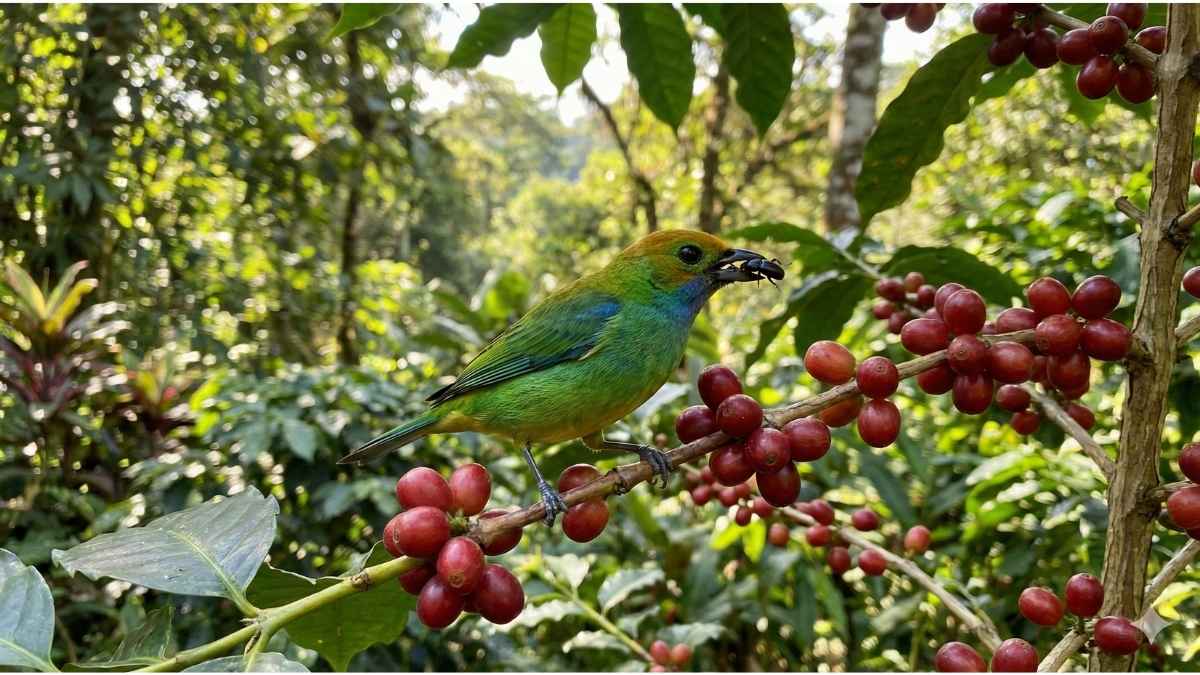 In shade systems, birds act as natural pest control, eliminating the need for synthetic chemicals like Endosulfan.
Here is where the climate math gets backward. Most carbon programs pay to plant new saplings, but they offer almost zero incentive for a coffee farmer to keep their massive, centuries-old shade trees standing. That's a huge problem—because losing those old giants releases carbon that new twigs can’t replace for decades.
A landmark 2025 Smithsonian Analysis revealed a massive valuation gap. Existing shade-coffee farms hold approximately 482 million metric tons of carbon. If these farms are converted to sun monocultures, that carbon is released. The study concludes that the damage of losing these mature systems cannot be offset by planting new saplings elsewhere.
When you buy Bird Friendly® or genuine shade-grown coffee, you aren't just buying a bean; you are funding the preservation of a Carbon Stock that is actively stabilizing the global climate.
🚜 Real World Scenarios:
Decision Matrix
Not sure which specific coffee fits your life? Use this decision flow to pick the right bag.
🚜 Real World Scenarios: Decision Matrix
Not sure which coffee fits your life? Use this decision flow to pick the right bag for your specific needs.
| 🤔 Your Primary Concern | ✅ Recommended Combo | 💡 Why? |
|---|---|---|
| 🩺 "My stomach hurts after coffee" | Shade Grown + Medium-Dark Roast | Shade reduces pesticide load; dark roasting creates N-MP to block acid production. |
| 🧪 "I want maximum antioxidant benefits" | Shade Grown + Light-Medium Roast | Light roasts preserve more Chlorogenic Acids (CGA), but can be harder on the stomach. |
| 🍄 "I am terrified of Mold/Toxins" | High Altitude + Wet Processed (Washed) | Altitude reduces humidity; wet processing physically removes mold substrates. |
| 🐦 "I want to support the environment" | Bird Friendly® Certification | The only label that guarantees canopy density and native tree diversity. |
| 💰 "I'm on a strict budget" | Origin: Ethiopia + Label: SHG | Ethiopian heirloom coffee is often naturally shade-grown (even without certs). SHG guarantees density. |
← Swipe left on table to see more (Mobile) →
FAQ
for Shade-Grown Coffee
Q: Does shade-grown coffee have more caffeine?
A: Generally, no. Sun-grown coffee produces more caffeine as a stress response to intense UV radiation and pests (caffeine is a natural pesticide). Shade-grown Arabica is typically lower in caffeine, which contributes to a smoother, less bitter taste.
Q: Is "Low Acid" coffee the same as shade-grown?
A: No. "Low Acid" usually refers to the pH or the roast profile. Shade-grown refers to the cultivation method. However, because shade beans are denser and sweeter, they are often roasted in ways that balance acidity better than sun-grown beans.
Q: Why is shade coffee more expensive?
A: The Yield Gap. Shade farms produce roughly 20-30% less coffee per acre than sun farms because the trees take up space. You are paying for the farmer's lost volume, which is the cost of quality and conservation.

Meet Saqib
Saqib Ali Ateel is a PhD Scholar by training and a "student of the soil" by nature. He combines deep research, hands-on farming wisdom, and agricultural systems supervision to reveal what’s really on your plate. His mission is simple: to help your family navigate the food industry's complexity so you can eat cleaner, safer, and smarter.
📚 References
- Smithsonian National Zoo & Conservation Biology Institute (2025). "Carbon Stock Valuation in Coffee Agroforestry Systems." Communications Earth & Environment.
- Journal of Agricultural and Food Chemistry (2024). "Metabolic Profiling of Shade vs. Sun Coffee: Sucrose Synthase Activity."
- Food Control (2024). "Ochratoxin A reduction during coffee roasting: A systematic review."
- Jha, S., et al. (2024). "Biodiversity and Ecosystem Services in Coffee Systems."