Organic Swiss Water Decaf Coffee: The Chemical-Free
Truth, Explained
If you’ve ever stood at the counter, nose over the grinder, and wondered what “chemical-free” really means, you aren't alone. When you are looking for one of the cleanest options for your daily routine, exploring organic swiss water decaf coffee is a solid go-to. Decaffeination isn’t just a flavor choice—it’s a processing decision that can either preserve organic integrity or quietly introduce industrial solvents into your morning cup.
I started auditing lot codes and handling claims after seeing how easily a “clean” farm story gets contaminated downstream at the decaf facility. In this article, I shall try to break down the science (osmosis, carbon filtration, and what is actually being removed), the regulations that brands hide behind, and the simple label checks that separate truly clean beans from solvent-stripped lookalikes.
If you would rather skip the agricultural chemistry lesson for now, here is the 2026 cheat sheet for your morning cup.
🛑 The Blunt Answer: Which Decaf Should You Buy?
- If you want the safest daily drinker for your family: Buy a medium-roast whole bean with the dual labels: "USDA Organic" and the official "Swiss Water Process" seal (like Dillanos).
- If you want the lowest price but want to avoid toxins: Skip the boutique micro-roasters and buy bulk 2lb bags from transparent mid-size roasters like Mayorga.
- If you are brewing espresso: Buy a dedicated decaf espresso blend. Water-processed beans are more porous and extract faster; an espresso-specific roast profile compensates for this physical degradation.
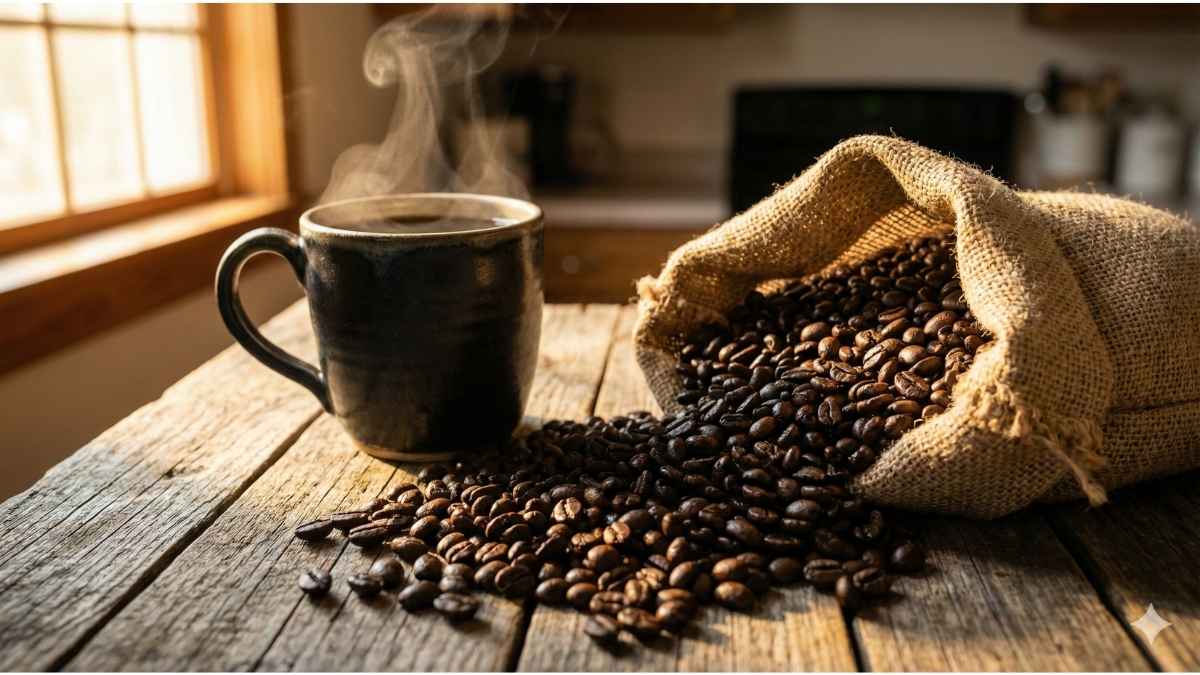
🔍 The 30-Second Label Check: How to Verify Your Bag
Don't rely on front-of-bag marketing buzzwords. Before you checkout, flip the bag over and look for these specific indicators to ensure your coffee wasn't chemically stripped:
- USDA Organic Seal + Certifier Name: It must have the seal, but also legally must state the certifying agent below the distributor address (e.g., "Certified Organic by QAI" or "Oregon Tilth").
- The "Swiss Water Process" Identifier: Look for the official blue/black wave logo or the exact phrase "Swiss Water® Process."
- Avoid the "Naturally Decaffeinated" Trap: If it says "Natural" but lacks the Swiss Water logo, it is almost certainly processed with Ethyl Acetate (a solvent).
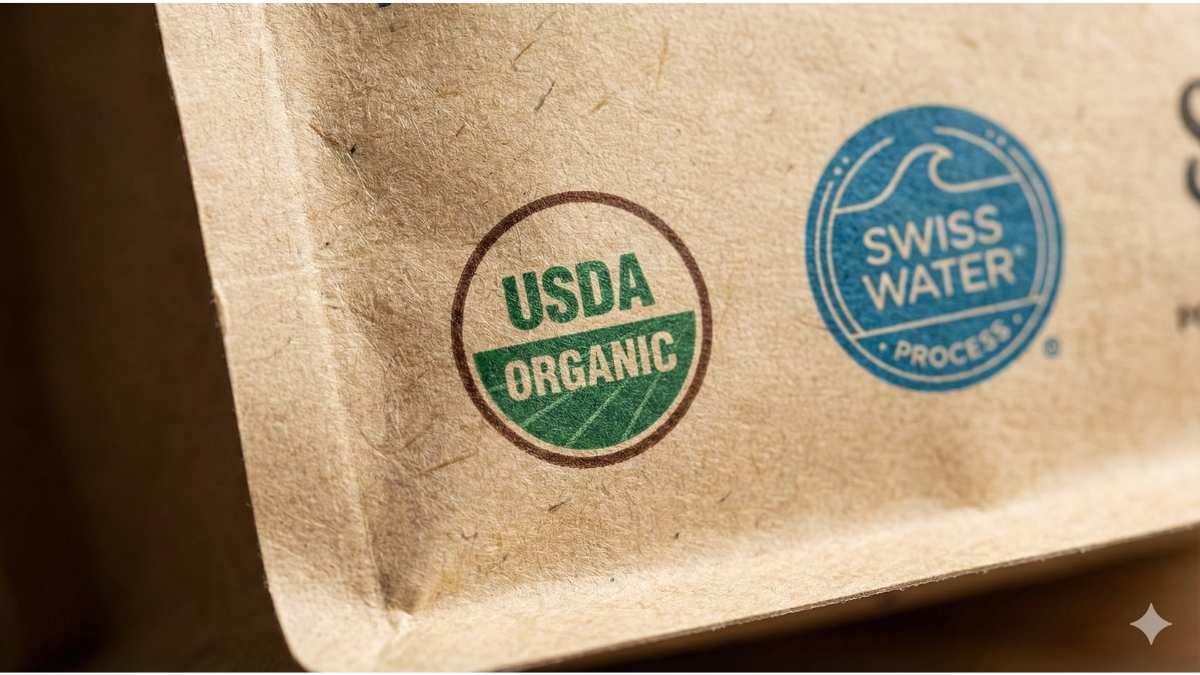 Always verify your bag: A true chemical-free roast will carry both the USDA Organic certifier name and the official Swiss Water Process seal.
Decaffeination Methods: Chemical Stripping vs. The Water
Process
To understand why this specific processing method commands a premium, we must look at the cellular biology and the regulatory environment of the alternatives.
The Hidden Solvents in Standard Decaf (Methylene Chloride
& Ethyl Acetate)
Conventional decaffeination relies on chemical stripping. The raw beans are steamed open and washed repeatedly with chemical solvents. The most common is methylene chloride.
In the United States, 21 CFR 173.255 permits methylene chloride as a food additive solvent, so long as residue levels do not exceed 10 parts per million. While the FDA considers this permissible, methylene chloride is fundamentally an industrial degreaser. For those of us focused on cellular health and minimizing synthetic toxic load, relying on a regulatory threshold of a known volatile compound is an unnecessary risk.
Another option is Ethyl Acetate (often marketed as the "Sugarcane Process"). While it can be derived from fruit, the commercial coffee industry frequently uses synthetic ethyl acetate. It is a solvent-based process, plain and simple.
How the Swiss Water Process Actually Works (The Science)
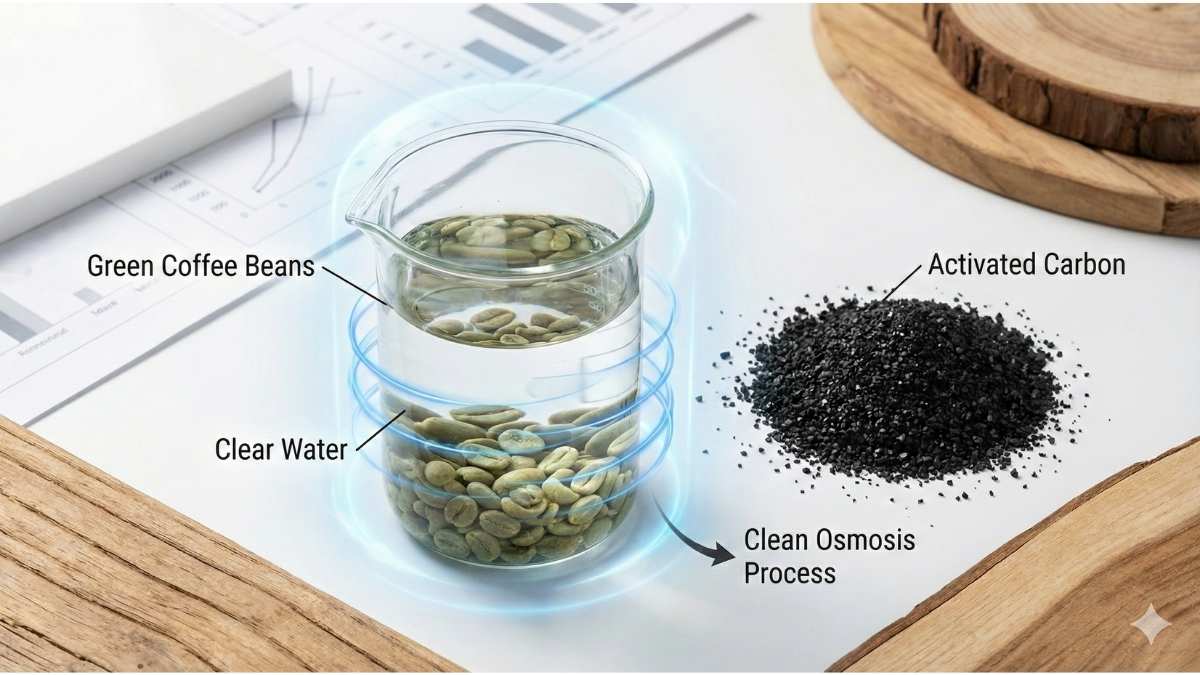 The water process relies purely on solubility and activated carbon, leaving synthetic industrial solvents completely out of the equation.
First, the decaffeination facility creates "Green Coffee Extract" (GCE). Think of GCE as water that is already 100% saturated with the flavor compounds of coffee, but contains zero caffeine. When fresh, caffeinated green coffee beans are soaked in this GCE, a specific biological mechanism occurs: because the water is already full of flavor compounds, the flavor stays locked inside the bean. But because the water has no caffeine, the caffeine naturally diffuses out of the bean and into the water to reach equilibrium.
Instead of soaking the beans in synthetic solvents, the Swiss Water method avoids added solvents and simply relies on water, carbon filtration, and the science of osmosis to gently draw the caffeine out. The caffeine-rich water is passed through proprietary activated carbon filters, which physically trap the caffeine molecules (C8H10N4O2) in their microscopic pores. The clean GCE is then circulated back to extract more caffeine.
Why "Certified Organic" Matters for Organic
Decaf Coffee Beans
A common misconception is that if a farm does not use synthetic pesticides, the resulting coffee is organic. That is only half the equation. Organic integrity must be maintained through the entire chain of custody.
If pristine, organically grown beans from Peru are shipped to a processing facility and soaked in methylene chloride, they instantly lose their organic certification. The NOP regulations explicitly state in 7 CFR Part 205 that organic handling strictly prohibits the use of "excluded methods" and synthetic solvents.
Therefore, seeking out organic decaf coffee beans is your built-in regulatory shield. The Swiss Water Process facility itself maintains organic certification, meaning the chain of custody from the soil in Chiapas to your kitchen table remains entirely uncompromised. (To learn more about reading these labels, check out our deep dive: Organic Coffee Certifications.)
Is Decaf Really Caffeine-Free? The 99.9% Reality
I am frequently asked by pregnant mothers and caffeine-sensitive members of our community if decaf is truly zero-stimulant. My calculation shows that no commercial coffee is 100% caffeine-free.
The molecular weight of caffeine is 194.19 g/mol. The Swiss Water company has engineered its carbon filtration to target and remove exactly 99.9% of these specific molecules. However, the FDA explicitly notes that decaffeinated coffees still contain trace amounts. If a standard cup of coffee has 95mg of caffeine, a water-processed decaf will typically contain less than 2mg (though this varies slightly by bean density and serving size). For most physiological purposes, this is statistically insignificant, but if you have strict medical sensitivity, be aware that it is not absolute zero.
⚖️ The Truth Table: Regs vs. Marketing Myths
| 🏷️ Feature/Claim | 🔬 Scientific Reality (The Regs) | 🤥 Marketing Myth | 👨🌾 The PhD Farmer Verdict |
|---|---|---|---|
| "Chemical-Free Decaf" | Solvents like Methylene Chloride are legal under 21 CFR 173.255. 🧪 | "All decaf is highly toxic." ☠️ | Methylene chloride physically degrades during roasting, but buying organic water-process eliminates the synthetic risk entirely. ✅ |
| "Naturally Decaffeinated" | Usually refers to Ethyl Acetate, which can be synthetically manufactured. 🏭 | "Natural means water-based." 💧 | "Natural" has no strict legal definition here. Look exclusively for the "Swiss Water" or "Organic" seals. 🔍 |
| "Caffeine Free" | FDA confirms trace caffeine remains in all decaf. 📉 | "It has zero caffeine." 🚫 | Expect ~2mg per cup. Safe for sleep hygiene, but not a true 0.0mg baseline. ☕ |
2026 Deep Dive: The Best Organic Decaf Coffee Brands
When auditing the unit economics and the traceability of the 2026 market, these five roasters stand out for sourcing high-density water-processed beans and providing excellent buying convenience.
1. Dillanos Swiss Water Organic Blend
- Best For: Everyday drip and home espresso.
- Buy-Ready Specs: Available in 12oz or 5lb bags. Whole bean or multiple grind options. Subscribe & Save (15% off). Ships nationwide.
- The Verdict: They anchor their roast profiles perfectly. By aiming for a medium roast with toasted grain notes, they mask the slight physical degradation that happens during the water extraction process.
- Best For: Budget-conscious families and batch brewers.
- Buy-Ready Specs: 2lb bulk bags. Whole bean only. Prime shipping available via Amazon.
- The Verdict: Incredible unit economics ($0.80/oz) without compromising on organic integrity. It’s a darker roast, which holds up wonderfully to milk or cream.
- Best For: Pour-over enthusiasts (Chemex, V60).
- Buy-Ready Specs: 12oz bags. Whole bean or ground. Fast standard shipping.
- The Verdict: Excellent supply chain transparency and a heavy focus on protecting the fragile floral aromatics of the bean.
4. Volcanica Sumatra Mandheling Decaf
- Best For: French Press drinkers who love earthy, low-acid coffee.
- Buy-Ready Specs: 16oz bags. Whole bean or French Press coarse grind.
- The Verdict: Sumatran coffees are famously heavy-bodied. Volcanica does an excellent job keeping that syrupy mouthfeel intact even after the decaffeination process.
5. Genuine Origin (Chiapas, Mexico)
- Best For: Hobbyist home roasters.
- Buy-Ready Specs: 65lb bulk boxes. Ships via freight/UPS. Unroasted green coffee only.
- The Verdict: If you roast your own coffee, Genuine Origin provides the strict traceability, moisture logs, and cup scores you need to guarantee you are starting with pristine raw material.
Transparency Note: The research and lot-code auditing behind these coffee guides takes time. If you use the links in this article to purchase your beans, I may earn a small commission at no extra cost to you. As an Amazon Associate, I earn from qualifying purchases. This helps keep the site running and the reviews strictly independent.
The "PhD Farmer" Guide: How to Brew Decaf So It
Doesn’t Taste Flat
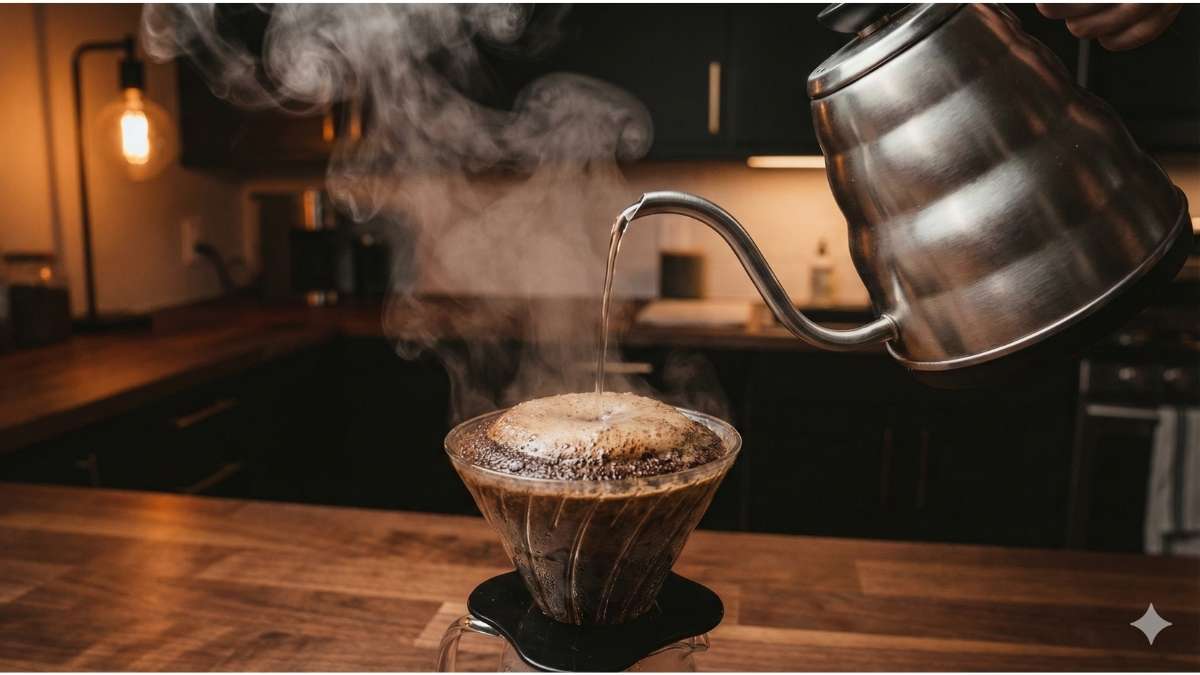 Because the decaffeination process alters bean density, lowering your water temperature to 195°F–200°F prevents bitter over-extraction.
Because the beans have spent hours soaking in Green Coffee Extract to remove the caffeine, their cellular structure is physically altered. The beans become more porous and brittle. When they hit the roaster, they develop faster, and when they hit your grinder, they shatter differently.
To stop your decaf from tasting flat, you must adjust your extraction variables:
1. Drop your water temperature: Porous beans extract flavor rapidly. Instead of water right off the boil (205°F), aim for 195°F–200°F to prevent pulling bitter tannins.
2. Tighten your ratio: If you normally brew a 1:16 ratio (coffee to water), tighten it to 1:14 or 1:15 to increase the body and mouthfeel.
3. Grind slightly finer: Compensate for the faster water flow-through rate by increasing the resistance in your filter bed.
Frequently Asked Questions (FAQ)
Is it safe to drink Swiss Water decaf during pregnancy?
Yes. Because the Swiss Water process avoids synthetic solvents like methylene chloride, it eliminates the risk of chemical residue. However, since it still contains trace amounts of caffeine (~2mg per cup), consult your doctor if you have been instructed to consume absolutely zero stimulants.
How much caffeine is actually left in Swiss Water decaf?
The process guarantees that 99.9% of the caffeine is removed. In practical terms, an 8oz cup of this coffee will contain between 1mg and 2mg of caffeine, compared to 95mg in a standard caffeinated cup.
Is Swiss Water decaf better than CO2 decaf?
Both are entirely safe and approved for certified organic handling. Biologically, neither leaves synthetic residues. However, many specialty roasters prefer the Swiss Water process as they report it preserves the fragile lipid structures (fats/oils) that carry flavor better than the high-pressure CO2 environment.
Does decaf coffee go stale faster?
Yes. Because the cellular structure is made more porous during the soaking phase, roasted decaf ages and degasses much faster than caffeinated coffee. To keep it fresh, buy whole beans, store them in an airtight, opaque container, and grind immediately before brewing.

Meet Saqib
Saqib Ali Ateel is a PhD Scholar by training and a "student of the soil" by nature. He combines deep research, hands-on farming wisdom, and agricultural systems supervision to reveal what’s really on your plate. His mission is simple: to help your family navigate the food industry's complexity so you can eat cleaner, safer, and smarter.