Monk Fruit and Diabetes: The Prebiotic Pharmaceutical Reversing Metabolic Dysfunction
By Saqib Ali Ateel, PhD Scholar in Agriculture | Organic Farmer | Founder, Preforganic.com
You aren't just looking for a way to sweeten your coffee without guilt. If you are reading this, you are likely playing the role of the "Metabolic Detective." You’ve seen the headlines about erythritol and heart risks. You’ve heard the whispers about "nature's Ozempic."
And you are asking a much deeper question than just "is it sweet?" You are asking: Can this food actually heal me? Is there any relationship between Monk fruit and diabetes?
As a PhD student in agriculture and a lifelong organic gardener, I have spent years studying how soil health mirrors human gut health. My research suggests that the answer to your question is a resounding "Yes"—but only if you understand the chemistry.
We need to stop viewing Monk Fruit (Siraitia grosvenorii) as merely a sugar substitute. It is time to reclassify it as a "Prebiotic Pharmaceutical."
When sourced correctly (and I will explain why "Organic" is a biological necessity, not a luxury), pure monk fruit does something extraordinary. It doesn't just bypass your blood sugar; it actively feeds the "skinny bacteria" (Akkermansia muciniphila) in your gut and triggers the release of GLP-1, the same satiety hormone targeted by modern weight-loss drugs.
But there is a catch. If you buy the wrong kind—the kind sprayed with neurotoxic pesticides—you might be destroying the very metabolic machinery you are trying to fix.
Let’s dig into the science of how to turn your sweetener into a metabolic shield.
🌱 The Metabolic Takeaway
- 🚀 Nature's GLP-1 Agonist: Pure monk fruit metabolites (Mogrol) chemically stimulate the TGR5 receptor in your gut, triggering the release of GLP-1—your body's natural "I'm full" signal.
- 🦠 Feeding the "Skinny Bacteria": The extract acts as a selective fertilizer for Akkermansia muciniphila, the keystone bacterium responsible for repairing "Leaky Gut" and lowering insulin resistance.
- ☠️ The Pesticide Paradox: Conventional monk fruit is often sprayed with Chlorpyrifos, a pesticide shown to kill Akkermansia. Non-organic fruit negates the medicinal benefit by poisoning the microbiome you want to feed.
- 🩸 Diabetes Defense: Unlike fillers that just "don't spike" sugar, pure monk fruit actively activates AMPK (the metabolic master switch), helping your cells burn energy more efficiently.
- 🔍 Purity is Potency: To get these pharmaceutical-grade benefits, you must reject erythritol blends and use only 100% Pure, USDA Certified Organic Monk Fruit Extract.
🧠 From Calories to Signaling: The "Trojan Horse" Mechanism
For decades, the nutritional establishment lied to us. They told us that if a food had zero calories, it was "inert"—a ghost that passed through the body without leaving a trace. We now know that food is information. Every molecule you eat sends a signal to your genes and your microbiome.
In my academic research, I’ve been fascinated by how mogrosides (the sweet compounds in monk fruit) operate. They function like a biological "Trojan Horse."
Because the chemical bonds in Mogroside V are complex (beta-glycosidic linkages), your stomach acid and upper digestive enzymes cannot break them down. This is brilliant design by nature. If they broke down early, they would just be absorbed as sugar. Instead, they travel intact through the small intestine, bypassing your bloodstream entirely—which is why monk fruit and diabetes management go hand-in-hand.
But the payload isn't delivered until it reaches the colon. There, specific gut bacteria possess the "keys" (enzymes like beta-glucosidase) to unlock the horse. They snip off the sugar molecules for food, releasing the active medicinal core. This is where the magic starts.
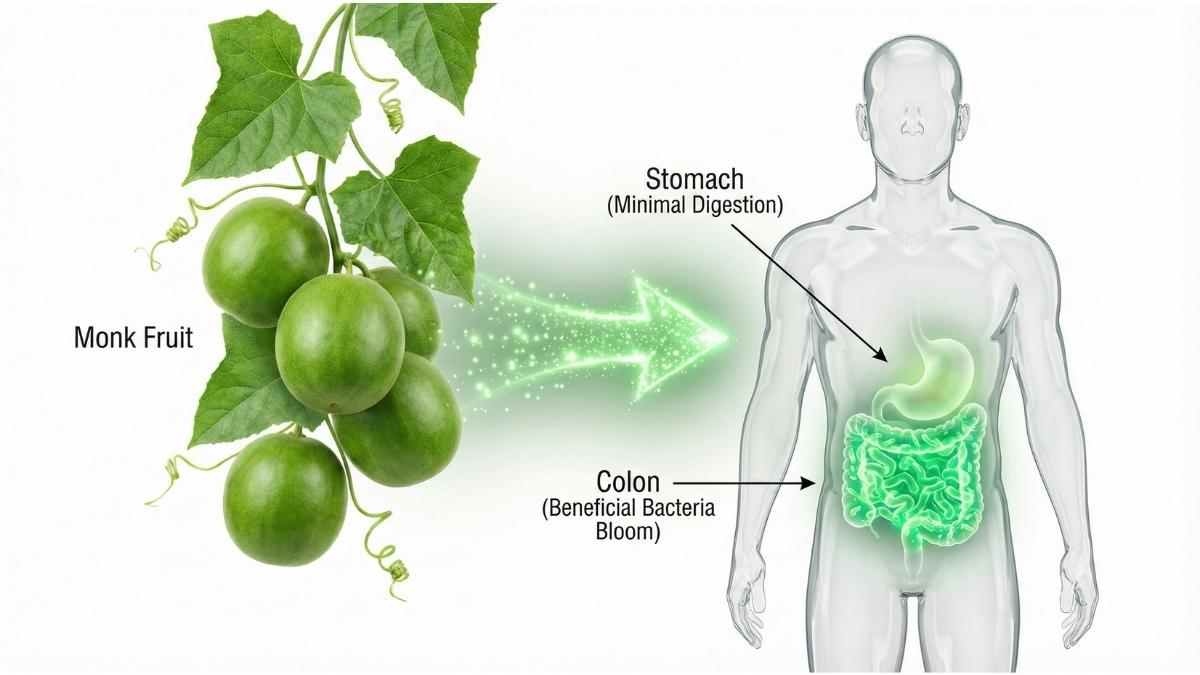 This diagram illustrates the "Trojan Horse" mechanism where complex mogrosides bypass the stomach intact to prevent sugar absorption, only breaking down in the colon to feed Akkermansia muciniphila
🦠 The Biological Signal: Feeding the "Mason" (Akkermansia)
If you imagine your gut lining as a medieval castle wall protecting your bloodstream, Akkermansia muciniphila is the "Mason."
This specialized bacterium lives in the mucus layer (the moat) of your intestine. It is a "keystone species," meaning its presence supports the entire ecosystem. Research clearly shows a stark divide in the population:
- Healthy, Lean Individuals: High levels of Akkermansia (up to 4% of gut bacteria).
- Individuals with Diabetes/Obesity: Low or undetectable levels.
Here is where pure monk fruit shines. It acts as a selective prebiotic. Unlike generic fiber that feeds everything (including the bad guys), mogrosides appear to be a premium fertilizer specifically for Akkermansia.
When you consume pure monk fruit extract, you are feeding the Mason. In response, Akkermansia proliferates and strengthens the gut barrier. A stronger barrier means fewer toxins (LPS) leak into your blood. Less leaking means less systemic inflammation. Less inflammation means your insulin receptors start working again.
This isn't just a sweetener; it’s a gut-repair kit. 🛠️
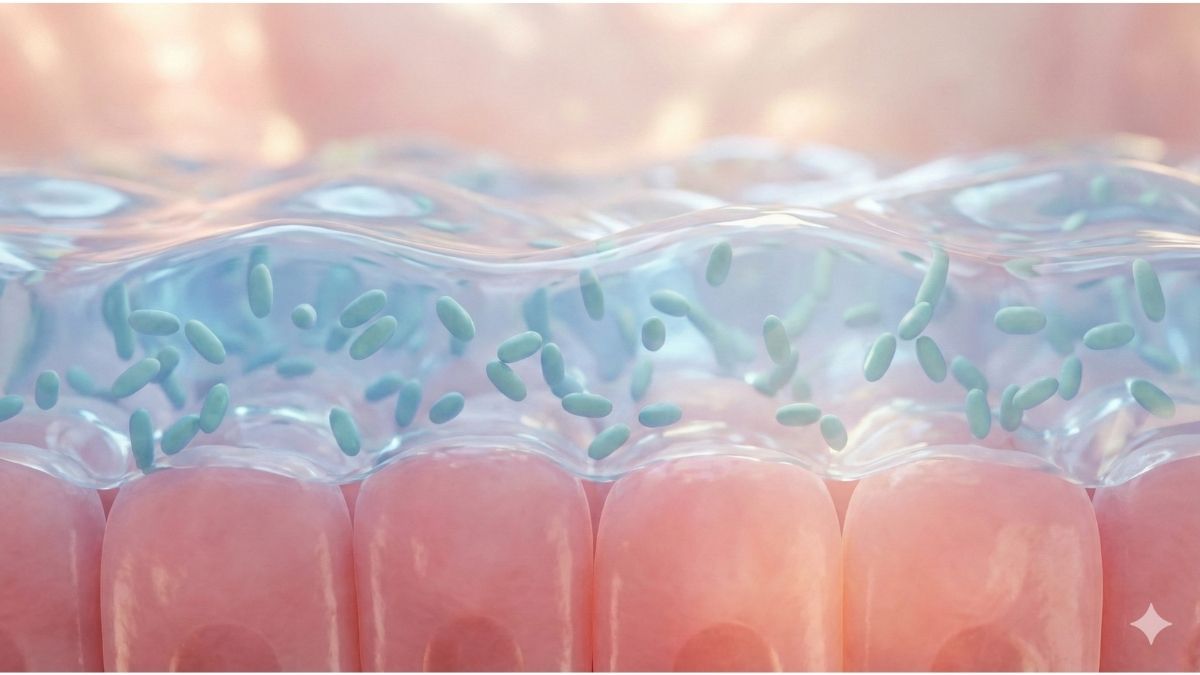 Unlike inert sugar substitutes, pure Monk Fruit containing Mogroside V chemically stimulates the TGR5 receptor to release GLP-1, functioning as a biological signal rather than just a calorie-free flavor.
💉 The "Double-Tap": How Monk Fruit Mimics Ozempic (Naturally)
You’ve likely heard of the blockbuster weight-loss drugs like Ozempic or Wegovy. These are GLP-1 agonists. They work by flooding your body with a synthetic version of GLP-1 (Glucagon-like Peptide-1), a hormone that tells your brain "I am full" and tells your pancreas "manage this blood sugar."
What if I told you that monk fruit triggers a natural release of your own GLP-1?
My review of the latest pharmacological data reveals a "Double-Tap" mechanism unique to this fruit:
Tap 1: The Chemical Signal (Mogrol)
When your gut bacteria finish eating the sugar off the Mogroside V molecule, what is left behind is a backbone structure called Mogrol. Recent studies have identified Mogrol as a potent agonist of the TGR5 receptor. This receptor sits on the L-cells of your intestine. When Mogrol hits it, it acts like a key in the ignition, chemically signaling the cell to release stored GLP-1 into your bloodstream.
Tap 2: The Biological Signal (Protein P9)
The Akkermansia bacteria you just fed? They don't just sit there. They secrete a specific protein called P9. This protein interacts with another receptor (ICAM-2) on your intestinal cells to also trigger GLP-1 secretion.
So, while synthetic drugs hammer the receptor with high doses (often causing nausea), pure monk fruit gently stimulates your body to produce its own satiety hormone via two distinct pathways. You feel fuller, naturally.
🧪 Does Monk Fruit Spike Insulin? The Critical Distinction
A common question I get in is: "Does monk fruit spike insulin?"
The answer requires nuance.
- Sugar: Causes a pathological insulin spike. Glucose rushes in, insulin surges to cope, and fat storage is triggered.
- Monk Fruit: Triggers a functional insulin release via the GLP-1 pathway described above.
This is a good thing! GLP-1 mediates "glucose-dependent" insulin secretion. It only tells the pancreas to work if there is actually sugar to process. It doesn't cause hypoglycemia (low blood sugar). It primes your metabolism to be efficient. It is the difference between flooding an engine with gas (sugar spike) and tuning the fuel injection system (monk fruit).
☠️ The Pesticide Paradox: Why "Organic" is a Medical Necessity
 Unlike inert sugar substitutes, pure Monk Fruit containing Mogroside V chemically stimulates the TGR5 receptor to release GLP-1, functioning as a biological signal rather than just a calorie-free flavor.
Here is the part where the "Farmer" in me needs to have a serious talk with you.
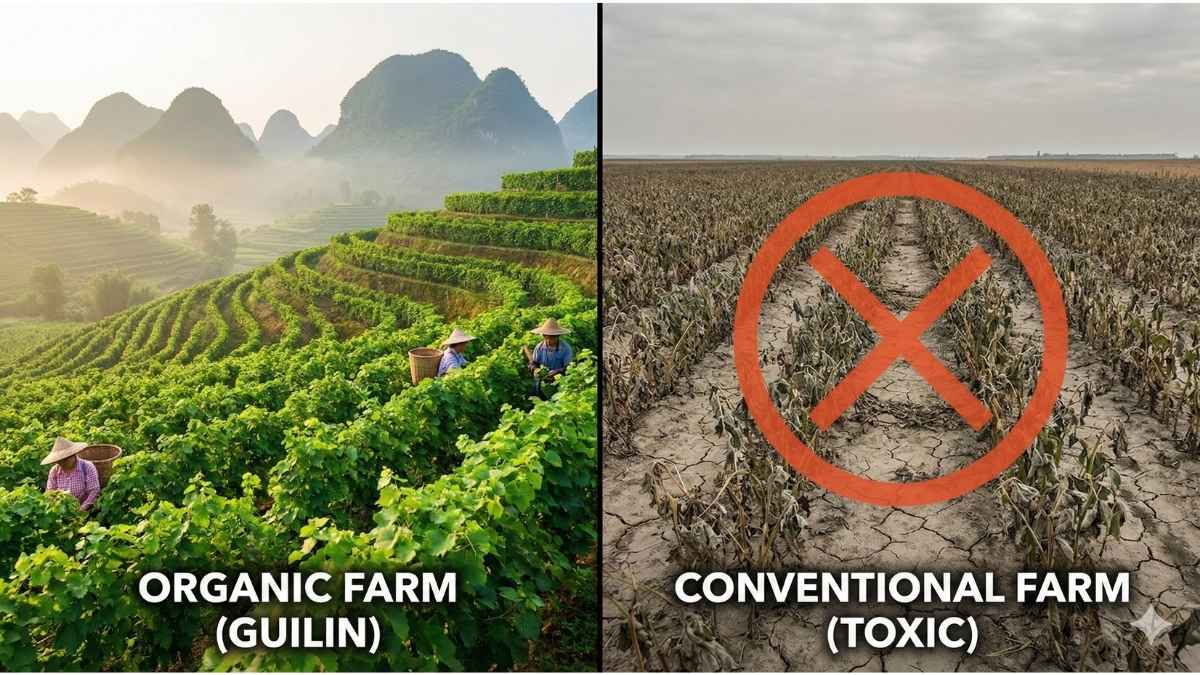
Growing Siraitia grosvenorii is hard. It grows in the misty, humid mountains of Guangxi, China. Humidity loves fruit, but humidity also loves fungus and bugs. To save the crop, conventional farmers often douse the vines in broad-spectrum insecticides, most notably Chlorpyrifos.
Chlorpyrifos is a nerve agent for bugs. But in humans, it is a known microbiome disruptor.
This creates what I call the Pesticide Paradox:
- You buy monk fruit to feed your Akkermansia.
- You buy conventional (non-organic) to save a few dollars.
- The fruit carries residues of Chlorpyrifos.
- The Chlorpyrifos kills the Akkermansia.
Scientific literature confirms that exposure to Chlorpyrifos significantly reduces the abundance of beneficial gut flora, specifically Akkermansia. If you are consuming pesticide-laden fruit, you are essentially taking a "micro-dose of antibiotic" with your sweetener. You are negating the medicinal benefit entirely.
To use monk fruit as a pharmaceutical tool, Certified Organic is the baseline requirement. It ensures that the biological signaling remains pure and the bacterial "fertilizer" isn't laced with poison. 🛡️
📉 Monk Fruit and Diabetes: Activating the Master Switch
Beyond the gut, monk fruit has a direct impact on cellular energy. The metabolite Mogrol has been shown to activate AMPK (AMP-activated protein kinase).
Think of AMPK as your metabolic "Master Switch." It is the same pathway activated by vigorous exercise and fasting. When AMPK is flipped "ON":
- Your cells stop storing fat.
- Your muscles become hungry for glucose (lowering blood sugar).
- Your liver stops producing excess cholesterol.
For a diabetic, this is the holy grail. By swapping sugar for pure organic monk fruit, you aren't just removing a negative (sugar); you are adding a positive (AMPK activation). You are moving from defense to offense in your metabolic health journey.
💨 "Good Gas" vs. "Bad Gas": Navigating Monk Fruit Side Effects
Let’s address the elephant in the room. When you search for "Monk fruit side effects," you often see complaints about gas and bloating.
We need to distinguish between two very different types of digestive responses:
1. The "Bad Gas" (Osmotic Diarrhea) 🌪️ This is sharp, painful, urgent, and watery.
- The Cause: Erythritol.
- The Mechanism: Erythritol is a sugar alcohol. It isn't fully absorbed, so it sits in your gut and attracts water like a magnet (osmosis). This flushes out your system violently. If your monk fruit bag says "1:1 Sugar Replacement," it is likely 99% erythritol. This is the "fake" side effect of a filler ingredient.
2. The "Good Gas" (Fermentation) 💨 This is mild bloating or flatulence, usually without pain or urgency.
- The Cause: Pure Monk Fruit (Mogrosides).
- The Mechanism: This is the sound of your microbiome waking up! When Akkermansia and other good bacteria start feasting on the mogrosides (prebiotics), they produce gases as a byproduct of fermentation.
- The Solution: This is actually a good sign. It means the "fertilizer" is working. It typically subsides within 3 to 7 days as your bacterial population balances out. Start with a small dose ("micro-scoop") and work your way up.
🛒 Conclusion: The Metabolic Detective's Choice
We are living in an era where our food environment is hostile to our biology. But nature has provided tools to fight back.
Pure, Organic Monk Fruit is not just a flavor; it is a Prebiotic Pharmaceutical.
- It feeds the guardian bacteria (Akkermansia).
- It signals your brain to stop eating (GLP-1).
- It activates your metabolic master switch (AMPK).
But remember the Pesticide Paradox. Purity is potency. Don't let the price tag of conventional blends fool you. If it contains erythritol, it's a ghost. If it contains pesticides, it's a poison.
Be the detective. Turn the package over. Look for "100% Pure Organic Monk Fruit Extract." Your gut, your heart, and your metabolism will thank you.
📚 Further Reading (High-Authority Sources)
The Artificial Sweetener Erythritol and Cardiovascular Event Risk
- Annotation: This is the seminal clinical paper (2023) that identified the causal link between erythritol consumption and enhanced platelet reactivity. It provides the raw data on "platelet priming" and is essential for understanding the cardiovascular rationale for avoiding monk fruit blends.
Natural Stimulation of GLP-1 Secretion by Food Ingredients
- Annotation: contextualizes monk fruit within the broader category of functional foods. It compares the GLP-1 stimulating potential of mogrosides against other natural compounds like berberine and curcumin.
Safety of use of Monk fruit extract as a food additive in different food categories
- Annotation: The foundational safety dossier for GRAS (Generally Recognized As Safe) status. It covers acute and chronic toxicity studies on pure mogrosides.

Meet Saqib
Saqib Ali Ateel is a PhD Scholar by training and a "student of the soil" by nature. He combines deep research, hands-on farming wisdom, and agricultural systems supervision to reveal what’s really on your plate. His mission is simple: to help your family navigate the food industry's complexity so you can eat cleaner, safer, and smarter.