The Prebiotic Paradox: Unlocking the Hidden Monk Fruit
Benefits for Your "Skinny Bacteria" (And Why Organic is
Non-Negotiable)
You’ve likely heard the buzz. You know that sugar is the enemy of your metabolism, and you’ve probably scanned the aisles for a natural alternative that doesn't taste like chemicals. But if you are asking, "What are the true monk fruit benefits?" and expecting a simple answer about calories, you are missing the most essential part of the story.
As a PhD student deeply immersed in agricultural science, and a gardener who has spent years nurturing soil, I’ve learned that nature rarely creates something just for "flavor." Sweetness in nature is usually a signal—a biological dinner bell.
For years, we thought Monk Fruit (Siraitia grosvenorii) was just a "ghost" sweetener—a zero-calorie trick that passed through the body unnoticed. We were wrong.
New research suggests that while monk fruit doesn't feed you (calories), it feeds something else. It acts as a premium fertilizer for a specific, powerful bacterium in your gut known as Akkermansia muciniphila—the "skinny bacteria" linked to metabolic health and Ozempic-like effects.
But there is a catch—a massive, invisible paradox that most health influencers overlook. This biological magic trick only works if the fruit is pure. If you are consuming conventional monk fruit laced with pesticide residues, you aren't feeding your gut heroes; you might be poisoning them.
Here is the deep science on how to turn your sweetener into a metabolic shield, and why "Certified Organic" is the only safe path forward.
Summary in Bullets 🧠
- ➤ The "Skinny Bacteria" Fuel: Pure monk fruit isn't just a sweetener; it’s a specific prebiotic that feeds Akkermansia muciniphila, a keystone bacterium essential for maintaining a lean metabolism and a strong gut lining.
- ➤ Nature's Ozempic Effect: Metabolites from monk fruit (specifically Mogrol) can stimulate the secretion of GLP-1, the same satiety hormone targeted by modern weight-loss drugs, helping to curb appetite naturally.
- ➤ The Pesticide Paradox: Conventional monk fruit cultivation in China often uses pesticides like Chlorpyrifos. Research shows these toxins can decimate Akkermansia populations, meaning non-organic fruit defeats the very health purpose you bought it for.
- ➤ Healing "Leaky Gut": By boosting Akkermansia, mogrosides help thicken the mucus layer of the intestine, acting as a "Metabolic Shield" against systemic inflammation.
- ➤ The Purity Protocol: To get these benefits, you must avoid "blends" with erythritol and insist on 100% Pure, Organic Extract to ensure you are feeding, not harming, your microbiome.
Beyond Calories: Why "Is Monk Fruit Healthy"
Is the Wrong Question
When people ask me, "Is monk fruit healthy?", they usually mean, "Will it make me fat?" The simple answer is no. But the scientific answer is far more exciting.
From an academic perspective, we need to stop looking at food merely as "fuel" (calories) and start looking at it as "information" (signaling). When you eat a strawberry, you aren't just eating sugar; you are eating anthocyanins that talk to your genes. Monk fruit is no different.
The sweetness of this ancient gourd comes from a group of compounds called Mogrosides (specifically Mogroside V). These are not sugars; they are triterpene glycosides. Structurally, they look more like saponins (soapy compounds found in beans) than table sugar.
The Trojan Horse of Nutrition
Here is the fascinating mechanics of it: Your body does not possess the enzymes to digest Mogroside V in the stomach or small intestine. It is too complex. So, it travels through your upper digestive tract completely intact. It acts like a Trojan Horse, carrying its payload of energy safely past your bloodstream (preventing an insulin spike) and delivering it directly to the colon.
This is where the magic happens. Your gut microbiome does have the keys to unlock this horse. Specific bacteria possess enzymes called beta-glucosidases that can snip the sugar molecules off the mogroside backbone.
This process turns monk fruit from a passive sweetener into an active prebiotic. But unlike generic fiber that feeds everything, monk fruit appears to be highly selective. It invites a VIP guest to the table.
Meet the Mason: The Science of Akkermansia muciniphila
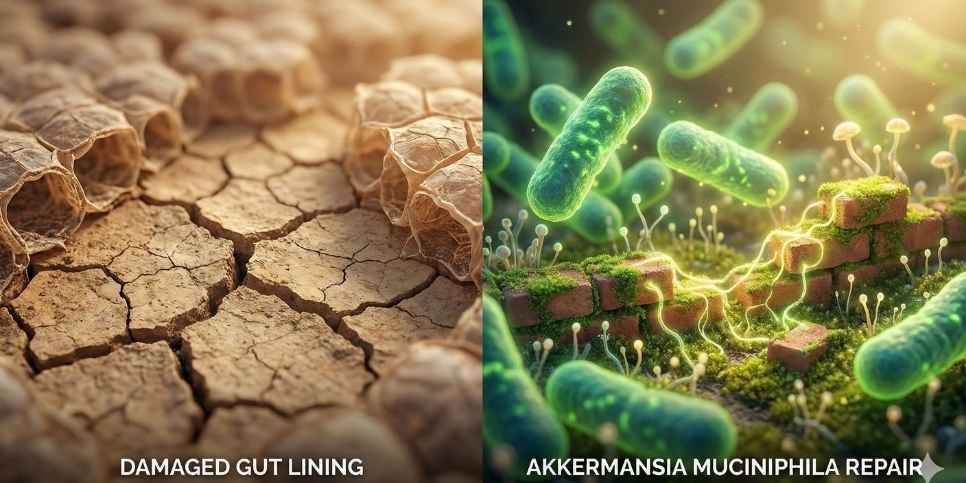 This illustrates the critical role of Akkermansia muciniphila as the "Mason" of the gut. By feeding on and stimulating the mucus layer, these bacteria repair the intestinal barrier (right) preventing the "Leaky Gut" inflammation associated with a damaged lining (left)
To understand the profound monk fruit benefits for your gut, you have to meet the beneficiary: Akkermansia muciniphila.
I often compare the gut lining to a medieval castle wall. This wall protects your bloodstream (the kingdom) from the chaos of the gut (the wild). But the bricks of this wall are delicate. To protect them, your body produces a thick, slimy layer of mucus—a "moat."
Akkermansia is the Mason. It is a unique bacterium that feeds on this mucus. That sounds bad, but it’s actually brilliant. By grazing on the old, outer mucus, it stimulates your cells to produce fresh, new mucus constantly. This keeps the moat deep and the wall strong.
The "Skinny" Connection
Scientists call Akkermansia the "sentinel of the gut." High levels of this bacterium are strongly correlated with:
- Leanness and lower body fat.
- High insulin sensitivity.
- Low systemic inflammation.
Conversely, low levels are found in people with obesity, Type 2 diabetes, and metabolic syndrome. It is so powerful that pharmaceutical companies are currently trying to bottle it as a drug.
But you don't need a drug if you have the fertilizer.
The Fertilizer Effect
Recent studies have analyzed how mogrosides interact with human gut bacteria. The results were striking. When exposed to Mogroside V, the Akkermansia population bloomed.
Think of it like my home garden. If I want tomatoes, I don't just water the ground; I use a tomato-specific fertilizer. Monk fruit is the specific fertilizer for Akkermansia.
By providing this fuel source, you encourage the Mason to set up shop, repair your mucus barrier, and protect you from "Leaky Gut"—the condition where toxins seep into the bloodstream and trigger inflammation.
The GLP-1 Connection: Nature's Own Appetite Control
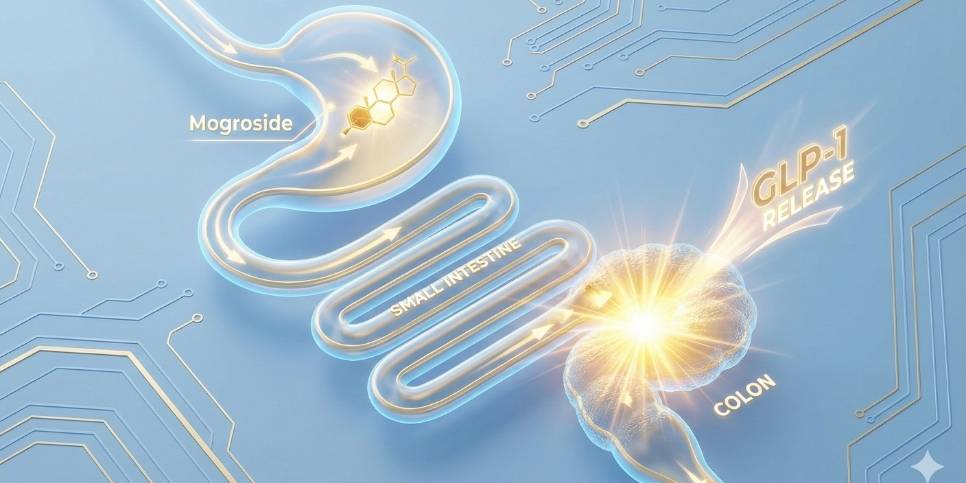 Unlike sugar, Mogroside V acts as a "Trojan Horse," bypassing digestion in the stomach to reach the colon intact. Once there, it activates TGR5 receptors on L-cells to stimulate the release of the satiety hormone GLP-1.
This is where the science gets truly empowering for the "Bio-Hacker Mom" trying to manage cravings. You have likely heard of GLP-1 agonists (like Ozempic or Wegovy). These drugs mimic a hormone called Glucagon-like Peptide-1.
GLP-1 is your "satiety signal." When released, it tells your brain, "I'm full," and it tells your pancreas, "Handle this blood sugar."
The Mogrol Mechanism
Remember how the bacteria snip the sugars off the Mogroside V molecule? What remains is the backbone, a molecule called Mogrol.
For a long time, we thought Mogrol was just waste. But new data suggest Mogrol acts as a TGR5 agonist. TGR5 is a receptor on the L-cells of your intestine. When Mogrol hits this receptor, it acts like a key in the ignition, signaling the cell to release GLP-1.
Furthermore, Akkermansia itself secretes a protein called P9, which also stimulates GLP-1 secretion.
So, monk fruit benefits your waistline through a "Double-Tap" mechanism:
1. Chemical: The metabolite (Mogrol) signals satiety.
2. Biological: The bacteria it feeds (Akkermansia) signal satiety.
You aren't just cutting calories; you are actively upregulating the hormones that control your hunger.
The Pesticide Paradox: Why Organic is Non-Negotiable ⚠️
 Due to the humid growing conditions in Guangxi, China, conventional monk fruit is often treated with pesticides like Chlorpyrifos. Consuming non-organic fruit risks introducing toxins that reduce the abundance of beneficial Akkermansia bacteria.
This is the most critical section of this article. If you take nothing else away, please remember this:
The biological benefits of monk fruit can be entirely erased by the agricultural reality of its farming.
As a student of agriculture, I know that growing Siraitia grosvenorii is difficult. It is a finicky vine that grows in the humid, subtropical mountains of Guangxi, China. Humidity loves fruit, but humidity also loves bugs and fungus.
To combat this, conventional farmers often rely on heavy applications of pesticides. One of the most common classes of insecticides used in this region is organophosphates, specifically Chlorpyrifos.
The "Anti-Antibiotic"
Chlorpyrifos is designed to destroy the nervous systems of insects. But here is the tragedy: it also destroys the microbiome.
Specific studies on the impact of Chlorpyrifos have shown that exposure to this pesticide significantly reduces the abundance of Akkermansia muciniphila in the gut.
Do you see the paradox?
- You buy monk fruit to feed your Akkermansia.
- You buy conventional (non-organic) monk fruit to save money.
- The conventional fruit contains residues of Chlorpyrifos.
- The pesticide kills the very bacteria the fruit was supposed to feed.
You are planting seeds (mogrosides) and salting the earth (pesticides) at the same time.
The Glyphosate Factor
It’s not just insecticides. Herbicides like Glyphosate (Roundup) are also a threat. Glyphosate works by blocking the shikimate pathway—a metabolic route found in plants and bacteria. When you ingest glyphosate residues, you are essentially taking a daily dose of a mild antibiotic that targets your beneficial flora, including Bifidobacterium and Lactobacillus.
This leads to dysbiosis (microbial imbalance), which is the exact opposite of what we are trying to achieve.
The Organic Imperative
This is why PrefOrganic.com is so dogmatic about the "Organic" label. It isn't just about saving the planet; it's about bio-efficacy.
If you want the monk fruit benefits—the gut repair, the GLP-1 boost, the metabolic shielding—the extract must be clean. Purity isn't a luxury; it is a functional requirement. If the product isn't Certified Organic, you cannot trust it to be a medicinal tool.
🌿 The PrefOrganic Reality Check: Why This is Different
At PrefOrganic, we usually champion organic food for two reasons: to protect our family's long-term health and to be kind to the planet. But Monk Fruit is a unique case. Here, "Organic" isn't just a lifestyle preference; it is a biological necessity.
The science we’ve discussed creates a stark reality: If you consume conventional monk fruit to heal your gut, the pesticide residues (like Chlorpyrifos) may be actively killing the Akkermansia bacteria you are trying to feed. In this specific instance, choosing Certified Organic isn't just about being "clean"—it is the difference between a product that works as a metabolic tool and one that might simply add to your toxic load. To get the benefit, you must respect the biology.
Monk Fruit and Diabetes: A Functional Food? 🩸
We have established that monk fruit is safe, but can it actually help manage blood sugar? The search term "Monk fruit and diabetes" is popular for a reason.
Traditional advice for diabetics is "avoid sugar." This is defensive. Monk fruit allows us to go on the offensive.
- Insulin Sensitivity: By reducing systemic inflammation (via the Akkermansia barrier effect), monk fruit can help improve insulin receptor sensitivity.
- AMPK Activation: The metabolite Mogrol has been shown to activate AMPK (Adenosine Monophosphate-activated Protein Kinase). This is the same pathway targeted by the diabetes drug Metformin. AMPK activation tells your cells to stop storing fat and start burning energy.
So, is monk fruit healthy for diabetics?
It is perhaps the healthiest sweetener option available, provided it is not cut with fillers like dextrose (which is sugar) or maltodextrin.
Comparing the Contenders: Monk Fruit vs. The Rest
To help you navigate the grocery aisle, let’s look at how monk fruit stacks up against other sweeteners specifically regarding gut health.
Stevia is a great natural option, and it is generally safe. However, biologically, it is mostly "inert" or "bacteriostatic." Some research suggests stevia might pause the growth of certain bacteria.
- Stevia: The Neutralizer. (Good, but passive).
- Monk Fruit: The Fertilizer. (Better, active healing).
We covered this in our deep dive on heart health, but it bears repeating. Erythritol is a sugar alcohol. It is small, absorbs quickly, and does not feed beneficial bacteria in the colon. In fact, high doses can cause osmotic diarrhea (watery gut).
- Erythritol: The Ghost. (Adds volume, potential clotting risk, no gut benefit).
- Pure Monk Fruit: The Food. (Feeds the good guys).
Monk Fruit vs. Sucralose (Splenda)
Sucralose is an atomic bomb for the microbiome. Studies have shown it can reduce beneficial gut bacteria by up to 50% and raise the pH of the gut, creating an environment where pathogens thrive.
- Sucralose: Scorched Earth. (Avoid at all costs).
How to Use the "Metabolic Shield"
You are convinced. You want to feed the Mason. How do you do it?
The Micro-Dose Protocol
Pure Organic Monk Fruit (50% Mogroside V) is incredibly potent—300 times sweeter than sugar. You don't need teaspoons; you need "smidgens."
- Morning: Add a tiny pinch (1/64 tsp) to your coffee.
- Effect: This daily micro-dose provides a consistent signal to your Akkermansia without overwhelming your palate.
The Synbiotic Stack
To supercharge the effect, pair your monk fruit with a soluble fiber source.
- The Recipe: Mix your Pure Monk Fruit with Organic Acacia Fiber or Organic Inulin.
- Why? The fiber provides the bulk food for the microbiome, while the monk fruit provides the specific mogrosides. Together, they create a "Synbiotic" effect that maximizes SCFA (Short-Chain Fatty Acid) production.
A Note on "Good Gas" ✨
If you switch to pure monk fruit and start repairing your gut, you might notice some mild bloating or gas in the first few days. Don't panic!
In the world of gut health, we distinguish between "Bad Gas" (from sugar alcohols/intolerance) and "Good Gas" (fermentation). When Akkermansia and other beneficial bacteria wake up and start feasting on prebiotics, they produce gas as a byproduct. This is a sign of life. It usually subsides within a week as your ecosystem balances out.
Conclusion: Upgrade Your Biology
We are living in an era where our food is often our biggest threat. But it can also be our greatest medicine.
By choosing Pure, Organic Monk Fruit, you are making a sophisticated choice. You are refusing to settle for "safe enough." You are rejecting the pesticide-laden conventional crops that undermine your health.
Instead, you are choosing a tool. You are choosing to feed the "Skinny Bacteria" that protect your gut. You are stimulating your own natural satiety hormones. You are building a Metabolic Shield that stands guard against inflammation.
Don't just sweeten your coffee. Upgrade your biology.
Trust the fruit. But verify the source. PrefOrganic.
Further Reading 📚
To verify the science behind Akkermansia, pesticides, and gut health, I recommend these deep dives:
- A foundational study explaining how Akkermansia muciniphila protects against obesity and metabolic inflammation.
- Pesticides and the Microbiome (Frontiers in Microbiology) How glyphosate and chlorpyrifos disrupt gut bacteria communities.
- Scientific evidence on how natural plant glycosides can stimulate the release of GLP-1 from intestinal L-cells.

Meet Saqib
Saqib Ali Ateel is a PhD Scholar by training and a "student of the soil" by nature. He combines deep research, hands-on farming wisdom, and agricultural systems supervision to reveal what’s really on your plate. His mission is simple: to help your family navigate the food industry's complexity so you can eat cleaner, safer, and smarter.