The Chemical Reality of Organic Coffee vs Regular Coffee:
A PhD Farmer's Analysis
The smell of a fresh pour—that earthy, roasted heat hitting your face at 6:00 AM—is one of the few reliable comforts left. But as a farmer who has walked fields in Punjab and analyzed soil samples in the lab, I know that smell can mask a complicated reality. When you compare organic coffee vs regular coffee, you aren't just choosing between price points or brands; you are navigating a chemical battlefield invisible to the naked eye.
We rely on this bean to wake us up, but few of us stop to ask: What did this bean go through before it got to my cup? Did it fight for its own survival under a shade tree, developing complex sugars? Or was it force-fed synthetic nitrogen and bathed in herbicides to rush it to market?
I'm not here to preach from a soapbox. I just want to show you the residue logs and soil science so you know exactly what ends up in your cup.
🛑 The Blunt Answer: Which Should You Brew?
You don’t need to analyze soil samples to make a grocery list. I’ve distilled the 2026 data down to four practical rules:
-
If you drink coffee daily (3+ cups):
Switch to Organic. The cumulative exposure to "safe" levels of glyphosate adds up. -
If you are pregnant or nursing:
Strictly Organic. Endocrine disruptors like Chlorpyrifos (found in imports) are not worth the risk. -
If you are on a tight budget:
Buy Whole Bean Conventional over "Instant" or "Ground." Whole beans have less surface area for mold and preservatives. -
If you chase flavor:
Organic/Shade-Grown. The slow maturation creates a statistically sweeter cup (3-5 points higher on the SCA scale).
📊 At-A-Glance: The Evidence
This isn't marketing fluff. This is what the agronomic data tells us.
| Feature |
Certified Organic (Shade-Grown) |
Conventional (Sun-Grown) |
The PhD Farmer Verdict |
|---|---|---|---|
|
🚫 Herbicides (Glyphosate) |
Zero Tolerance. (Strictly Prohibited). |
Common. Residues often survive roasting. |
🛡️ Organic prevents chemical intake. |
|
🍄 Mold Risk (Mycotoxins) |
Low. (Due to strict wet-processing & hygiene). |
Variable to High. (Risk is in drying method, not lack of fungicide). |
🧼 Hygiene beats chemicals. |
| 🧪 Antioxidant Bioavailability |
High. (The "Inversion Effect" delivers more to the cup). |
Lower. (Nitrogen forcing creates "empty" biomass). |
💊 Organic is more potent medicine. |
| 🌍 Carbon Footprint |
0.3 kg CO2e. (Often Carbon Negative). |
1.4 kg CO2e. (Nitrogen fertilizer is dirty). |
🌱 Organic farming regenerates soil biology and sequesters carbon. |
| ☕ Flavor Profile |
Complex/Sweet. (Slow ripening). |
Flat/Bitter. (Rapid, stressed ripening). |
⏳ You can taste the patience. |
1. The "Chemical Reality": Pesticides & The
Cocktail Effect
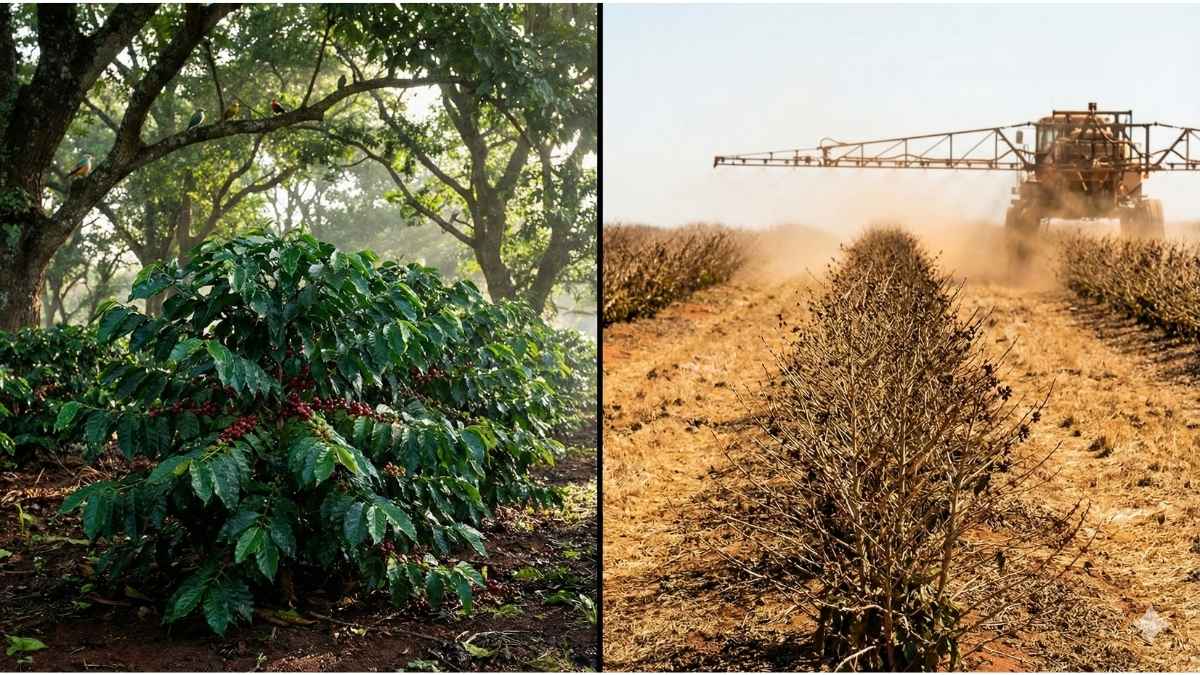 The Visual Divide: Shade-grown organic farms (left) support biodiversity, while conventional monocultures (right) require chemical intervention to survive.
There is a comforting lie the industry tells us: "The US government tests our food, so it must be safe." As someone who has studied regulatory frameworks around the world, I can tell you that "legal" does not mean "clean."
The "99% Compliance" Trap
The latest USDA Pesticide Data Program summary proudly states that 99% of samples are compliant with EPA standards. That sounds great until you read the fine print. Coffee is almost exclusively an imported crop. The data shows that 66.1% of residue violations come from imported goods.
Furthermore, over 5% of samples contain residues with no established tolerance. This means farmers in Brazil or Vietnam might use chemicals that aren't even registered in the US, so the EPA has no safety benchmark to measure them against. You aren't necessarily drinking "safe" coffee; you're drinking coffee containing chemicals that exist in a regulatory blind spot.
Regulatory Dissonance: The Geography of Safety
Safety is relative. If you drink a conventional cup in Berlin, it is held to a strict standard. If you drink that same cup in New York, the rules change.
- EU Standard: The limit for glyphosate is 0.1 mg/kg.
- US EPA Standard: The limit is 1.0 ppm (approx 1.0 mg/kg).
The US allows 10x more glyphosate on your beans than Europe. A bean considered illegal and toxic in France is sold as "premium roast" in the United States.
We also see the "Cocktail Effect." A 2025 study from Iran found beans containing a mixture of herbicides, fungicides, and insecticides simultaneously. Regulatory bodies test chemicals one by one; they rarely test what happens when you mix three of them in your breakfast mug.
2. Busting the "Roasting Safety Net" Myth
"Doesn't the heat kill the chemicals?"
I hear this question constantly. It makes sense intuitively—roasters get up to 400°F (200°C). Surely that burns off the poison?
The Kinetic Truth:
Unfortunately, chemistry isn't that simple. A 2024 study on glyphosate degradation proved that 26% to 41% of the herbicide survives the roast. The coffee bean is dense; its complex matrix of fibers and proteins shields pockets of the chemical from thermal destruction.
Even worse, the transfer rate into your cup is highly efficient. For filter coffee and drip brewers, the transfer is "virtually quantitative." This means if the residue survived the roast, nearly 100% of it ends up in your hot water.
The Verdict: Roasting is a "reduction" step, not a "sterilization" step. It lowers the load, but it does not eliminate it.
3. The "Mold Myth": Is Organic Riskier?
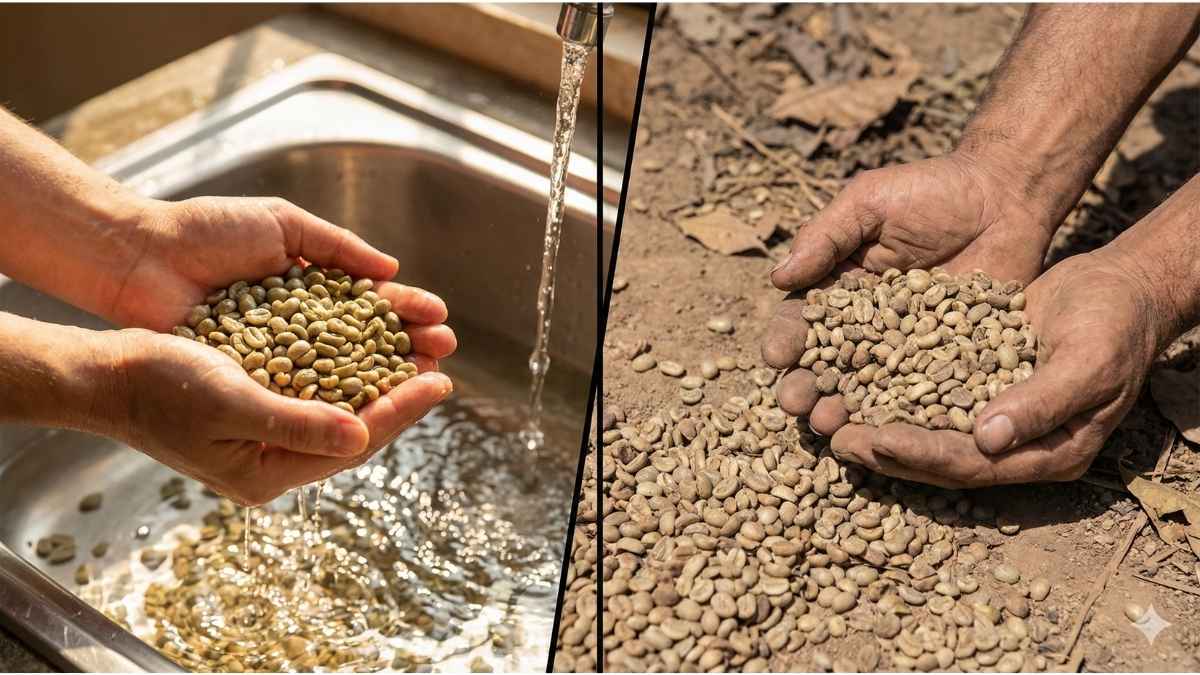 The Real Mold Fix: "Washed" beans (left) are physically cleaned of mold spores, whereas beans dried on the soil (right) are at high risk for Ochratoxin A.
This is the most common argument I hear from conventional agriculture lobbyists: "If organic farmers don't use fungicides, their coffee must be full of mold."
It sounds logical, but it is agronomically false.
Hygiene > Chemicals
The risk of Ochratoxin A (OTA)—a nasty kidney toxin produced by mold—isn't about whether you sprayed the plant. It's about how you dried the bean.
- Highest Risk: Beans gleaned from the soil (common in cheap conventional brands)
- High Risk: "Natural" or Dry-processed beans (fruit rots on the bean).
- Lowest Risk: Wet-Processed/Washed Beans.
Most Certified Organic coffee is "Specialty Grade," which mandates raised drying beds and wet processing. This physically washes away mold spores. The Clean Label Project and recent global reviews confirm that mold is a supply chain issue, not a farming method issue. A clean organic farm beats a dirty conventional farm every time.
4. Nutritional Alchemy: The "Inversion Effect."
Here is where the plant physiology gets fascinating. If you analyze a raw, conventional green bean in a lab, it often has more total antioxidants than an organic one. Why? Because synthetic nitrogen force-feeds the plant, puffing it up.
But you don't drink green beans.
When you roast and brew them, a paradox occurs—the "Inversion Effect."
Studies from 2024 show that Organic infusions deliver higher levels of bioavailable Chlorogenic Acids (CGA) to the human body.
Why?
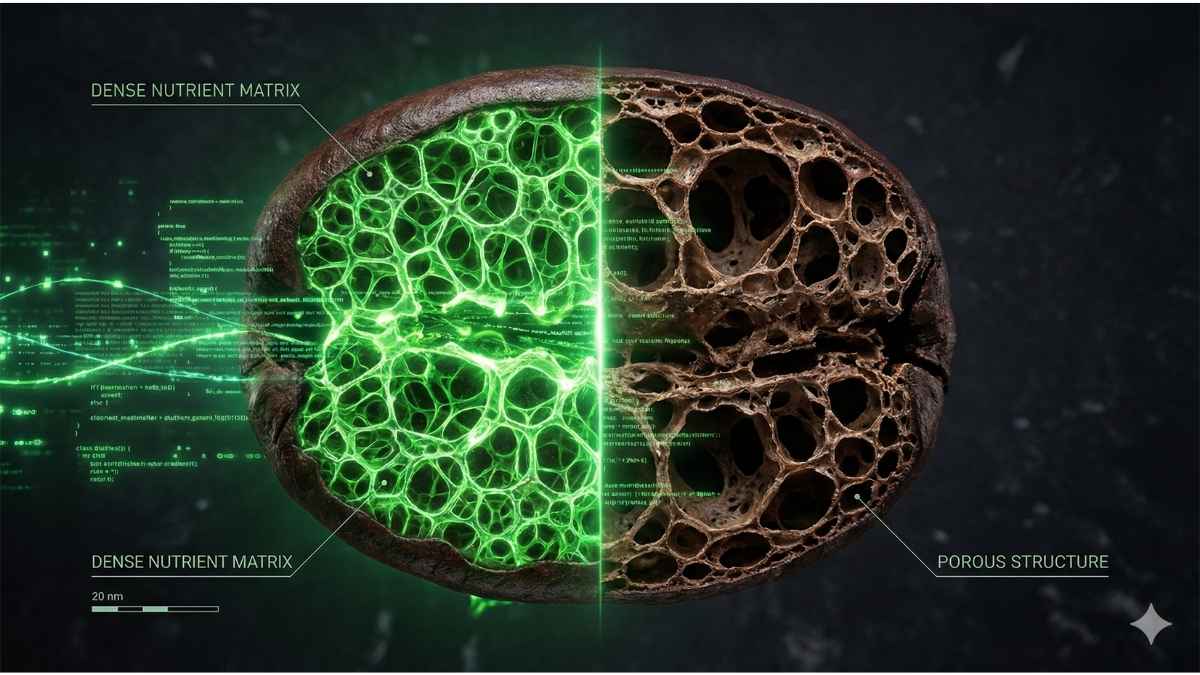
The "Matrix Effect."
Organic beans, grown without chemical shortcuts, develop a denser, more robust cellular structure. During brewing, this structure releases its medicinal compounds more efficiently into the water. The conventional bean is like a bloated bodybuilder with weak muscles; the organic bean is the lean fighter.
5. The Flavor Dividend: Why Organic Tastes Better
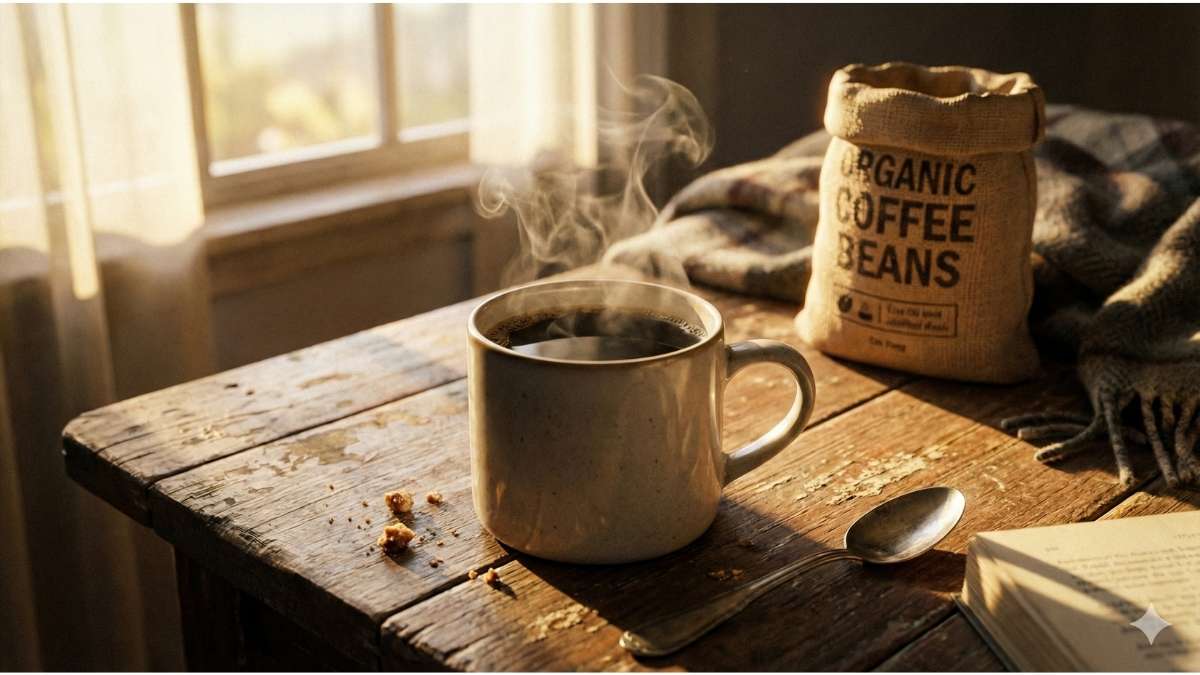 The Flavor Dividend: Beyond safety, the slow ripening of shade-grown coffee creates a naturally sweeter, more complex cup profile.
We don't just drink coffee for the antioxidants; we drink it for the soul.
The Shade Effect
Organic coffee is almost always shade-grown. The shade tree protects the coffee bush from the scorching sun, slowing down the cherry's ripening process by 2–4 weeks.
Think of it like cooking a brisket. Low and slow renders the fat and creates flavor. Fast and hot dries it out.
- Sun-Grown (Conventional): Ripens fast. Flattens flavor. Harsh acidity.
- Shade-Grown (Organic): Ripens slow. Accumulates sucrose and fructose. Complex sweetness.
This isn't subjective. In blind cupping by the Specialty Coffee Association (SCA), shade-grown organic lots consistently score 3–5 points higher than their conventional neighbors.
6. Real World Scenarios: What If I Can't?
I know we don't all live in a world where $25 bags of single-origin beans are an option. Inflation is real. Here is how to navigate the imperfect reality.
Scenario A: The Budget Constraint
- The Fix: If you can't buy Organic, buy Arabica over Robusta. Arabica generally requires fewer pesticides. Also, buy Dark Roast. The longer roast time destroys slightly more pesticide residue than a light roast.
Scenario B: The Diner/Office Coffee
- The Fix: Don't stress the occasional cup. The human body is resilient. The goal is to control your daily habit at home, not to live in a bubble of fear when you're out with friends.
Scenario C: I want convenience (K-Cups/Pods)
- The Fix: Look for "Compostable" pods. If a company cares enough to make the pod eco-friendly, they usually care enough to source cleaner beans.
☕ Brand Table: Trusted Sources
(Note: These are examples of what I look for in a brand, not paid placements.)
| 🏷️ Brand Category | ✅ Why It Works | 🎯 Ideal For |
|---|---|---|
| 🏠 Local Roasters | Freshness ensures maximum antioxidants. | 👅 Flavor Hunters. |
| 🌿 USDA Organic + Fair Trade | Ensures no synthetic inputs + living wage. | ⚖️ Ethical Realists. |
| 🌙 Demeter (Biodynamic) | The "PhD" level of organic. Holistic farming. | 💪 Health Maximalists. |
FAQ: Common Questions
Q: Is organic coffee naturally decaffeinated?
No. Organic refers to how it's grown, not the caffeine content. However, look for "Swiss Water Process" organic decaf. Conventional decaf often uses chemical solvents like Methylene Chloride.
Q: Does organic coffee have less acid?
Often, yes. Shade-grown beans usually have a smoother acidity profile compared to the harsh, sharp acidity of sun-grown, nitrogen-forced beans.
Q: Is "Natural" coffee the same as Organic?
No! "Natural" usually refers to the processing method (drying with the fruit on), while "Organic" refers to the farming method. You can have a conventional natural coffee that is full of pesticides and mold risk.

Meet Saqib
Saqib Ali Ateel is a PhD Scholar by training and a "student of the soil" by nature. He combines deep research, hands-on farming wisdom, and agricultural systems supervision to reveal what’s really on your plate. His mission is simple: to help your family navigate the food industry's complexity so you can eat cleaner, safer, and smarter.
References
1. Food Quality and Preference, 2024. "Self-care vs. World-care: Consumer motivations in coffee."
2. USDA Agricultural Marketing Service. Pesticide Data Program Annual Summary, Calendar Year 2024.
3. Clean Label Project. Coffee Safety Study: Mycotoxins and Pesticides.
4. Journal of Food Composition and Analysis, 2024. "Glyphosate degradation kinetics during coffee roasting."
5. Science of the Total Environment, 2025. "Co-occurrence of pesticide residues in imported green coffee beans."
6. Specialty Coffee Association (SCA). "The impact of shade management on cup quality scores."